1

The high school course in English — Key Ideas to Explore
290
9
Project Gutenberg
2022
English language -- Study and teaching (Secondary); English literature -- Study and teaching (Secondary)
Readers of public-domain and historical texts
Project Gutenberg digital edition
en
Edition facts
Words: 22,712
Reading time: 99 min
Text sections: 16
Source:
Project Gutenberg record #69236
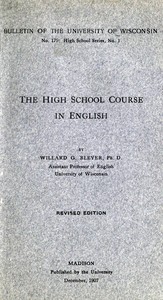
A 1907 bulletin by University of Wisconsin professor Willard G. Bleyer offering practical suggestions for organizing high school English, emphasizing composition through short weekly themes, close reading of short prose, and teacher-pupil conferences.
Editorial Edition Score
4.7/5
★★★★★
★★★★★
Calculated from edition completeness, EPUB availability, text structure and catalogue metadata. Not a user rating.
Edition quality
Willard G. Bleyer’s 1907 bulletin, part of a University of Wisconsin high school series, treats English as a sequence of teachable skills rather than a body of content. The opening table of contents—listing composition, reading, and year-by-year plans—signals a systematic approach. Bleyer insists that first-year pupils write one-paragraph themes of about 150 words, a length he argues reveals characteristic errors as clearly as longer papers and prevents “writing to fill space.” His rationale is practical: short themes allow teachers to correct quickly while still seeing each student’s faults.
The Paragraph as a Unit of Instruction
Bleyer elevates the paragraph to a central pedagogical tool. In first-year composition, he requires “one well-rounded paragraph of about 150 words” per theme, arguing that this teaches the pupil from the start “to regard the paragraph as a unit of some length, which may be complete in itself.” This is not merely a convenience for grading; it reflects a structural principle. By limiting the assignment to a single paragraph, Bleyer forces the student to organize ideas within a bounded form, avoiding the sprawl of longer, unfocused essays. He also pairs this with a dual writing regimen: one theme prepared outside class and another written rapidly during a recitation period. The in-class exercise gives practice in producing a single draft under time pressure, while the out-of-class theme allows for careful revision. Both are corrected promptly using signs and abbreviations, and the pupil must revise or rewrite—a process Bleyer insists be returned to the teacher for verification.
Correlating Reading and Composition
Bleyer advocates a tight link between what students read and what they write. In the first year, after studying “descriptive methods used in the portrayal of a character or scene in the story read in class,” pupils are encouraged to write descriptions of familiar persons or places. The reading list itself is chosen with correlation in mind: short stories, tales, and narrative sketches—such as Hawthorne’s “Twice Told Tales” and Irving’s “Rip Van Winkle”—are favored because they make possible “close and effective correlation of the reading and composition.” Bleyer warns against selections that are too long, lest interest flag or the pupil fail to grasp the work as a unit. This emphasis on manageable, prose-based texts suggests a deliberate scaffolding: the pupil learns narrative structure from the reading and then applies it in writing. The teacher’s role extends beyond correction; conferences are used to learn “concerning the pupil’s interests and character” and to encourage those disheartened by the difficulties of expression.
A System of Teacher-Pupil Conferences
Bleyer devotes notable attention to individual conferences, which he calls “of great importance” in the first year. These meetings serve multiple functions: they allow the teacher to talk over written work, to encourage a struggling pupil, and to gain insight into the pupil’s “interests and character.” The conference is not merely remedial; Bleyer states that “by sympathy and insight” the teacher can be as helpful to the excellent pupil as to the mediocre or poor one. This reflects a view of teaching as responsive and interpersonal, not mechanical. The bulletin also recommends regular conferences of teachers themselves—a point buried in the organization section—to ensure consistency across the course. Bleyer’s system thus balances standardized procedures (signs for correction, fixed theme lengths) with individualized attention, a tension that runs through the entire document.
Bleyer’s bulletin is less a curriculum than a method. Readers interested in early twentieth-century educational reform will note its emphasis on efficiency, measurable outcomes, and the teacher’s diagnostic role. The document’s value lies not in its literary judgments but in its detailed, almost procedural account of how English was to be taught—one paragraph, one conference, one corrected theme at a time.
Reader reflection
How will you remember this book?
Save your reaction, strongest insight, and memorable passage.
Your progress
0
/
10
2
How much did you enjoy the reading experience?
3
Would you recommend this book to another reader?
4
How much effort did this book require?
5
Which aspect of the book did you value most?
6
Did the story or argument move comfortably?
7
How original did the book feel?
8
Would you read this book again?
9
What did this book teach you most?
10