1

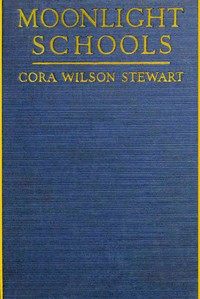
Moonlight Schools for the Emancipation of Adult Illiterates — Text and Context
623
9
Project Gutenberg
2018
Literacy -- Kentucky; Education -- Kentucky
Readers of public-domain and historical texts
Project Gutenberg digital edition
en
Edition facts
Words: 37,580
Reading time: 164 min
Text sections: 24
Source:
Project Gutenberg record #57061
Cora Wilson Stewart's firsthand account of the Kentucky moonlight schools, which taught adults to read and write. Drawing on letters, war efforts, and rural reform, the book reveals the movement's practical strategies and emotional stakes, from homefront literacy to overseas army camps.
Editorial Edition Score
4.8/5
★★★★★
★★★★★
Calculated from edition completeness, EPUB availability, text structure and catalogue metadata. Not a user rating.
Edition quality
Cora Wilson Stewart opens her account not with statistics but with a declaration of purpose: the book is written in "simple language" and "kept free from technical terms," aimed at teachers and the general public alike. This stylistic choice mirrors the pedagogical approach of the moonlight schools themselves—direct, accessible, and grounded in experience. Stewart frames the narrative as a "lamp of experience," borrowing Patrick Henry's phrase to position the schools as a practical experiment rather than a theoretical treatise.
The dedication to "volunteer teachers" sets the tone for a work that celebrates grassroots effort over institutional authority. Throughout the excerpts, Stewart emphasizes the adaptability of the moonlight school model, from Kentucky's rural schoolhouses to army occupation camps in Germany, where a lieutenant reports using "your book" with Italian soldiers. The movement's reach is traced through letters, curriculum shifts, and the personal transformations of adult learners.
From Kentucky Hills to the Rhine
The moonlight schools began as a local Kentucky initiative, but Stewart documents their rapid expansion during World War I. A war course of study replaced peacetime drills with lessons on food conservation, the Red Cross, and Liberty Loans, designed to "bring isolated people into co-operation with the agencies that were striving to win the War." The Soldier's First Book was revised and provided free to illiterate soldiers, a condition Stewart insisted upon.
The most striking evidence of the movement's reach comes from a letter by a Kentucky lieutenant stationed in Germany: "I suppose it will come somewhat as a surprise to learn that we are conducting moonlight schools according to your plans in far-off Germany." He describes teaching a class of mostly Italian soldiers, keeping records and submitting reports "in the same manner that other work is being done in the army." Stewart notes that the schools had "trailed the illiterate soldier through the camps, across the seas, through England and France to the army of occupation on the Rhine."
Letters as Proof of Progress
Stewart uses letters from students and soldiers as primary evidence of the schools' impact. One mother, newly literate, writes to her son; his reply reveals both pride and a telling detail: "I could read your letter a whole lot better than I could Pa's." This small observation underscores the generational and gendered dimensions of literacy—the mother's writing is clearer than the father's, suggesting differing levels of practice or education.
Another letter, from a soldier in Germany, closes with a wish: "I hope that every American boy when he returns from overseas will be able to read and write." Stewart presents these voices without embellishment, letting the correspondents speak for themselves. The letters serve as documentary proof, but they also carry emotional weight, showing how literacy connected families across distances and transformed relationships.
Reconstruction and the Return to Peace
After the Armistice, the moonlight schools shifted focus again. Stewart describes how soldiers returned "talking education, urging a better school system, and a provision for everybody, young and old, to improve themselves." The government sent 50,000 Country Life Readers overseas for illiterate soldiers detained on foreign soil, with lessons on "the clean ballot, just taxation, soil conservation and cultivation, good roads and the prevention of disease."
Stewart highlights two war heroes—Alvin York and Sergeant Sandlin—who returned to their home states and began raising money for schools. York, who captured 132 Germans single-handedly, "came home and started raising money to build a school for the people of his native hills." Sandlin, a Kentucky mountaineer, enlisted under the Illiteracy Commission. These examples tie the fight against illiteracy to broader themes of civic reconstruction, suggesting that literacy was as vital to peacetime as to war.
Stewart's narrative is built on contrasts: the local and the global, the civilian and the military, the personal letter and the national campaign. Readers should attend to how she weaves together administrative details—curricula, commissions, reports—with the voices of individual learners and teachers. The book is less a systematic history than a collection of evidence marshaled for a cause. Its value lies in the specificity of its examples and the clarity of its argument that literacy is a form of emancipation, both personal and civic.
Reader reflection
How will you remember this book?
Save your reaction, strongest insight, and memorable passage.
Your progress
0
/
10
2
Did this book hold your interest?
3
Would you encourage someone else to read it?
4
What was the reading difficulty like?
5
Was the book easy to understand?
6
Would you start a conversation about this book?
7
How much did the book move you?
8
Was the book what you thought it would be?
9
Which lesson or insight stayed with you?
10