1

Literature in the Elementary School — Key Ideas to Explore
541
8
Project Gutenberg
2011
Literature -- Study and teaching
Readers of public-domain and historical texts
Project Gutenberg digital edition
en
Edition facts
Words: 69,574
Reading time: 303 min
Text sections: 7
Source:
Project Gutenberg record #35341
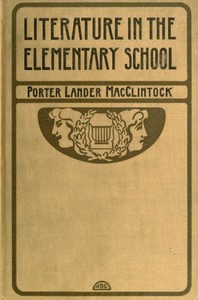
An early 20th-century pedagogical work by Porter Lander MacClintock, grounded in his experience at John Dewey's Laboratory School, arguing for literature's distinct role in elementary education through specific genres, artistic effects, and child development.
Editorial Edition Score
4.7/5
★★★★★
★★★★★
Calculated from edition completeness, EPUB availability, text structure and catalogue metadata. Not a user rating.
Edition quality
Porter Lander MacClintock opens Literature in the Elementary School by grounding his argument in direct experience: the book emerged from teaching at the University of Chicago's Laboratory School under John Dewey, from private reading with children, and from lectures to teachers. He acknowledges that the material retains the informal, spontaneous character of its origin as lectures, and notes that a synopsis was circulated in 1904. This origin shapes the book's structure—it is not a detached manual but a practitioner's reflection, aiming to articulate what literature can distinctively offer children in school settings.
From Lecture Hall to Printed Page
The preface reveals MacClintock's method: the book's chapters began as lectures, and he admits the difficulty of turning “spontaneous and informal lectures” into decorous chapters. This origin explains the direct, conversational tone that persists throughout. He also notes that central material first appeared as articles in the Elementary School Teacher in 1902, and a synopsis was widely circulated by 1904. Readers should expect a work that argues from lived practice rather than abstract theory, and that assumes familiarity with ongoing debates in progressive education.
The Antidote to Romance: Stories of Real Life
In a key passage on stories of real life, MacClintock warns that too much romance and fantasy can distort a child's “sense of fact” and “vitiate” taste. He proposes that realistic stories serve as an artistic antidote, one that “should have the same kind of charm as the original poison.” He insists that even young children should be appealed to on several sides; a child who likes only fairy tales or war stories is limited. The goal is catholic taste. This section shows MacClintock balancing the value of imagination with the need for grounding in actuality.
Art Casting Back Its Radiance
MacClintock describes how realistic stories “throw back upon actual life the glow of art.” He illustrates with classroom examples: children who made a verse about “rosy radishes” and then painted them found new joy in a grocer's window; those who learned Lowell's phrase “dusty gold” for dandelions sought to create a phrase for buttercups. Yet he notes a limit—when children tried to make poetry about Uneeda biscuits and ginger-ale, they concluded “it would not go.” The passage reveals his belief that art dignifies life, but only certain subjects readily accept that halo.
Recognition and the Child's Experience
MacClintock highlights the “tingling interest” children feel when a story parallels their own lives—a father who saw a bear, a found eagle's feather, daffodils in a garden. This recognition, he argues, is central to literature's educational value. The excerpts show him attending to the child's perspective, not just the teacher's. His examples are concrete and drawn from classroom observation, reinforcing the book's grounding in practice rather than prescription.
MacClintock's book is best read as a series of connected arguments rather than a systematic curriculum. Readers will find the most value in his specific classroom anecdotes and his insistence that literature serves education not by moralizing but by shaping perception and taste. The informal, lecture-derived style invites the reader to engage critically with his claims, testing them against their own experience with children and texts.
Reader reflection
What did you think of this book?
Answer a few questions and save a private reflection on this device.
Your progress
0
/
10
2
What was your overall reaction to the book?
3
Would you recommend this book to another reader?
4
How easy was the book to follow?
5
Did it raise ideas you would like to talk about?
6
How understandable was the text?
7
How would you describe its reading pace?
8
Did this book create an emotional response?
9
What changed or sharpened your thinking?
10