
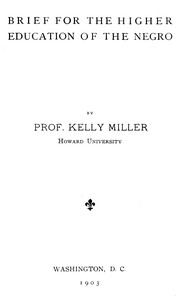
Brief for the higher education of the negro — Key Ideas to Explore

(3 User reviews)   853
In Category - Teaching Methods
Miller, Kelly, 1863-1939 Project Gutenberg 2021
African Americans -- Education Readers of public-domain and historical texts
Project Gutenberg digital edition en

Edition facts

Words 8,086
Reading time 36 min
Text sections 1

This digital edition of Brief for the higher education of the negro — Key Ideas to Explore is described by source-level measurements including 8,086 words, 36 min estimated reading time, and 1 detected text section.

The text analysis averages about 22.8 words per sentence, while the detected sections provide another way to judge how the source is divided.

Project Gutenberg metadata also associates the work with “African Americans -- Education,” connecting these edition facts with the source record’s subject description.

Kelly Miller's 1903 brief argues for the higher education of African Americans, countering industrial education advocates with evidence of intellectual capacity and the practical value of classical learning.
Share
Editorial Edition Score 4.4/5

Calculated from edition completeness, EPUB availability, text structure and catalogue metadata. Not a user rating.

How this score is calculated
  • Description quality20 pts
  • Title & short description10 pts
  • Source metadata20 pts
  • Text length15 pts
  • Chapters / structure15 pts
  • EPUB file integrity20 pts

Total of 100 points, scaled to a 2.5-5.0 range. Editions with an empty description or a missing EPUB file are not scored.

Edition quality

Read the Text

+-------------------------------------------------+ |Transcriber’s note: | | | |Obvious typographic errors have been corrected. | | | +-------------------------------------------------+

BRIEF FOR THE HIGHER EDUCATION OF THE NEGRO

The Negro’s Traditional Place in Society.

Ridicule and contempt have characterized the habitual attitude of the American mind toward the Negro’s higher strivings. The African was brought to this country for the purpose of performing manual and menial labor. His bodily powers alone were required to accomplish this industrial mission. No more account was taken of his higher susceptibilities than of the mental and moral faculties of the lower animals. As the late Mr. Price used to say, the white man saw in the Negro’s mind only what was apparent in his face, “darkness there, and nothing more.” His usefulness in the world is still measured by physical faculties rather than by qualities of mind and soul. The merciless proposition of Carlyle that, the Negro is useful to God’s creation only as a servant, still finds wide acceptance. It is so natural to base a theory upon a long-established practice that one no longer wonders at the prevalence of this belief. The Negro has sustained servile relation to the Caucasian for so long a time that it is easy as it is agreeable to Aryan pride to conclude that servitude is his ordained place in society. When it was first proposed to furnish means for the higher development of this race, some, who assumed the wisdom of their day and generation, entertained the proposition with a sneer, others, with a smile.

MANIFESTATIONS OF HIGHER QUALITIES.

As the higher susceptibilities of the Negro were not wanted, their existence was at one time denied. The eternal inferiority of the race was assumed as a part of the cosmic order of things. History, literature, science, speculative conjecture, and even Holy Writ were ransacked for evidence and argument to support the ruling dogma. While the slave holder had proved beyond all possibility of doubt the incapacity of the Negro for knowledge, yet he, prudently enough, passed laws forbidding the attempt. His guilty conscience caused him to make assurance doubly sure by re-enacting the laws of the Almighty.

For three hundred years the Negro by his marvelous assimilative power and by striking individual emanations has been constantly manifesting the higher possibilities of his nature, until now whoever assumes to doubt his susceptibility for better things needs himself to be pitied for his incapacity to grasp the truth. The same Carlyle who regards the Negro as an “amiable blockhead,” and amenable only to the white man’s “beneficent whip,” also declares: “That one man should die ignorant who had capacity for knowledge, this I call a tragedy, were it to happen forty times in a minute.” When it is known that the Negro has capacity for knowledge and virtue there can be no further justification for shutting him out from the higher cravings of his nature.

IS THE HIGHER EDUCATION OF THE NEGRO WORTH WHILE AS A PRACTICAL PHILANTHROPY?

The education of the Negro is not of itself a thing apart, but is an integral factor of the general pedagogic equation. Race psychology has not yet been formulated. No reputable authority has pointed out just wherein the two races differ in any evident mental feature. The mind of the Negro is of the same nature as that of the white man and needs the same nurture. The general poverty of the Negro, however, and his inability to formulate and direct his own scheme of culture, render the question not so much one of abstract pedagogics, as of practical philanthropy. The philanthropist is supremely indifferent as to whether an individual, white or black, should study Kant or Quaternious, except, in so far as the resulting development reacts beneficially upon the common welfare. Does the higher education of the few capable Negroes possess sufficient advantage to the race at large to justify its continuance by a wise and discriminating philanthropy? The great missionary societies, representing the philanthropic arms of the Congregational, Presbyterian, Methodist and Baptist denominations after forty years of arduous, earnest endeavor and the expenditure of many millions of dollars in this field, answer this question emphatically in the affirmative. An ounce of opinion from such sources should be worth a ton of speculation from those who reach their conclusions by a process of “pure reasoning.”

THE FUNCTION OF EDUCATION TO A BACKWARD RACE.

The African was snatched from the wilds of savagery and thrust into the midst of a mighty civilization. He thus escaped the gradual progress of evolution. Education must accomplish more for a backward race than for a people who are in the fore-front of progress. It must not only lead to the unfoldment of faculties but must equip for a life from which the recipient is separated by many centuries of development. The African chieftain who would make a pilgrimage from the jungle to Boston might accomplish the first part of his journey by the original modes of transportation--in the primitive dugout or on the backs of his slaves; but he would complete it upon the steamship, the railway, the electric car and the automobile. How swift the transformation and yet how suggestive of centuries of toil, struggle and mental endeavor. It required the human race thousands of years to bridge the chasm between savagery and civilization, which must now be crossed by a school curriculum of a few years’ duration. In a settled state of society, the chief function of education is to enable the individual to live the life already attained by his race, but the educated Negro must be a pioneer, a progressive force in the uplifting of his race, and that, too, notwithstanding the fact that he belongs to a backward breed that has never taken the initiative in the progressive movements of the world.

THE HIGHER TRAINING OF CHOICE YOUTH.

The first great need of the Negro is that the choice youth of the race should assimilate the principles of culture and hand them down to the masses below. This is the only gate-way through which a new people may enter into modern civilization. Herein lies the history of culture. The select minds of the backward race or nation must receive the new cult and adapt it to the peculiar needs of their own people. Japan looms up as the most progressive of the non-Aryan races. The wonderful progress of these Oriental Yankees is due in a large measure to their wise plan of procedure. They send their picked youth to the great centers of western knowledge; but before this culture is applied to their own needs it must first be sifted through the sieve of their native comprehension. The graduates of the schools and colleges for the Negro race are forming centers of civilizing influence in all parts of the land, and we confidently, believe that these grains of leaven will ultimately leaven the whole lump.

SELF-RELIANT MANHOOD.

Another great need of the race, which the schools must in a large measure supply, is self-reliant manhood. Slavery made the Negro as dependent upon the intelligence and foresight of his master as a soldier upon the will of his commander. He had no need to take thought as to what he should eat or drink or wherewithal he should be clothed.

Knowledge necessarily awakens self-consciousness of power.

When a child learns the multiplication table he gets a clear notion of intellectual dignity. Here he gains an acquisition which is his permanent, personal possession, and which can never be taken from him. It does not depend upon external authority; he could reproduce it if all the visible forms of the universe were effaced. It is said that the possession of personal property is the greatest stimulus to self-respect. When one can read his title clear to earthly possessions, it awakens a consciousness of the dignity of his own manhood. And so when one has digested and assimilated the principles of knowledge he can file his declaration of intellectual independence. He can adopt the language of Montaigne “Truth and reason are common to everyone, and are no more his who spake them first than his who speaks them after; ’tis no more according to Plato than according to me, since he and I equally see and understand them.”

Primary principles have no ethnic quality. We hear much in this day and time of the white man’s civilization. We had just as well speak of the white man’s multiplication table. Civilization is the common possession of all who assimilate and apply its principles. England can utilize no secret art or invention that is not equally available to Japan. We reward ingenuity with a patent right for a period of years upon the process that has been invented; but when an idea has been published to the world it is no more the exclusive property of the author than gold, after it has been put in circulation, can be claimed by the miner who first dug it from its hiding place in the earth. No race or nation can preempt civilization any more than they can monopolize the atmosphere which surrounds the earth, or the waters which hold it in their liquid embrace.

I have often noticed a young man accommodate his companion with a light from his cigar. After the spark has once been communicated, the beneficiary stands upon an equal footing with the benefactor. In both cases the fire must be continued by drawing fresh supplies of oxygen from the atmosphere. From whatever source a nation may derive the light of civilization, it must be perpetuated by the exercise of their own faculties. Self-reliant manhood is the ultimate basis of American citizenship.

TRAINING FOR LEADERSHIP.

The work of the educated colored man is largely that of leadership. He requires, therefore, all the discipline, judgment and mental equipment that long preparation can afford. The more ignorant and backward the masses the more skilled and sagacious should the leaders be. If a beneficial and kindly contact between the races is denied on the lower plane of flesh and blood, it must be sought in the upper region of mental and moral kinship. Knowledge and virtue know no ethnic exclusiveness. If indeed races are irreconcilable, their best individual exponents are not. All dignified negotiation must be conducted on the high plane of individual equality.

“For east is east, and west is west, and never the twain shall meet, ’Till earth and sky stand presently at God’s great judgment seat; But there is neither east nor west, border nor breed nor birth, When two strong men stand face to face, though they come from the ends of the earth”

The irreconcilable become reconciled only after each has manifested the best possibilities of a common nature. The higher education tends to develop superior individuals who may be expected to exercise controlling influence over the multitude. The individual is the proof, the promise and the salvation of the race. The undeveloped races which, in modern times, have faded before the breath of civilization have probably perished because of their failure to produce commanding leaders to guide them wisely under the stress and strain which an encroaching civilization imposed. A single red Indian with the capacity and spirit of Booker T. Washington might have solved the red man’s problems and averted his pending doom.

THE MORAL IMPOTENCY OF ELEMENTARY AND MECHANICAL KNOWLEDGE.

Again, the higher education should be encouraged because of the moral impotency of all the modes of education which do not touch and stir the human spirit. It is folly to suppose that the moral nature of the child is improved because it has been taught to read and write and cast up accounts, or to practice a handicraft. Tracing the letters of the alphabet with a pen has no bearing on the Golden Rule. The spelling of words by sounds and syllables does not lead to the observance of the Ten Commandments. Drill in the multiplication table does not fascinate the learner with the sermon on the mount. Rules in grammar, dates in history, sums in arithmetic, and points in geography do not strengthen the grasp on moral truth. The ability to saw to a line or hit a nail aplomb with a hammer does not create a zeal for righteousness and truth. It is only when the pupil comes to feel the vitalizing power of knowledge that it begins to re-act upon the life and to fructify in character. This is especially true of a backward race whose acquisitive power outruns its apperceptive faculty.

THE SOCIAL SEPARATION OF THE RACES.

The Negro has now reached a critical stage in his career. The point of attachment between the races which slavery made possible has been destroyed. The relation is daily becoming less intimate and friendly, and more business-like and formal. It thus becomes all the more imperative that the race should gain for itself the primary principles of knowledge and culture.

The social separation of the races in America renders it imperative that the professional classes among the Negroes should be recruited from their own ranks. Under ordinary circumstances, professional places are filled by the most favored class in the community. In a Latin or Catholic country, where the fiction of “social equality” does not exist, there is felt no necessity for Negro priest, teacher, or physician to administer to his own race. But in America this is conceded to be a social necessity. Such being the case, the Negro leader, to use a familiar term, requires all the professional equipment of his white confrere, and special knowledge of the needs and circumstances of his race in addition. The teacher of the Negro child, the preacher of a Negro congregation, or the physician to Negro patients, certainly requires as much professional skill as those who administer to the corresponding needs of the white race. Nor are the requirements of the situation one whit diminished because the bestower is of the same race as the recipient. The Negro has the same professional needs as his white confrere and can be qualified for his function only by courses of training of like extent and thoroughness. By no other means can he be qualified to enlighten the ignorant, restrain the vicious, care for the sick and afflicted, or administer solace to weary souls, plead in litigation the cause of the injured.

THE PROFESSIONAL NEEDS OF THE CITY NEGRO.

According to the census of 1900, there were 72 cities in the United States with a population of more than 5,000 persons of color, averaging 15,000 each, and aggregating 1,000,000 in all. The professional needs of this urban population for teachers, preachers, lawyers and physicians call for 5,000 well-equipped men and women, not one of whom would be qualified for his function by the three R’s or a handicraft.

THE EFFECT OF HIGHER EDUCATION UPON THE RURAL MASSES.

The supreme concern of philanthropy is the welfare of the unawakened rural masses. To this end there is need of a goodly sprinkling of well educated men and women to give wise guidance, direction and control. Let no one deceive himself that the country Negro can be uplifted except through the influence of higher contact. It is impossible to inaugurate and conduct a manual training or industrial school without men of sound academic as well as technical knowledge. The torch which is to lighten the darksome places of the South must be kindled at the centers of light.

THE IMPORTANCE OF CULTIVATED TASTE.

Rational enjoyment, through moderation, is perhaps as good a definition as can be given of culture. The reaction of culture on conduct is a well known principle of practical ethics. The Negro race is characterized by boisterousness of manner and extravagant forms of taste. As if to correct such deficiencies, his higher education, hitherto, has largely been concerned with Greek and Latin literature, the norms of modern culture. It is just here that our educational critics are liable to become excited. The spectacle of a Negro wearing eye-glasses and declaiming in classic phrases about the “lofty walls of Rome,” and the “wrath of Achilles” upsets their critical calmness and composure. We have so often listened to the grotesque incongruity of a Greek chorus and a greasy cabin and the relative value of a rosewood piano and a patch of early rose potatoes that if we did not join in the smile in order to encourage the humor, we should do so out of sheer weariness. And yet we cannot escape the conviction that one of the Negro’s chief needs is a higher form of intellectual and esthetic taste.

THE RELATIVE CLAIMS OF INDUSTRIAL AND HIGHER EDUCATION.

Whenever the higher education of the Negro is broached, industrial training is always suggested as a counter irritant. Partisans of rival claims align themselves in hostile array and will not so much as respect a flag of truce. These one-eyed enthusiasts lack binocular vision. The futile discussion as to whether industrial or higher education is of greater importance to the Negro is suggestive of a subject of great renown in rural debating societies: which is of greater importance to man, air or water. We had as well attempt to decide whether the base or altitude is the more important element of a triangle. The two forms of training should be considered on the basis of their relative, not rival, claims.

THE HIGHER EDUCATION STIMULATES INDUSTRIAL ACTIVITY.

Indeed, one of the strongest claims for the higher education of the Negro is that it will stimulate the dormant industrial activities of the race. The surest way to incite a people to meet the material demands of life is to teach them that life is more than meat. The unimaginative laborer pursues the routine rounds of his task, spurred on, only by the immediate necessities of life and the taskmaster’s stern command. To him, it is only time and the hour that run through the whole day. The Negro lacks enlightened imagination. He needs prospect and vista. He does not make provision because he lacks prevision. Under slavery he toiled as the ass, dependent upon the daily allowance from his master’s crib. To him the prayer, Give us this day our daily bread, has a material rather than a spiritual meaning. If you would perpetuate the industrial incapacity of the Negro, then confine him to the low grounds of drudgery and toil and prevent him from casting his eyes unto the hills whence come inspiration and promise. The man with the hoe is of all men most miserable unless, forsooth, he has a hope. But if imbued with hope and sustained by an ideal, he can consecrate the hoe as well as any other instrument of service, as a means of fulfilling the promise within him. When a seed is sown in the ground it first sends its roots into the soil before the blades can rise out of it. But is it not actuated by the plant consciousness to seek the light of heaven? For what is the purpose of sending its roots below, if it be not in order to bear fruit above? The pilgrim fathers in following the inspiration of a lofty ideal developed the resources of a continent. Any people who attempt to reach the sky on a pedestal of bricks and mortar will end in confusion and bewilderment as did the builders of the Tower of Babel on the plains of Shinar in the days of Eld. It requires range of vision to stimulate the industrial activities of the people. The most effective prayer that can be uttered for the Negro is “Lord, open thou his eyes.” He can not see beyond the momentary gratification of appetite and passion. He does not look before and after. Such stimulating influence can be brought to bear upon the race only through the inspiration of the higher culture.

MEN OF HIGHER TRAINING THE LEADERS OF INDUSTRIAL EDUCATION.

It requires men of sound knowledge to conceive and execute plans for the industrial education of the masses. The great apostles of industrial education for the Negro have been of academic training, or of its cultural equivalent. The work of Hampton and Tuskegee is carried on by men and women of a high degree of mental cultivation.

DR. BOOKER T. WASHINGTON AN EXAMPLE OF HIGHER CULTURE.

Kelly Miller, a professor at Howard University, opens his 1903 brief by confronting the prevailing assumption that African Americans are suited only for manual labor. He traces this belief to the legacy of slavery, where "bodily powers alone were required" and higher faculties were ignored. Miller quotes Thomas Carlyle's dismissive view of the Negro as an "amiable blockhead" while also turning Carlyle's own words against him: "That one man should die ignorant who had capacity for knowledge, this I call a tragedy." This rhetorical strategy—using an opponent's authority to undermine their position—characterizes Miller's method throughout.

The Argument from Historical Evidence

Miller does not rely on abstract theory. He points to three centuries of "marvelous assimilative power" and "striking individual emanations" as proof of intellectual capacity. He notes that slaveholders, while denying the Negro's ability to learn, nonetheless passed laws forbidding education—a contradiction he calls "guilty conscience" making "assurance doubly sure." This observation grounds his case in observable behavior rather than speculation.

He also addresses the charge that money spent on higher education has been wasted. Miller calculates that the forty or fifty million dollars spent amounts to less than one dollar per year per Negro child. He compares results with other groups: the American Indian, the Hawaiian, the Chinese—asking where philanthropy has yielded greater returns. The comparison is pointed, though the excerpts do not reveal his full evidence for these claims.

The Case of Booker T. Washington and Tuskegee

Miller engages directly with the most prominent advocate of industrial education, Booker T. Washington. He argues that Tuskegee itself was built on "intellect and oratory," not manual skill. If Washington had been born with "palsied hands" but the same intellectual gifts, the institution would not have suffered; but a "sluggish brain and a heavy tongue" would have prevented its creation. This is a precise, logical counter to the notion that practical training alone produces success.

Miller also critiques the legacy of slave mechanics: they "were not rooted and grounded in rational principles of the mechanical arts" and lacked "the power of self-perpetuation" because "the hand could not transmit its cunning because the mind was not trained." He distinguishes between "knack" and "knowledge," arguing that higher education provides the theoretical foundation that industrial training cannot.

The Practical Value of Stored Knowledge

Miller confronts the charge that advocates of higher education are "mere theorists" with no tangible plans. He identifies a new class of "educational philosophers" who deny the value of "stored up knowledge," valuing only information that is "convertible on demand into cash equivalent." This framing sets up a defense of liberal education as inherently practical, though the excerpts cut off before Miller fully develops this argument.

He also notes that higher education produced the 30,000 Negro teachers who staff the South's public schools, and that these graduates are "earnest advocates of peace, harmony and good-will between the races." This appeal to social utility counters the idea that classical learning is irrelevant to the needs of the community.

Miller's brief is a lawyerly argument, not a detached survey. He marshals historical evidence, logical counterexamples, and rhetorical reversals to defend a position under attack. Readers should note that the excerpts are incomplete—Miller's full case likely includes more detailed rebuttals and data. The text rewards attention to his use of opponents' words and his insistence on measurable outcomes rather than abstract principles.

I keep thinking about Kelly Miller’s quiet insistence that a mind, however neglected, deserves its full range—not just the practical, but the elegant. It reminded me of a manual I once thumbed through, Lessons in chalk modeling: The new method of map drawing — Text and Context, where shaping earth from chalk felt like a similar act of faith: that hands and minds, given patient tools, can form something truer than necessity demands.

Lucas Ramirez
1 month ago

Sofia Torres
2 weeks ago

Mila Robinson
1 week ago

5
5 out of 5 (3 User reviews )

Add a Review

Your Rating *
  • ...
    Megan Dorsey - 4 weeks ago
    An insightful historical text that sheds light on the educational philosophies and challenges faced by African Americans in the early 1900s. The author makes a compelling case for the necessity of higher education for the Negro, though some arguments may feel dated to modern readers. Still, the core message about the importance of education remains relevant and thought-provoking.

  • ...
    Richard Benjamin Moore - 2 weeks ago
    This book is a remarkable historical document that provides invaluable insight into the state of Negro higher education during the early 20th century. The author's arguments are well-reasoned and forward-thinking, emphasizing the importance of classical education alongside practical skills. It's a must-read for anyone interested in the foundations of African American education and the ongoing struggle for equality.

  • ...
    Tammie Yates - 1 week ago
    While historically significant, this work is mired in outdated terminology and often repeats the racial stereotypes of its time. The author's proposed curriculum, though progressive for its era, lacks practical implementation details and fails to address the systemic barriers that hinder educational advancement. A disappointing read for those expecting a more critical or comprehensive analysis.


Reader reflection

How will you remember this book?

Save your reaction, strongest insight, and memorable passage.

Your progress 0 / 10
1

Which reading stage best describes you?

2

Was reading this book enjoyable?

3

Would you pass this book on to a friend?

4

Did the language feel accessible?

Related eBooks