1

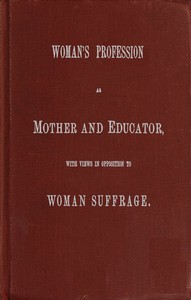
Woman's Profession as Mother and Educator, with Views in Opposition to Woman Suffrage — Story, Setting & Ideas
1137
10
Project Gutenberg
2017
Women -- Suffrage; Women -- Education
Readers of public-domain and historical texts
Project Gutenberg digital edition
en
Edition facts
Words: 48,356
Reading time: 211 min
Text sections: 14
Source:
Project Gutenberg record #56090
Catharine Beecher argues against woman suffrage by grounding women's influence in domestic and educational roles, using personal recollections of Litchfield's intellectual circle to claim that domestic training produces superior mental power.
Editorial Edition Score
4.7/5
★★★★★
★★★★★
Calculated from edition completeness, EPUB availability, text structure and catalogue metadata. Not a user rating.
Edition quality
Catharine Beecher's 1872 volume opens with a dedication to the ministers of the United States, framing the woman suffrage movement as an emergency that unites 'all the antagonisms that are warring on the family state.' The catalog subjects—Women—Suffrage and Women—Education—accurately reflect the book's dual focus, but the excerpts reveal that Beecher's opposition to suffrage is inseparable from her positive argument for women's domestic and educational profession. She does not merely list objections to voting rights; she constructs an alternative vision of female influence rooted in motherhood, teaching, and household management.
Domestic Training as Intellectual Discipline
Beecher devotes considerable space to arguing that women's traditional domestic duties exercise all intellectual and moral powers more thoroughly than men's specialized professions. She writes that a woman 'as mother and housekeeper has a constant succession of employments that tax all her intellectual and her moral powers,' while a man in his daily toils 'has only one or two subjects.' This claim is central to her opposition to suffrage: if women already wield supreme influence through the home, the ballot is unnecessary.
To support this, Beecher offers a detailed recollection of women in Litchfield, Connecticut, around fifty years earlier. She names Mrs. Judge Reeve, Miss Sarah Pierce, her mother, and aunts, noting that none had studied Latin, Greek, or mathematics, yet they were regarded as intellectual equals by the most talented jurists and gentlemen of the day. One brother even argued in a college exercise that women possess superior mental powers by nature. The passage is striking for its concrete, personal evidence—Beecher does not rely on abstract theory but on remembered conversations about Lavoisier's chemistry, medical reading, and literary discussions.
Health, Maternity, and the Need for Instruction
Another strand of Beecher's argument addresses what she calls 'the feeble constitution and poor health of women, causing them to dread maternity.' She describes an accumulation of 'mental and bodily tortures' and criticizes the 'extreme fastidiousness' that prevents mothers from learning or teaching necessary health information. She recounts a conversation with a lady physician who said she could not call mothers together to warn them because 'they would not hear me—I should have to nail the doors and windows to keep them.'
Beecher's solution is not to grant women political power but to train women teachers as lecturers on health in every school district. This proposal ties directly to her catalog subject of Women—Education, but the excerpts show that education is framed as a remedy for physical and moral decline, not as a path to equality. The emphasis on bodily suffering and the need for practical instruction in 'the laws of health' reveals a reformist impulse that coexists with her anti-suffrage stance.
The Structure of the Volume and Its Rhetorical Strategy
The table of contents lists five addresses or essays: 'An Address on Female Suffrage,' 'An Address to Ladies of Hartford, Conn.,' 'An Address to the Christian Women of America,' and three notes labeled A through D. This structure suggests that the book is a collection of occasional pieces rather than a single sustained treatise. The excerpts we have come from the dedication and from a later section that appears to be part of one of these addresses.
Beecher's rhetorical strategy is notable for its reliance on personal authority. She identifies herself as 'the daughter and sister of nine ministers of Jesus Christ,' grounding her right to address clergymen in family connection rather than public office. She also uses her own childhood memories as evidence, a move that personalizes her argument but also limits its generalizability. The excerpts do not reveal whether she engages with opposing arguments in detail or whether the later notes address counterpoints.
Readers should note that the excerpts represent only a portion of the book's argument. Beecher's opposition to suffrage is embedded in a broader vision of women's influence through domestic and educational work, and her evidence is often anecdotal and autobiographical. The catalog subjects accurately capture the book's themes, but the excerpts suggest that the relationship between them is more integrated than a simple pro/con debate. Those interested in nineteenth-century anti-suffrage rhetoric will find a carefully constructed case that prioritizes maternal and pedagogical authority over political rights.
Reader reflection
What did you think of this book?
Answer a few questions and save a private reflection on this device.
Your progress
0
/
10
2
Did this book hold your interest?
3
Would you pass this book on to a friend?
4
How easy was the book to follow?
5
How would you describe its reading pace?
6
How useful were the ideas in this book?
7
How much did the book move you?
8
How closely did the book connect with your experience?
9
What did this book teach you most?
10