1

The Goose-step: A Study of American Education — Background and Themes
57
8
Project Gutenberg
2021
Education -- United States; Universities and colleges -- United States
Readers of public-domain and historical texts
Project Gutenberg digital edition
en
Edition facts
Words: 199,253
Reading time: 867 min
Text sections: 98
Source:
Project Gutenberg record #65492
Upton Sinclair's 1923 exposé of American higher education argues that universities serve corporate and wealthy interests, suppressing academic freedom and radical ideas. The book profiles dozens of institutions and their leaders, using satirical chapter titles and firsthand accounts to illustrate how trustees, presidents, and donors enforce ideological conformity.
Editorial Edition Score
4.9/5
★★★★★
★★★★★
Calculated from edition completeness, EPUB availability, text structure and catalogue metadata. Not a user rating.
Edition quality
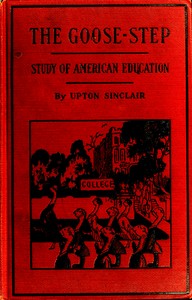
From its first pages, Upton Sinclair’s The Goose-step announces itself as an exposé, not a detached survey. The title itself—a military drill step—signals his central metaphor: American universities, he contends, train students to march in lockstep for corporate and wealthy patrons. The table of contents reads like a rogue’s gallery, with chapter headings such as “The University of the House of Morgan” and “The University of the Black Hand,” each targeting a specific institution or power broker. Sinclair’s method is to name names, quote internal documents, and recount episodes of administrative interference. The book’s structure—moving from the “little gosling” (the student) through a series of institutional case studies—invites the reader to see a systemic pattern rather than isolated scandals.
The Opening Gambit: Satire as Evidence
Sinclair wastes no time establishing his tone. The introductory chapters use barnyard imagery—goslings, geese, goose-steppers—to frame students as passive creatures being shaped by forces they barely perceive. He quotes a University of Chicago professor who laments that alumni are indistinguishable from “bathtub salesmen,” and cites Professor Cattell’s crack that a university club could more easily lose its library than its bar. These early salvos serve a dual purpose: they entertain while documenting insider discontent. Sinclair’s own voice is sardonic, as when he imagines a president’s secretary trying to “smooth him down” before a lecture. The reader quickly learns that the book will blend muckraking journalism with personal anecdote, and that no institution—including the one that hosted Sinclair himself—will be spared.
The Middle Excerpts: Anatomy of a Power Structure
In the chapters excerpted here, Sinclair zooms in on the University of Chicago and its president, Harry Pratt Judson. He describes Judson as a “high interlocking director in all the Rockefeller foundations” and the author of a manual titled The Higher Education as a Training for Business. The phrase “interlocking directorate” recurs throughout the book, borrowed from corporate criticism to describe how the same wealthy men sit on multiple university boards. Sinclair’s account of his own invitation to speak at Chicago is a set piece: he portrays the administration’s maneuvering to confine him to a small hall, limit publicity, and protect donors from scandal. The episode illustrates his broader argument that “absolute freedom of speech” is a public-relations slogan, not a reality. By including his own role in the story, Sinclair makes the reader a witness to the mechanisms of control.
The Later Excerpts: A System of Suppression
Later in the book, Sinclair broadens his critique to the national scene. He devotes chapters to the University of California, Stanford, Harvard, Columbia, and many others, each time tracing the influence of a particular industry or fortune—lumber, mining, wheat, railroads. The chapter “Little Halls for Radicals” generalizes from the Chicago episode: “The touchiest problem with all academic authorities is that of ‘outside speakers.’” Sinclair argues that universities manage dissent by careful hiring, weeding out undesirables before they gain prestige, and then controlling the visibility of any radical event that slips through. He presents this as a deliberate strategy, not a series of accidents. The cumulative effect is to depict American higher education as a closed system where wealth dictates curriculum, hiring, and even the architecture—the “mullioned windows and crenellated battlements” that signal tradition but mask corporate control.
The Rhetorical Engine: How Sinclair Builds His Case
Sinclair’s method is cumulative and associative. He piles up examples from different states and institutions, linking them with repeated phrases like “interlocking directorate” and “goose-step.” He quotes professors and administrators against themselves, often using their own words to indict the system. The book’s length—nearly 200,000 words—allows him to amass detail without relying on a single smoking gun. He also inserts himself as a character, a tactic that risks self-promotion but also grounds the argument in lived experience. Readers should note that Sinclair does not pretend to neutrality; he writes as a socialist and a muckraker, and his evidence is selected to support a thesis. The book is best approached as a polemic supported by documentary evidence, not as an impartial academic study.
First-time readers should treat The Goose-step as a primary document of early twentieth-century reform journalism. Sinclair’s claims about specific universities can be cross-checked against other sources, but the book’s value lies in its detailed portrait of how power operated in American higher education a century ago. Pay attention to the footnotes, which Sinclair uses to cite letters, reports, and speeches. The book rewards readers who follow those trails.
Reader reflection
What did you think of this book?
Answer a few questions and save a private reflection on this device.
Your progress
0
/
10
2
How much did you enjoy the reading experience?
3
Would you pass this book on to a friend?
4
Did the language feel accessible?
5
Did the book offer a fresh perspective?
6
How clearly were the main ideas presented?
7
How useful were the ideas in this book?
8
Did this book create an emotional response?
9
What did this book teach you most?
10