1

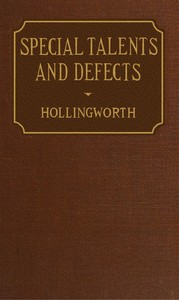
Special talents and defects — A Reader’s Guide
1795
13
Project Gutenberg
2024
Educational psychology; Educational tests and measurements; Exceptional children
Readers of public-domain and historical texts
Project Gutenberg digital edition
en
Edition facts
Words: 59,364
Reading time: 259 min
Text sections: 18
Source:
Project Gutenberg record #74232
Leta Hollingworth's 1923 study examines how specific talents and defects can dissociate from general intelligence, using case studies and test data to argue that educational assessment must look beyond IQ scores.
Editorial Edition Score
4.8/5
★★★★★
★★★★★
Calculated from edition completeness, EPUB availability, text structure and catalogue metadata. Not a user rating.
Edition quality
Leta Hollingworth opens Special Talents and Defects by acknowledging the field is "not well illuminated," a candid admission that sets the tone for this methodical work. Drawing on experimental evidence, she argues that mental functions like spelling, reading, or mechanical skill can be relatively independent of general intelligence. The book is not an introductory psychology text; it assumes readers already know the vocabulary of elementary psychology and have studied general educational psychology. Instead, it focuses on bringing together original investigations to extract implications for educators, psychologists, and anyone who deals with human beings professionally.
Dissociation from General Intelligence
Hollingworth’s central claim is that specific abilities can be "relatively dissociated from general intelligence." She illustrates this with two striking cases: a 14-year-old boy with an IQ of 93 who could not spell simple words like "September" or "houses," and a 12-year-old girl with an IQ of 59 who spelled at a fifth-grade level. The boy, despite average intelligence, scored below first grade on spelling; the girl, though feeble-minded, scored three years above expectation. Hollingworth warns that judging such individuals solely by a spelling test would be "profoundly deceived." These examples show that educational assessment must consider multiple measures, not a single score.
The Role of Drill and Motivation
Hollingworth notes that bright children often read fluently but spell poorly because reading is motivated by gaining ideas, while spelling requires exact drill. She observes that for very young, bright children, "it is not necessary to spell exactly, but only approximately." This discrepancy between reading and spelling is attributed to distaste for drill. The book suggests that teaching methods should account for such motivational factors, and that subjects like German or Italian, with more phonetic spelling, might show greater mutual helpfulness between reading and spelling than English does.
Methodological Caution and Scope
Hollingworth is careful to delimit her subject, noting that the book does not aim to cover the psychology of elementary school subjects or mental measurement comprehensively. She states that the "chief difficulty in organizing the subject has been to delimit it." The references are selected, not complete, to avoid cumbering the volume. This restraint reflects the book’s purpose: to provide an ordered presentation of original investigations for practical application, not an exhaustive treatise. Readers are expected to supplement this volume with additional knowledge of educational psychology and mental measurement.
Hollingworth’s work remains a landmark in educational psychology for its clear demonstration that special talents and defects can exist independently of general intelligence. Readers should approach the case studies and test data as evidence of the need for nuanced assessment, not as proof of fixed categories. The book’s value lies in its insistence that educators look beyond IQ to understand the specific strengths and weaknesses of each child.
Reader reflection
How did this book work for you?
Your answers remain private and are stored only in this browser.
Your progress
0
/
10
2
How did the book work for you overall?
3
Would you pass this book on to a friend?
4
How demanding did the text feel?
5
Could you apply anything you learned?
6
Would you read this book again?
7
How strong was your personal connection to the text?
8
What did you appreciate most?
9
What is the main idea you are taking away?
10