1

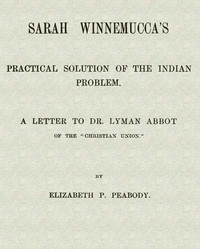
Sarah Winnemucca's Practical Solution of the Indian Problem A Letter to Dr. Lyman Abbot of the "Christian Union" — Context and Discussion
370
9
Project Gutenberg
2018
Indians of North America -- Education; Paiute Indians -- Education; Winnemucca, Sarah, 1844?-1891
Readers of public-domain and historical texts
Project Gutenberg digital edition
en
Edition facts
Words: 12,949
Reading time: 57 min
Text sections: 2
Source:
Project Gutenberg record #57526
Elizabeth Peabody's 1886 letter defends Sarah Winnemucca's self-directed Indian education plan, contrasting it with passive government programs. Peabody draws on decades of Indian history study and personal witness to rebut slanders against Winnemucca, emphasizing the Paiute leader's agency and the moral failure of white reformers who misunderstand her.
Editorial Edition Score
4.5/5
★★★★★
★★★★★
Calculated from edition completeness, EPUB availability, text structure and catalogue metadata. Not a user rating.
Edition quality
Elizabeth Palmer Peabody opens her letter to Dr. Lyman Abbot by framing Sarah Winnemucca's "New Departure" as a radical break from conventional Indian policy: instead of Indians passively receiving civilization from white superiors, Winnemucca's plan is "a spontaneous movement, made by the Indian himself, from himself, in full consciousness of free agency." Peabody anchors this idea in Paiute history, tracing it to Chief Truckee's 1848 encounter with John C. Fremont, which sparked an "unquenchable ardor" for white civilization before the usual pattern of wounding and discouragement set in. The letter thus sets up a central tension between the promise of mutual respect and the reality of betrayal by white settlers who shot Indians "as if they were wild beasts."
A Mediator's Authority and the Weight of Personal Witness
Peabody grounds her defense of Winnemucca not in abstract principle but in direct observation. She reports having heard Winnemucca speak in public "as many as thirty times" across Massachusetts, Rhode Island, Connecticut, New York, and Pennsylvania, noting that Winnemucca "never repeated or contradicted herself once." This claim of consistency is paired with a description of Winnemucca's extemporaneous style: she "took no previous thought as to what she should say, but trusted that the right words would be given her by the 'Spirit Father.'" Peabody herself was impressed, and she asserts that audiences were similarly moved to believe Winnemucca was a "special messenger." The letter thus presents Winnemucca's oratorical reliability as evidence against the "slanderous rumors" that Peabody attributes to a figure named Gibson, who has allegedly turned potential coadjutors into opponents.
Decades of Study vs. Hasty Judgment
Peabody counters the charge that she is "passively deluded" by detailing her own long engagement with Indian affairs. She traces her interest to age seven, when her mother's enthusiasm for an "Indian princess" married to a Revolutionary War general first shaped her views. By ten, she had heard her father read Heckewelder's history of tribal child-rearing, which taught her "the characteristic Indian virtues." She later read Catlin, studied the "Indian Ring" from its fur-trade origins, and learned the secret history of the Florida war from army officers. This cumulative knowledge, she implies, gives her authority to judge Winnemucca's case. The contrast is sharp: Peabody's seventy years of study versus the "few persons" who "jumped to the conclusion" without seeking a personal interview.
The Practical Outcome: A Senate Bill and Unfinished Work
Peabody reports a concrete political achievement: on July 6, 1884, the Senate passed a bill that "by implication abolished the agency of Pyramid Lake" and proposed giving the reservation to Winnemucca's and Leggins' bands in severalty. This legislative success, however, is undercut by the ongoing campaign of slander that has prevented Winnemucca from gaining the support of well-intentioned white reformers. Peabody laments that "the children of light should misunderstand each other" and that a mistake by "the good-intentioned" is especially disastrous because their impressions are "swallowed incontinently, without investigation." The letter thus balances a note of progress with a sharp critique of the very reformers who should be Winnemucca's allies, leaving the reader with a sense of a solution blocked not by Indian failure but by white misapprehension.
Peabody's letter is as much a document of her own intellectual biography as it is a defense of Winnemucca. Readers should attend to how she weaves personal history—her mother's influence, her father's reading, her conversations with army officers—into a political argument. The letter does not provide Winnemucca's own voice at length, but it insists that her spoken testimony, witnessed repeatedly by Peabody, is the most reliable evidence. To assess the "practical solution," one must weigh Peabody's claim to expertise against the acknowledged absence of a personal interview with Winnemucca's detractors.
Reader reflection
Your personal reading reflection
Build a private reading journal entry for this title.
Your progress
0
/
10
2
Was reading this book enjoyable?
3
How likely are you to recommend this book?
4
How demanding did the text feel?
5
Would you read this book again?
6
How did the reading compare with what you expected?
7
How useful did the reading feel?
8
What was its emotional impact?
9
What did this book teach you most?
10