1

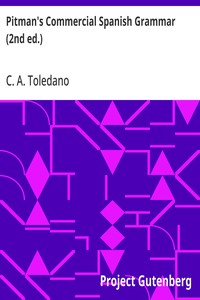
Pitman's Commercial Spanish Grammar (2nd ed.) — Edition Insights
1128
10
Project Gutenberg
2005
Spanish language -- Grammar; Commercial correspondence, Spanish; Spanish language -- Textbooks for foreign speakers -- English
Readers of public-domain and historical texts
Project Gutenberg digital edition
en
Edition facts
Words: 80,018
Reading time: 348 min
Text sections: 11
Source:
Project Gutenberg record #15127
This 1911 textbook by C. A. Toledano, a Manchester University instructor, teaches Spanish grammar through commercial correspondence, with exercises on letters, bills, and market reports. It balances technical vocabulary with general language rules, avoiding pedantry while preparing students for business contexts.
Editorial Edition Score
4.8/5
★★★★★
★★★★★
Calculated from edition completeness, EPUB availability, text structure and catalogue metadata. Not a user rating.
Edition quality
C. A. Toledano’s 1911 grammar explicitly aims to avoid “pedantry and the agglomeration of superfluous and intricate rules” while also shunning “coarseness” or “scrappiness.” The preface, written from Manchester, positions the book as a practical tool for students preparing for a commercial career, drawing on the author’s twenty-five years of teaching experience. The exercises immediately reflect this dual focus: alongside standard grammar drills, they include translations of business letters, invoices, and market reports. For instance, Exercise 2 asks students to render “Brown sugars have been rather brisk for some time” and “the recent change in the classification of yarns wound on bobbins” into Spanish, embedding commercial vocabulary within grammatical practice.
Pronunciation and the Alphabet
The opening lesson on the alphabet and pronunciation is notably concise. Toledano lists the Spanish letters with their names and gives five vowel sounds that “never vary,” illustrated by pairs like Yo amo and Amigo. He notes that k and w appear only in foreign words. The treatment is brisk, with no separate section on stress or diphthongs beyond a brief footnote. This economy reflects the author’s stated aim to be “brief and clear,” leaving more space for the commercial exercises that follow. The phonetic examples, such as un buque (a ship) and una butaca (an armchair), already hint at the vocabulary domains—shipping and household goods—that recur in later lessons.
Adjectives and Degrees of Comparison
Lesson XXXV covers the comparative and superlative with a mix of standard rules and commercial examples. Toledano explains tan…como and tanto…como, then offers a business-specific illustration: “Tan razonable en precio cuan apreciado por la buena calidad” (as reasonable in price as appreciated for good quality). The irregular superlatives—óptimo, pésimo, máximo—are noted as “used very sparingly,” yet the author includes them, perhaps for completeness. A striking detail is the warning that más mínimo is improper but “often found,” showing Toledano’s awareness of actual usage. The exercise sentences, such as “No hay nada de extraordinario en que afloje el mercado” (there is nothing extraordinary in the market slackening), tie grammatical points directly to commercial contexts.
Commercial Exercises and Vocabulary
The translation exercises are the book’s core. They include phrases like “the great object the meeting had in view was the promotion of further progress and civilisation,” which must be rendered into Spanish with commercial and diplomatic nuance. Toledano provides parenthetical translations for key terms—el abrir nuevas vías al for “further,” apelar a la espada for “arbitrament of the sword”—guiding the student through idiomatic choices. Other sentences involve bills of exchange, customs classifications, and interim dividends. The vocabulary is deliberately chosen to avoid “too much commercial technology,” yet it immerses the learner in the language of early 20th-century trade: almacenes fiscales (bonded warehouses), viajante (traveling salesman), indemnización (indemnity). This balance between general and specialized language is the book’s defining feature.
Toledano’s grammar is best approached as a period piece of language pedagogy, where the commercial world supplies both the motivation and the material for learning. Readers interested in the history of business Spanish or early 20th-century teaching methods will find its exercises revealing. The book does not claim to be a complete reference; its value lies in the specific, contextualized sentences that link grammar to the practical needs of a commercial career. Use the exercises as primary sources for how Spanish was taught to English-speaking business students a century ago.
Reader reflection
How will you remember this book?
Save your reaction, strongest insight, and memorable passage.
Your progress
0
/
10
2
What was your overall reaction to the book?
3
Would you encourage someone else to read it?
4
How demanding did the text feel?
5
Did any part of the book feel personally relevant?
6
Did you gain anything practical from the text?
7
Which part made the strongest impression?
8
Do you expect to return to this book?
9
Which lesson or insight stayed with you?
10