1

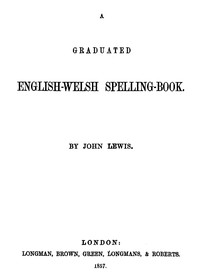
A Graduated English-Welsh Spelling Book — A Reader’s Guide
2741
9
Project Gutenberg
2015
Welsh language -- Orthography and spelling; English language -- Study and teaching -- Welsh speakers
Readers of public-domain and historical texts
Project Gutenberg digital edition
en
Edition facts
Words: 58,850
Reading time: 256 min
Text sections: 13
Source:
Project Gutenberg record #48043
John Lewis's 1857 spelling book for Welsh children learning English, structured in three graduated parts: monosyllables, polysyllables, and dialogues. The excerpts reveal a pedagogical method pairing English headwords with Welsh translations, using colon-separated noun/verb meanings and accent rules for homographs.
Editorial Edition Score
4.8/5
★★★★★
★★★★★
Calculated from edition completeness, EPUB availability, text structure and catalogue metadata. Not a user rating.
Edition quality
John Lewis's A Graduated English-Welsh Spelling Book (1857) opens with a preface grounded in thirty years of teaching experience. Lewis explicitly addresses the 'peculiar difficulties' faced by Welsh children acquiring English, and structures his book into three graduated parts: monosyllables, polysyllables, and dialogues. The excerpts show a systematic pairing of English headwords with Welsh translations, often providing multiple equivalents (e.g., 'Aim, amcan : amcanu'). A notable feature is the use of a colon to separate noun and verb meanings—a practical solution for words that serve both functions. Lewis also instructs learners to place accent on the first syllable for nouns and the latter for verbs in dissyllables, a rule embedded in the word lists themselves.
Structure and Graduation
The book's three-part division is explicitly described in the preface: Part I contains about 2,013 monosyllables arranged alphabetically and classified by letter count; Part II contains about 7,497 words arranged alphabetically and classified by syllable count; Part III offers 'copious English-Welsh Dialogues.' The excerpts confirm this graduated approach, moving from two-letter words like 'A, un' and 'Ah, O! och!' to three-letter words such as 'Act, gweithred : gweithredu' and 'Add, cyssylltu, dodi at.' The polysyllable section includes words up to four syllables (e.g., 'El-e-gance, tlysni, gwychder, tegwch'). This progression suggests a deliberate scaffolding from simple to complex, though the excerpts do not reveal how the dialogues function or whether they incorporate the vocabulary from earlier parts.
Pedagogical Features in the Word Lists
Several teaching strategies are evident. First, the colon notation: for words used as both noun and verb, Lewis places the noun meaning first, then the verb after a colon (e.g., 'Act, gweithred : gweithredu'). Second, multiple Welsh equivalents are often given for a single English word, separated by commas or semicolons—for instance, 'Air, awyr ; awyro' and 'El-e-gance, tlysni, gwychder, tegwch.' This indicates an awareness of semantic range. Third, the accent rule for dissyllables is stated in the preface and reinforced by the syllabified spelling (e.g., 'En-ter-prise' with hyphens). The word lists also include some grammatical notes: 'Em-bry-o' is glossed as 'anelwig, gorllyd, milrith,' and 'En-mi-ty' as 'gelyniaeth ; casineb.' These choices reflect a teacher's attention to common confusions.
The Welsh-English Interface
The catalog subjects classify this work under 'Welsh language -- Orthography and spelling' and 'English language -- Study and teaching -- Welsh speakers.' The excerpts bear this out: the book is entirely English-to-Welsh, with no Welsh-to-English section. The Welsh translations are given in a mix of formal and colloquial forms (e.g., 'Am, ydwyf, wyf' and 'As, megys, fel'). Some entries show dialectal or archaic variants: 'El-e-phant' is glossed as 'cawrfil, elephant ; oliffant,' where 'oliffant' is an older Welsh borrowing. The preface's phrase 'Welsh children' and the author's location in Llanrhyddlad (Anglesey) suggest a regional focus. The dialogues, though not excerpted, likely simulate real-life situations for English use. The book thus functions as a practical tool for bilingual education in mid-19th-century Wales.
Readers approaching this text should note its dual purpose: it is both a spelling primer and a bilingual dictionary. The colon notation and accent rules are essential for interpreting the entries correctly. The excerpts do not show the dialogues, so the third part remains unexamined. Lewis's preface emphasizes that children should 'learn and spell every word' with Welsh meanings—a method that treats vocabulary acquisition as the core of language learning. The book's graduated structure rewards sequential use, but its alphabetical arrangement also allows for reference-style consultation.
Reader reflection
How did this book work for you?
Your answers remain private and are stored only in this browser.
Your progress
0
/
10
2
Was reading this book enjoyable?
3
Would you recommend this book to another reader?
4
What was the reading difficulty like?
5
Was the book what you thought it would be?
6
Did anything about the book feel genuinely new?
7
Did it raise ideas you would like to talk about?
8
How much did the book move you?
9
What did this book teach you most?
10