1

Parents and children — A Closer Reading
55
9
Project Gutenberg
2023
Child rearing; Education -- Parent participation
Readers of public-domain and historical texts
Project Gutenberg digital edition
en
Edition facts
Words: 128,137
Reading time: 558 min
Text sections: 46
Source:
Project Gutenberg record #72445
Charlotte Mason's sequel to 'Home Education' examines the interplay of habit and idea in child-rearing, arguing that family life is the primary arena for moral and intellectual formation, with religious faith as its foundation.
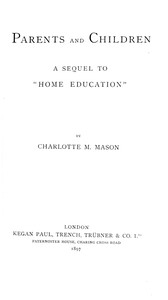
Charlotte Mason opens Parents and Children by grounding her educational philosophy in two principles: the physical basis of habit and the formative power of the idea. She presents these as covering 'the whole field of human nature,' enabling rational treatment of education's complex problems. The book, a sequel to Home Education, collects essays originally addressed to the Parents' National Educational Union, a body she helped found. Mason's voice is direct and authoritative, often using 'we' to align herself with her readers, as when she states, 'We take a very distinct stand upon this point.' Her prose is dense with references to contemporary educational thinkers like Herbart and Rein, whom she engages critically, not merely citing but interpreting their ideas to support her own.
Habit and Idea as Guiding Principles
Mason repeatedly contrasts the material and spiritual sides of education. Habit, she argues, has a 'physical basis'—a phrase she uses to emphasize that repeated actions shape the brain's structure. The idea, by contrast, is 'inspiring and formative,' an immaterial force that can transform a child's character. She does not treat these as equal partners; rather, the idea gives direction to habit. In the preface, she warns that applying these principles exhaustively would require 'the British Museum itself' to contain the necessary volumes, a characteristic hyperbole that underscores her ambition while acknowledging limits. Throughout the excerpts, she returns to this dual framework, using it to analyze everything from family dynamics to school systems.
The Family as the Seat of Education
Mason insists that 'the most valuable part of education is carried on in the family.' She quotes Herbart approvingly: 'Erziehung ist Sache der Familien; von da geht sie aus und dahin kehrt sie grössenteils zurück'—education is the business of families, from which it proceeds and to which it largely returns. This German phrase, left untranslated, signals her intellectual cosmopolitanism and her expectation that readers are familiar with Continental pedagogy. She elaborates that family life fosters 'dependence upon a head' and 'intimate knowledge' of children, conditions that make religious feeling natural. The family, she writes, should be 'the symbol of the order in the world,' a microcosm that prepares children for larger allegiances. This argument is not merely sentimental; it is structural, positioning the home as the primary institution for moral formation.
Religious Foundations of All Education
Mason takes a firm stand that 'all education is divine.' She distinguishes this from merely giving a 'religious education,' which would imply the possibility of a secular alternative. Instead, she holds that 'the Lord the Holy Spirit is the supreme educator of mankind.' This theological claim is central to her project, not a decorative piety. She invokes the medieval fresco in the Spanish Chapel in Florence, where the seven liberal arts appear under the Holy Spirit's rays, with pagan figures like Pythagoras and Euclid included as 'divinely taught.' This image allows her to claim that all genuine knowledge, even from non-Christian sources, comes from God. The passage reveals her strategy: she uses historical and artistic references to lend weight to her argument, weaving together theology, art history, and educational theory.
Critical Engagement with Herbart and Rein
Mason does not merely cite Herbart and Rein; she interrogates their ideas. She notes that Rein's mention of Rousseau is 'a little misleading,' because despite Rousseau's supplanting of parents in Emil, he 'awakened parents to their great work as educators.' This is a nuanced correction, showing Mason's willingness to disagree with authorities she otherwise respects. She also highlights the 'vast uncertainty' about the purpose of education, a problem she believes her principles can resolve. Her tone is that of a fellow investigator, not a dogmatist. When she quotes Rein on the family as 'the point at which both the religious and educational life of a people centres,' she adds, 'Here follows a passage which we do more than endorse, for it contains the very raison d'être of our society.' This blend of quotation, endorsement, and personal mission characterizes her authorial voice throughout.
Mason's prose rewards careful reading: her arguments unfold through a mosaic of quotation, commentary, and personal assertion. Readers should attend to how she uses German and Latin phrases, medieval art, and contemporary pedagogy to build her case. The book is not a practical manual but a philosophical treatise, demanding engagement with its principles rather than extraction of tips. Those new to Mason may wish to start with the preface, which succinctly states her core ideas, before venturing into the essays.
Reader reflection
How will you remember this book?
Save your reaction, strongest insight, and memorable passage.
Your progress
0
/
10
2
How much did you enjoy the reading experience?
3
Is this a title you would suggest to others?
4
How much effort did this book require?
5
Was the book what you thought it would be?
6
Would you like to discuss this book with someone?
7
Was the book easy to understand?
8
How would you describe its reading pace?
9
Which lesson or insight stayed with you?
10