1

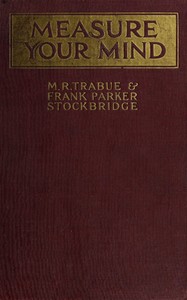
Measure Your Mind: The Mentimeter and How to Use It — Context and Discussion
55
8
Project Gutenberg
2020
Intelligence tests; Psychological tests; Educational tests and measurements
Readers of public-domain and historical texts
Project Gutenberg digital edition
en
Edition facts
Words: 97,563
Reading time: 425 min
Text sections: 27
Source:
Project Gutenberg record #61341
Examines the 1920 Mentimeter intelligence tests through their precise instructions, scoring scales, and the authors' deliberate choices in wording and structure, revealing early 20th-century assumptions about measuring mental ability.
Editorial Edition Score
4.9/5
★★★★★
★★★★★
Calculated from edition completeness, EPUB availability, text structure and catalogue metadata. Not a user rating.
Edition quality
The Mentimeter tests, as presented by Trabue and Stockbridge, are built on a scaffolding of exact language. The examiner's script for the number-series test, for instance, specifies that the candidate must “study out what kind of a series it is” before filling blanks, and the scoring directions insist that “no variations from the language and routine given above should be allowed.” This insistence on uniformity reveals a core authorial choice: the test is treated as a controlled experiment, where the wording itself is part of the measurement instrument.
The book’s preface frames the work as a “popular treatise on the measurement of intelligence by scientific methods,” but the excerpts show that the authors are equally concerned with the practical mechanics of administration. The scoring categories—ranging from “Inferior Ability” to “Superior Ability”—are tied to raw scores, yet the authors caution that the type of ability measured “is not necessarily a true indication of the general efficiency of the possessor.” This tension between precision and humility runs through the text.
The Examiner’s Script as Authorial Blueprint
The most striking feature of the excerpts is the detailed script provided for the examiner. In the number-series test, the instructions are given verbatim, including sample explanations: “In Sample A each number is obtained from the previous number by adding 2 to it; therefore, 12 should be the number between 10 and 14.” The authors do not merely describe the test; they dictate the exact words to be spoken, down to the timing cue “Ready! Go!” and the stop command “Stop! Time up! Give me your papers.”
This level of scripting reflects a deliberate authorial choice to minimize variability. The preface notes that Trabue’s experience included directing the examination of “more than a hundred thousand soldiers,” and the script bears the marks of large-scale administration. The language is imperative and unambiguous, designed to be followed by any examiner. Yet the samples themselves reveal a layered logic: Sample B requires the candidate to infer a pattern of decreasing subtractions, while Sample C alternates between a constant and an incrementing number. The authors are teaching the test-taker how to think, even as they measure that thinking.
Scoring Scales and the Language of Ability
The scoring system for Mentimeter No. 10 assigns ability labels to raw score ranges: 0–1 is “Inferior Ability,” 2–4 “Low Average,” 5–8 “Average,” 9–11 “High Average,” and 12–16 “Superior Ability.” The authors include a caveat that the score “is not necessarily a true indication of the general efficiency of the possessor,” which introduces a note of caution into an otherwise categorical scheme.
This phrasing is significant. The word “efficiency” rather than “intelligence” suggests a pragmatic, almost industrial framing of mental ability. The authors are careful not to overclaim, but the very act of assigning labels to scores implies a belief that intelligence can be quantified along a single dimension. The scoring directions also include a procedural note: “A convenient way of indicating that a series is not correctly completed is to cross out the serial number of that series.” Such small details reveal an authorial attention to the physical act of scoring, treating the test leaflet as a document to be marked and interpreted.
The Dual Structure of Mentimeter No. 10
The Addition Tests are described as having two parts: one measuring “the difficulty of the addition problems which a candidate can solve” and the other measuring “the speed at which one can add fairly easy problems.” The authors explicitly state that the first is “a fairly good test of intelligence,” while the second “has less relations to intellectual ability.” This distinction is a deliberate authorial choice, separating power from speed.
The wording is precise: “difficulty” and “speed” are treated as separable constructs. The phrase “fairly good test of intelligence” is hedged, suggesting the authors are aware of the limitations of their instrument. The structure of the test itself embodies a theory of mind—that intelligence can be decomposed into distinct components, each measurable by a different task. This two-part design is not merely practical; it reflects an underlying assumption about what mental measurement should capture.
The Role of the Preface in Framing Authority
The preface establishes the authors’ credentials in detail. Trabue’s experience is listed in six numbered points, including his work as “Chief Psychological Examiner in two of the largest Army camps, directing the intellectual examination of more than a hundred thousand soldiers.” Stockbridge is described as “an author and journalist of a high order,” with experience in science journalism and the “publicity campaign of the American Library Association War Fund.”
This biographical framing is itself an authorial choice. By foregrounding their expertise, the authors seek to lend authority to the tests that follow. The preface also notes that the Mentimeters are “based upon Doctor Trabue’s experience” in multiple settings, from charitable institutions to public schools to the Army. The language of the preface is confident and promotional, calling the collaboration “a particularly happy one.” Yet the body of the text, with its cautious caveats and detailed scripts, suggests a more measured approach. The tension between the preface’s boosterism and the test’s procedural rigor is a recurring feature of the work.
The excerpts from Measure Your Mind reveal a work that is as much about the language of testing as about the tests themselves. The authors’ choices—in scripting examiner instructions, labeling score ranges, and structuring test components—offer a window into early 20th-century assumptions about intelligence and its measurement. Readers attentive to diction and procedural detail will find a text that is both a historical artifact and a manual of psychological practice.
Reader reflection
What did you think of this book?
Answer a few questions and save a private reflection on this device.
Your progress
0
/
10
2
How much did you enjoy the reading experience?
3
Is this a title you would suggest to others?
4
How easy was the book to follow?
5
How clearly were the main ideas presented?
6
Would you like to discuss this book with someone?
7
How would you describe its reading pace?
8
How strongly did the book affect you emotionally?
9
What did this book teach you most?
10