1

Education of Women — Story, Setting & Ideas
712
7
Project Gutenberg
2018
Women -- Education -- United States
Readers of public-domain and historical texts
Project Gutenberg digital edition
en
Edition facts
Words: 20,655
Reading time: 90 min
Text sections: 4
Source:
Project Gutenberg record #57398
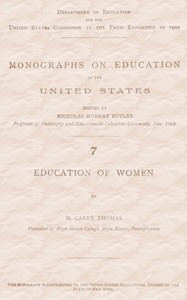
M. Carey Thomas, president of Bryn Mawr College, surveys the landscape of women's higher education in the United States circa 1900, comparing coeducational and separate institutions, and arguing for an unmodified curriculum.
Editorial Edition Score
4.5/5
★★★★★
★★★★★
Calculated from edition completeness, EPUB availability, text structure and catalogue metadata. Not a user rating.
Edition quality
M. Carey Thomas, president of Bryn Mawr College, opens this 1899 monograph with a striking claim: the higher education of women in America is unfolding “on a vast scale and in a variety of ways,” and the thirty years since the movement began are enough to draw “certain definite conclusions.” The text, one of several monographs edited by Nicholas Murray Butler for the Paris Exposition of 1900, is structured as a comparative survey. Thomas divides her subject into three institutional types—coeducational colleges, independent women’s colleges, and affiliated women’s colleges—and repeatedly returns to a central tension between regional custom and educational standards.
A National Experiment in Three Sections
Thomas organizes her evidence by geography, dividing the United States into three sections: the western states and territories (Section I), the southern and border states (Section II), and the New England and northern middle states (Section III). A table at the monograph’s opening maps the distribution of coeducational and women-only colleges, with an annotation that Roman Catholic colleges are excluded. This sectional framework allows Thomas to argue that coeducation prevails in the West and South because public sentiment there demands that tax-supported universities admit women, while separate women’s colleges cluster in the “narrow strip of colonial states lying along the Atlantic seaboard.” The structure itself implies that educational provision is not uniform but shaped by regional history and public opinion.
The Case for Separate Colleges
Thomas devotes considerable space to defending independent women’s colleges, though she acknowledges that coeducation is the dominant national system. She writes that “college life as it is organized in a woman’s college seems to conservative parents less exposed, more in accordance with inherited traditions.” The phrase “less exposed” recurs in her reasoning: she worries that intimate association with young men during “the most impressionable period of a girl’s life” may distract from intellectual training. Yet she insists that separate colleges must be “no less good than colleges for men.” This dual argument—defending separation while demanding equality—shapes the monograph’s rhetorical arc.
Against a Modified Curriculum
A recurring image in the text is the threat of a “modified curriculum” that would substitute music and art for mathematics and Greek. Thomas treats this as a historical possibility that was avoided: “In 1870 we could not have predicted the course to be taken by the higher education of women; the separate colleges for women might have developed into something wholly different.” She credits women themselves with rejecting inferior offerings, stating that “women themselves must be permitted to be the judges of what kind of intellectual discipline they find most truly serviceable.” The monograph thus positions the unmodified curriculum as a hard-won achievement, not a foregone conclusion.
Professional Education and the Future
Thomas’s survey extends beyond the college years to professional and graduate education. She notes that in professional schools—including theology, law, and medicine—coeducation is “almost the only method,” and predicts that as more women seek entry, existing schools will become coeducational. She also observes that only four graduate schools for men remain closed to women, and only one independent graduate school for women offers a Ph.D. program. The monograph ends with a forward-looking tone, suggesting that the progress of thirty years authorizes confidence in continued expansion. Thomas’s evidence is drawn from institutional data and her own administrative experience at Bryn Mawr.
Readers should note that this monograph was written for an international audience at the Paris Exposition, which may explain its comparative structure and its emphasis on American exceptionalism. Thomas’s voice is that of an advocate as much as a reporter: she is explicit about her belief that women’s education should follow the same rigorous path as men’s. The text is a primary source for debates about coeducation, separate institutions, and curricular standards at the turn of the twentieth century.
Reader reflection
How did this book work for you?
Your answers remain private and are stored only in this browser.
Your progress
0
/
10
2
What was your overall reaction to the book?
3
Would you recommend this book to another reader?
4
Did the language feel accessible?
5
Was the book easy to understand?
6
Would you start a conversation about this book?
7
How strongly did the book affect you emotionally?
8
Did the book deliver what you hoped for?
9
What changed or sharpened your thinking?
10