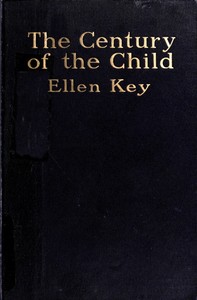
The Century of the Child — Reading Notes

(2 User reviews)   697
In Category - Teaching Methods
Key, Ellen, 1849-1926, Maro, Francis, 1870-1941 [Translator] Project Gutenberg 2018
Education; Child rearing; Parent and child Readers of public-domain and historical texts
Project Gutenberg digital edition en

Edition facts

Words 73,158
Reading time 319 min
Text sections 7

Before opening The Century of the Child — Reading Notes, the edition data offers a quick orientation: 73,158 words, 5 hr 19 min estimated reading time, and 7 detected text sections.

The text analysis averages about 26.3 words per sentence, while the detected sections provide another way to judge how the source is divided.

Project Gutenberg metadata also associates the work with “Education,” connecting these edition facts with the source record’s subject description.

Ellen Key's 1909 treatise argues that societal transformation must begin with the 'holiness of generation,' critiquing modern parenting, schooling, and the erosion of home life through recurring imagery of homelessness and the child as a symbol of renewal.
Share
Editorial Edition Score 4.7/5

Calculated from edition completeness, EPUB availability, text structure and catalogue metadata. Not a user rating.

How this score is calculated
  • Description quality20 pts
  • Title & short description10 pts
  • Source metadata20 pts
  • Text length15 pts
  • Chapters / structure15 pts
  • EPUB file integrity20 pts

Total of 100 points, scaled to a 2.5-5.0 range. Editions with an empty description or a missing EPUB file are not scored.

Edition quality

Read the Text

The thought of development not only throws light on the course of the world that lies behind us, continued through millions of years, with its final and highest point in man; it throws light, too, on the way we have to travel over; it shows us that we physically and psychically are ever in the process of becoming. While earlier days regarded man as a fixed phenomenon, in his physical and psychical relations, with qualities that might be perfected but could not be transformed, it is now known that he can re-create himself. Instead of a fallen man, we see an incompleted man, out of whom, by infinite modifications in an infinite space of time, a new being can come into existence. Almost every day brings new information about hitherto unsuspected possibilities; tells us of power extended physically or psychically. We hear of a closer reciprocal action between the external and internal world; of the mastery over disease, of the prolongation of life and youth; of increased insight into the laws of physical and psychical origins. People even speak of giving incurable blind men a new kind of capacity of sight, of being able to call back to life the dead; all this and much else which it must be allowed still belongs simply to the region of hypothesis, to what psychical and physical investigators reckon among possibilities. But there are enough great results analysed already to show that the transformations made by man before he became a human being are far from being the last word of his genesis. He who declares to-day that human nature always remains the same, that is, remains just as it did in those petty thousands of years in which our race became conscious of itself, shows in making this statement that he stands on the same level of reflection as an ichthyosaurus of the Jura period, that apparently had not even an intimation of man as a possibility of the future.

But he who knows that man has become what he now is under constant transformations, recognises the possibility of so influencing his future development that a higher type of man will be produced. The human will is found to be a decisive factor in the production of the higher types in the world of animal and plant life. With what concerns our own race, the improvement of the type of man, the ennobling of the human race, the accidental still prevails in both exalted and lower forms. But civilisation should make man conscious of an end and responsible in all these spheres where up to the present he has acted only by impulse, without responsibility. In no respect has culture remained more backward than in those things which are decisive for the formation of a new and higher race of mankind.

It will take the thorough influence of the scientific view of humanity to restore the full naïve conviction, belonging to the ancient world, of the significance of the body. In the later period of antiquity, in Socrates and Plato, the soul began to look down upon the body. The Renaissance tried to reconcile the two but the effort was unfortunately not serious enough. Boldness it did not lack, but its effort was not successful in carrying out a task which Goethe himself said must be approached both with boldness and with serious purpose. Only now that we know how soul and body together build up or undermine one another, people are beginning to demand again a second higher innocence in relation to the holiness and the rights of the body.

A Danish writer has shown how the Mosaic Seventh Commandment sinks back into nothing, as soon as one sees that marriage is only an accidental social form for the living together of two people, while the ethically decisive factor is the way they live together. In morality there is taking place a general displacement from objective laws of direction and compulsion to the subjective basis from which actions proceed. Ethics become an ethic of character, a matter dealing with the constitution of the temperament. We demand, we forgive, or we judge according to the inner constitution of the individual; we do not readily call an action immoral which only in an external point of view does not harmonise with the law or is opposed to the law. In each particular case we decide according to the inner circumstances of the individual. Applying this point of view to marriage, we find in the first place that this form offers no guarantee that the proper disposition towards the relation of the two sexes is present. This can exist as well outside of as within marriage. Many noble and earnest human beings prefer for their relation the freer form as the more moral one. But as the result of this, the significance of the Seventh Commandment is altered, that states explicitly that every relationship of sex outside of marriage is immoral. People have commenced already to experiment with unions outside of marriage. People are looking for new forms for the common life between man and woman. The whole problem is being made the subject of debate.

In this respect humanity occupies a field of discovery. People are seeing more and more what a complicated subject the whole relation of sex is, how full it is of dangers to the happiness of man. New observations are being constantly made both in regard to the significance of this relation for individuals and for posterity. To bring light gradually into this chaos is supremely important for humanity, and literature should therefore have the greatest possible freedom in this sphere,--just the opposite to the tendencies of the present day that would limit this freedom. While I fully agree with what has been said I should like to state that the greatest obstacle to the free discussion of this theme is still the Christian way of looking at the origin and nature of man. His only possible escape from the results of the fall is made to consist in his belief in Christ; for with this point of view, there came into Western Europe, by means of Christianity, the opinion that everything concerning the continuation of the race was impure; to be suppressed if possible, and if this could not be done, that it must at least be veiled in silence and obscurity. For Christianity, eternal life, not life in the world, is ever the significant factor. The dualism of existence it tries in the first place to remove by asceticism, not by attempting to ennoble the life of human impulses. This standpoint still continues to be popular in our days, as is shown in its victories through legislation directed against the nude in art and in literature.

The Christian way of looking at the relation of the sexes as something ignoble, alone capable of being made holy by indissoluble marriage, has had great direct influence on man's development during a certain period of time. It has caused progress in self-mastery, which has elevated the life of the soul. Modesty, domesticity, sincerity, have been promoted by it; these along with innumerable other influences have developed the impulse to love. If these emotions disappeared from love, it would not be human, but only animal.

But allowing that the individual love between every new pair of human beings always requires seclusion and reserve; allowing too that personal modesty always remains an achievement wrought by mankind, differentiating man from the animal world, it is still true that this kind of spirituality, which passes over in silence and shame all the serious questions connected with this subject, or treats them as occasions for ambiguities calling forth joking and blushes, must be rooted out.

Each one from earliest childhood should on every question asked about this subject receive honest answers, suitable for the especial stage of his development. One should be in this way completely enlightened about one's own nature as man or woman, and so acquire a deep feeling of responsibility in relation to one's future duty as man or woman. One should be trained in habits of earnest thought and earnest speaking on this subject. In this way alone can there come into existence a higher type of sex with a higher type of morality.

But at the time when Bjoernsen in _Thomas Rendelen_ brought up the question of training youth to purity through intelligence of nature's laws, I objected to his book on the ground that like the purity sermons of Christianity his efforts were rather directed to the mastery of natural impulses than towards their ennoblement. I showed that Bjoernsen certainly brought up two new points of view, that of bodily health, and that of the ennobling of sex. He did not, as Christianity does, stress the spiritual and personal side of the question. These new points of view of his were significant, because they united the just egoism of the individual with the combining altruism produced by the feeling of solidarity. The great purpose of Bjoernsen's book was to transform inherited characteristics as they are related to man's attitude towards morality. So he proposed to create a sound and happy new generation, in which the sufferings of present day sexual discord should be brought to an end. For this purpose he wished the collaboration of the schools. They were to communicate the knowledge of human beings as members of sex, and to instruct their scholars how, as human beings, they should protect themselves and their posterity.

I objected at that time to this plan, showing that the school was not the place to lay the foundation for such knowledge. It should be slowly and carefully communicated by the mother herself; the school should only give a theoretical basis. More defective still, I found the question of chastity handled essentially and solely as a question of bodily purity, as a negative not a positive ideal. I maintain that only erotic idealism could awaken enthusiasm for chastity. The basis for such idealism must be found in stories, history, and belles-lettres. Information derived from physiology is, in this respect, very inadequate, unless the imagination and the feeling are moved in the same direction. Neither imagination nor feeling can be helped by natural science and bodily exercises alone, and just as little by Christian religious instruction.

No, we must on the basis of natural science attain, in a newer and nobler form, the whole antique love for bodily strength and beauty, the whole antique reverence for the divine character of the continuation of the race, combined with the whole modern consciousness of the soulful happiness of ideal love. Only so can the demand for real chastity save mankind from the torments which sexual divisions and degradations now bring with them. It is profoundly significant that in the world of the past, divinity was associated with woman on the ground of observations concerning the continuation of the race; while in Christianity, woman became divine as the Virgin Mother. Through heathen and Christian thought, reunited and ennobled, the woman will receive a new reference for herself as a sexual being. Antique and modern love, the love of the senses and the love of soul, will, united and ennobled, induce human beings, men and women alike, to adore again Eros the All-powerful.

To diminish the significance of love, to oppose it as a lowering sensualism, does not mean the elevation of mankind; it means, on the other hand, working for its debasement. For as lowering as sexual life would be if it were continued in man accompanied by a feeling of shame as a characteristic of animal life, it would be just the same if it were regarded as a degrading duty, reluctantly carried out for the preservation of the species.

Antiquity stood higher than the present day, for example when Lycurgus' laws asserted that a people's strength lies in the breast of blooming womanhood. Accordingly in Sparta, the physical development of the woman was watched over as well as of the man, and the age of marriage was determined with reference to a healthy offspring. Higher, too, stood Judaism in relation to the conception of the seriousness of bearing children. This conviction expressed itself in the strictest hygienic legislation known to history. Jewish, like other Oriental legislation, depended, in relation to sexual morality as in relation to diet, on sharp-sighted observations of natural law and disease. The foundation to a new ethic in these questions cannot be laid, until men begin with Old Testament shrewdness and Old Testament seriousness to handle the life questions which the idealism of Christianity has indeed spiritualised but at the same time debased.

This new ethic will call no other common living of man and woman immoral, except that which gives occasion to a weak offspring, and produces bad conditions for the development of their offspring. The Ten Commandments on this subject will not be prescribed by the founders of religion, but by scientists.

Up to the present day, partly as a result of a perverted modesty in such things, science has only been able to offer incomplete observations on the physical and psychical conditions for the improvement of the human type in its actual genesis.

Ontogeny is really a new science in our century, introduced by Von Leeuwenhock, de Graaf, and others. It was founded in 1827, by von Baer. The differences of opinion and the discovery of different theories are very far from being ended. Purely scientific points of view are being combined with social, physiological, or ethical ones. It is maintained that by changing the diet of the mother the sex of the child can be determined. Attempts have been made to show that about three fifths of all men of genius were first-born children.

People are studying what influence the age of parents has on the child; extreme youth of parents seems unfavourable for the offspring as well as extreme age. The first child of a too youthful mother is often weak, and besides ordinarily the joys of motherhood are not desired, because she feels that physically and psychically a child is too great a burden to her, who herself is only a child. The conditions of a strong, well-nourished offspring require the postponement of the marriage age for women. In northern countries it should be established, if not by law at least by custom, at about twenty years. This is all the more necessary because then the young woman can have behind her some years of careless youthful joy, an undisturbed self-development, and will also have reached the physical development necessary for motherhood. While twenty years should be regarded as the earliest period of marriage it should actually be often postponed some years still for the well-being of the woman, the man, and the children, and married life as a whole, in which most conflicts arise because women have decided about their fate before their personality was definitely formed, before their heart was able to find its choice. The love of the man chooses and the young girl often confuses the happiness of being loved with the happiness of loving, an experience which later on is gone through in a tragic way. To the many questions which are related to heredity and natural selection, belongs one which notices the significance of nature's purpose to cause strong opposites to exert upon one another the strongest attraction. This attraction often during married life changes into antipathy; it almost results in impatience against the characteristics which originally had so deep an attraction. Nature in this case seems to wish to reach its end with the greatest lack of consideration for the happiness of the individual. So often the contradictions of parents seem really to be moulded in full in the child. Occasionally these contradictions are expressed as a deep discord, but in both cases there often arises an exceptional being. To attain correct results in this case, belongs to the numerous still open possibilities.

Differences of opinion are most apparent in the theory of heredity, where there is a struggle between Darwin's view, that even acquired characteristics are inherited, and Galton's and Weissmann's conviction that this is not the case. In connection with this stands, also, the question of the marriage of consanguineous relations; some regard these marriages as dangerous, _per se_, for the posterity; others only as dangerous from the point of view that the same family trait is often found in both parents, and so becomes strongly impressed on the children. For example, congenital shortsightedness of both parents develops into blindness of the children, their stupidity becomes idiocy, their melancholy, insanity.

The Occident has gradually abolished the Oriental marriage law to which Moses gave validity, while other Oriental legislators, for example, Manes and Mohammed, are still followed to a great extent. In China, too, similar prohibitions have a binding power. Here and there the feeling of the significance of heredity has vaguely appeared in some Occidental writers. Sir Thomas More, like Plato, required a physical examination before entering into marriage. It was not until the nineteenth century that the question of the rights of the child in this respect began to be noticed. It was Robert Owen who in one way awakened the general right feeling in favour of children, by investigations begun in 1815. They showed that children under eight years old were forced to work by blows from leather whips, to work from fifteen to sixteen hours a day, with the result that a fourth or fifth of them ended as cripples. Another Englishman, Malthus, published in 1798 an essay on the _Principle of Population_, and directed the attention of society to the conditions which had caused him to write his work. He pointed to the deficiency of food supply produced by over-population and the obstacles it offered to legitimate marriages. Again, these conditions, he showed, resulted partly in great mortality among children, partly in the murder of children. Malthus saw the significance of selection and the danger of degeneration. With perfect calmness of conscience he met the storm he had evoked. Personally a blameless and tender hearted man, Malthus, as all other reformers of moral ideas, had to allow the shameless accusations of corruption and immorality to pass over his head. Harriet Martineau, who advocated Malthus's views, had the same experience. When she wrote her novels on this subject she knew very well to what she was exposing herself; but this remarkable woman, who died unmarried and childless, was at an early period of her life filled with a feeling for the holiness of the child. When nineteen years old, at the time of the birth of a small sister, she fell on her knees and devoutly thanked God that she had been allowed to be the witness of the great wonder of the development of the human being from the beginning. The same feeling caused her in her novels to expound the duty of voluntary limitation of population. She was pained by the thought of the fate endured by children, when they were so numerous that their parents were unable to maintain and educate them. This part of the subject of the right of the child called forth in all countries books for and against it. Everywhere the question is discussed. I shall briefly handle the differences of opinion about other sides of the right of the child.

In Francis Galton's celebrated work, _Hereditary Genius_, almost all has been said that is required to-day from the point of view of the improvement of the race. Galton, as early as the seventies, opposed Darwin's view that acquired characteristics were inherited. In this respect he had a fellow-champion in the German Weissmann, who on his side was opposed, among others, by the English Darwinian Romanes.

Ellen Key opens The Century of the Child with a striking image: the new century as a naked child recoiling from a world bristling with weapons. This metaphor sets the tone for a work that repeatedly uses the child as a measure of societal health. Key structures her argument around the conviction that human nature must be transformed through a new consciousness of the 'holiness of generation.' The book moves from the right of children to choose their parents, through critiques of schooling and child labor, to visions of future education. Throughout, she contrasts the ideal of a nurturing home with the reality of intellectual homelessness, a recurring motif that ties together her observations on family, school, and society.

The Child as a Symbol of Renewal

Key's opening chapter establishes the child as both a literal being and a symbol of potential renewal. She describes the turn of the century as a moment filled with 'sad memories or eager hopes,' and the child descending in terror represents the failure of the previous century to create a peaceful world. This image recurs implicitly throughout the book: the child is the site where transformation must begin. Key argues that 'nothing will be different in the mass except in so far as human nature itself is transformed,' and that this transformation hinges on how society treats its youngest members. The child is not merely a passive recipient of education but the central figure around which 'all morals, all laws, all social arrangements will be grouped.' This symbolic weight gives the book its driving force, as Key repeatedly returns to the gap between the ideal of childhood as a sacred period and the reality of neglect and mismanagement.

The Architecture of Home and Homelessness

A striking structural feature of Key's argument is her use of spatial imagery to diagnose social ills. She devotes an entire chapter to 'Homelessness,' where she describes how children and parents become 'as mutually dependent as the roots and flowers of plants, so often separate with mutual repulsion.' The home, which should be a place of rhythm and festivity, is instead a site of irritation and boredom. Key contrasts the 'artists of home life'—often simple, unexamined mothers—with highly cultivated mothers whose 'well-thought-out plans' fail. The school, clubs, and outside pleasures accustom youth to 'outside life,' killing the 'true feeling for holiday.' This movement between inside and outside, between the ideal home and the actual one, structures Key's critique: she repeatedly shows how institutions encroach on domestic space, leaving children intellectually homeless even within their own families.

The Mother as Artist or Architect

Key's treatment of motherhood is notably ambivalent. She praises the 'unselfish mother' who allows a child to grow according to his own laws, but she also catalogues maternal failures with sharp specificity. Mothers who 'spend the whole day in keeping their children's nervous system in a state of irritation' or who treat children as 'clay that she desired to mould' are condemned. Key quotes a son's bitter exclamation: 'even a mother must know how she tortures another; if she has not this capacity by nature, why in the world should I recognise her as my mother at all.' This direct speech, drawn from a book Key references, gives her argument an emotional edge. She distinguishes between the 'artist of home life'—who makes 'the rhythm of everyday life a dance'—and the methodical, educated mother whose very expertise becomes a form of stupidity. The mother figure thus oscillates between ideal and failure, a tension that Key uses to argue for a new kind of maternal consciousness rooted in selflessness rather than control.

The School as a Displacing Force

Key devotes several chapters to schooling, but her critique is less about curriculum than about the school's role in displacing the home. She writes that 'the school, not father and mother, teaches children to play, the school gives them manual training, the school teaches them to sing, to look at pictures, to read aloud.' This enumeration underscores a loss: the home no longer moulds the child's soul life. Parents surrender their children to schools during the years when they should be influencing their minds, and when the school returns them, parents 'do not know how to make a fresh start.' Key's recurring image of 'soul murder in the schools' suggests a violence done to the child's inner life. The school of the future, which she sketches, would be radically different—but the excerpts provide only hints of that vision. What remains clear is that Key sees the school as a symptom of a broader societal failure to prioritize the child's holistic development over institutional efficiency.

Readers approaching The Century of the Child should attend to its movement between the intimate and the institutional. Key's arguments gain force from her concrete observations of family life—the mother who irritates, the child who feels homeless—rather than from abstract theory. The book's structure, with its repeated returns to the home as both problem and solution, rewards careful attention to its imagery of space and movement. While Key's proposals for reform are only partially visible in these excerpts, her diagnosis of the gap between ideal and reality remains pointed.

Ellen Key's homeless child still haunts me—that ache for a home where a mother’s own rhythm sets the day. Yet I find myself returning to Montessori’s quieter rooms, where the child’s work becomes its own shelter. Somehow, between Key’s prophecy and that prepared environment, the longing settles into something almost tender. It’s enough, some evenings, to simply sit with both and remember. Spontaneous Activity in Education — Story, Setting & Ideas holds that calm.

Olivia Green
3 weeks ago

Scarlett Allen
1 month ago

5
5 out of 5 (2 User reviews )

Add a Review

Your Rating *
  • ...
    Patrick King - 1 month ago
    {'rating': 3, 'text': "An interesting historical treatise with many progressive ideas, though some are idealistic. The writing is engaging, but the cultural context of the early 20th century is evident. It's a valuable read for those interested in educational history, offering a mix of insightful observations and dated social commentary."}

  • ...
    Brian Chambers - 4 weeks ago
    {'rating': 2, 'text': "The book's utopian vision lacks practical grounding, and its views on gender roles and child psychology are clearly of its time. The arguments are repetitive, and the prose can be melodramatic. While historically relevant, it offers little that hasn't been better addressed in modern educational reform."}

  • ...
    Mario Roberta Powers - 3 weeks ago
    {'rating': 5, 'text': "A visionary work that was ahead of its time, 'The Century of the Child' offers a compelling critique of educational and social systems that still resonates today. Key's passionate advocacy for child-centered education and progressive reforms is inspiring and thought-provoking. A timeless classic that every parent and educator should read."}


Reader reflection

What did you think of this book?

Answer a few questions and save a private reflection on this device.

Your progress 0 / 10
1

Which reading stage best describes you?

2

What was your overall reaction to the book?

3

Would you recommend this book to another reader?

4

How easy was the book to follow?

Related eBooks