
The Burston School Strike — Themes and Context
Edition facts
The catalog record for The Burston School Strike — Themes and Context provides practical reading context through 10,476 words, 46 min estimated reading time, and 2 detected text sections.
The text analysis averages about 18.0 words per sentence, while the detected sections provide another way to judge how the source is divided.
Project Gutenberg metadata also associates the work with “Higdon, Thomas George,” connecting these edition facts with the source record’s subject description.
Calculated from edition completeness, EPUB availability, text structure and catalogue metadata. Not a user rating.
How this score is calculated
- Description quality20 pts
- Title & short description10 pts
- Source metadata20 pts
- Text length15 pts
- Chapters / structure15 pts
- EPUB file integrity20 pts
Total of 100 points, scaled to a 2.5-5.0 range. Editions with an empty description or a missing EPUB file are not scored.
Read the Text
(half-joke-real-earnest) manner. He is very much opposed, however, to private property in Sundays.
The Reverend Charles suggested that it might be prejudicial to the school, etc., if the teacher stayed away.
Kings in the past have threatened dire penalties for non-attendance at church, but when people attend church simply because the schoolmistress, the wealthy farmer, or the large employer puts in an appearance, then they show little respect or love for Divine teaching. Attendance should be a matter of choice, not compulsion.
Timothy Sparks, who later attained world-wide celebrity by using his real name, Charles Dickens, issued a quaint little book upon this subject, entitled “Sunday under Three Heads.”
Robert Kett, Norfolk rebel, suggested in 1549 “that all bondmen should be made free, for God made all free with his precious blood-shedding.” I presume he meant that this might also apply to Council School teachers.
He likewise suggested “that someone should be appointed in every parish to teach poor men’s children catechism and the primer; that enclosing of common lands should be put a stop to; and that priests and vicars who were unable to preach and set forth the word of God should be removed from their benefices.”
What a pulpit emptying ordinance this last clause is!
It cost Kett dear. The Earl of Warwick instructed an army of German mercenaries to pursue him; 3,500 of his Norfolk followers were cut down, and he was hanged as a rebel for his presumption.
A rebel is a person who comes on earth before the people are intelligent enough to understand him. None but a rebel ever had Saviour carved on his tomb. Had he suggested that vicars should live up to their teachings we would have classed him as an Impossiblist, of course.
The keeping of Sunday will always be a matter of controversy until we in England also “Remember the week-day to keep it holy.”
Now, let us move on to the petty persecutions and puny pretexts for dismissal vouchsafed to Mr. and Mrs. Higdon after more than three years’ service and twelve years in the county.
The Reverend Charles Tucker Eland, to give him his full title, parted in the middle, departed this Burston village life for a short holiday in Switzerland.
A clergyman’s holiday has two good points. It gives both him and his congregation a well-earned rest. Whilst the Reverend School Manager was away in Switzerland, an epidemic of whooping cough had the audacity to enter the village.
Mrs. Higdon, the schoolmistress, at once sent over to another reverend school manager, the Reverend Millard (Rector of Shimpling and vice-chairman of the local Managers’ Committee), and he, after consultation, decided to close the Council School for one week. _He_ signed the notices, and made entry in the log to that effect.
When the Rector of Burston arrived back from Mount Pilatus another meeting of the school managers was held.
This Managers’ Committee informed Mrs. Higdon, through the chairman (Reverend C. T. Eland this time) “that the committee took a very serious view of her having closed the school _without_ permission, but,” added the Reverend Pulpiteer, no doubt in an outburst of holiday extravagance, “the managers will now let the matter drop.”
A VERY REVEREND COMMITTEE.
I think we might here observe a silent pause whilst we appropriately meditate upon the reverend chairman’s logic and the Managing Committee’s generosity. In fact, the names of the members of the committee should be handed down to _posterity_. Here they are:
BURSTON COUNCIL SCHOOL.
The School Managing Committee.
The Right Reverend Rector, Charles Tucker Eland.
The Right Reverend Reverend Rector’s good lady.
(_County Council_, _two votes by appointment_.)
The Right Reverend Rector’s friend, the Right Reverend Rector of Shimpling, Reverend Charles Millard.
The Right Reverend Charles Tucker Eland’s glebe tenant, Farmer Fisher.
The Right Reverend Rector’s friend’s friend, the Rector of Shimpling’s churchwarden, Farmer Stearn, and lastly, beloved, Mr. Harry Witherly.
A fitting finale to this family party—I mean Council School Managing Committee—was provided by the Right Reverend Charles Tucker Eland’s loyal glebe tenant, Farmer Fisher, who remarked upon “the harm which had been done to the parish by closing the school.”
Had Farmer Fisher been a _medico_ one might have sympathised with him in his sorrow at “whooping cough” not being allowed to attend school whilst the rector was in Switzerland, but as Mr. Fisher is not a medical gentleman by profession one is forced to the sad conclusion that though he may put money in his purse he really ought to have more furniture in his attic.
His theory for the elimination of disease is certainly original.
Children who may suffer in the future from mumps, whooping cough, scarlet fever, managers, or any other disease liable to be captured by juveniles, may say to their parents, “Please don’t keep me at home. Please mother, Mr. Fisher recommends Council School treatment, so that I may share it with the others.”
“Yes, Bor. Whoop, whoop, whooping cough.”
Yes! I can safely recommend a little attic salt. I must not be too hard, however, on our friend; it is not quite safe for glebe tenants to differ from rectors as a rule. Three are already on notice for differing.
Mrs. Higdon, having faced the alternatives of being reprimanded for _not_ closing the school or for allowing the reverend gentleman from Shimpling to close it—you takes your choice—went back to attend to her bairns considerably chastened, and Burston breathed again as of yore.
Unfortunately, the only two Englishmen who could have done justice to this theme are both dead.
Set to appropriate poetry by Gilbert, composed and orchestrated with a slight Mozartean sprinkling of consecutive fifths by Sir A. Sullivan, it might have brought down the house at the Savoy, likewise the National Union of Teachers’ Executive, had the N.U.T.S. not been suffering from sleeping sickness.
However, the reverently-composed committee had not given up all hopes, although the case was against them this time.
The next act opens with the appearance of Mr. Ikin, assistant-secretary to the Norfolk Education Committee. He paid what is known as a surprise visit.
A surprise visit is the most modern form of torture.
In the olden days they always brought you something. To-day they try to take everything you’ve got. In the olden days you sometimes received a goose, to-day they send you a picture postcard.
His surprise words to Mrs. Higdon were: “What is wrong between you and the managers?”
Mrs. Higdon replied that she was not aware that there was anything wrong.
Mr. Ikin went on to say that the local managers had written to the Norfolk Education Committee, complaining that she had lighted the schoolroom fire against their instructions, and that “as she had so many faults to find with the place, would the committee kindly remove her to a sphere more genial?”
That a good, healthy, religious enemy is not to be despised the lives of Bruno, Galileo, Kepler, Wycliffe, Wesley, or a study of the Thirty Years’ War will prove.
Here is a copy of the letter sent to Mrs. Higdon:
Norfolk Education Committee, Shirehall, Norfolk,
BURSTON AND SHIMPLING SCHOOL.
Dear Madam,—In a communication received from the managers on the 13th of November, the committee were asked “if they will kindly remove Mrs. Higdon to a sphere more genial.”
I may remind you that this is the second place in which you have come into conflict with the managers.
The committee have decided that the managers’ instructions are to be obeyed, and as they have instructed you that the fire is not to be lit, I am to give you directions to obey these instructions. I trust there will be no further friction.
Yours faithfully, Thos. A. Cox, _Secretary_.
Mrs. A. K. Higdon, Burston School, Diss.
It seems the old method of fire-lighting still prevails. That is by friction.
In reading this parochial letter of complaint one cannot help but admire the warm interest which the Reverend Managers’ Committee display in Mrs. Higdon.
They are so solicitous about her welfare that they desire the Norfolk Education Committee to “kindly remove her to a sphere more genial.”
One is here tempted to quote Ingersoll’s advice to his wife. Once upon a day, when the lady was suffering from heat in the head—vulgarly termed temper—he turned to her, and mildly remarked:
“Darling, I am afraid that you have not yet shed all your Christian virtues.”
Unfortunately, the reverend chairman, with Machiavellian subtlety, omits to mention whether the “genial sphere” to which he recommends Mrs. Higdon’s removal is on this planet or the other one.
The many readers of Pickwick will have vivid recollections of the memorable part played by a warming pan, but who would believe that a similar amount of indignation could be aroused in the breasts of the Reverend Managers’ Committee at the lighting of a schoolroom fire to dry the wet clothes of the agricultural labourers’ children. The great difficulty one is confronted with in placing these items before the general public is to convince folks that these complaints were made against Council School teachers and not High Church ones. These backstairs, intriguing, silly, childish complaints might well be laughed out of court if they were not being launched with a definite object in view. That object was to strike at Higdon through his wife.
This is a very ancient pastime. Satan, by all accounts, was an early exponent of it. He had a similar object in view, _viz._, to assist emigration and check sympathetic vibration.
Readers may have noted the paragraph: “This is the second place in which you have come into conflict with the managers.”
To understand this sentence is to possess the key to all the petty persecution and to gain a grip upon the problems of the countryside.
Mr. Higdon has constantly, at Wood Dalling, his previous place, and at Burston, tried to secure brighter conditions of life and better housing for the tillers and toilers.
WHERE ARE THE “NUTS”?
He has been an ardent advocate of the Agricultural Labourers’ Union. He and his wife are both members of the N.U.T. to-day, and have been during the past eight years. Mrs. Higdon was this year made honorary member by her Association, East Dereham, in order to ensure her continuance of her qualification for support could she not afford to pay.
In order to relieve the anxiety of a few up-to-date doubting Thomases I here insert certificate of membership:
Received of Mrs. Higdon (1913), of Burston, Diss., following amounts on behalf of N.U.T. and the East Dereham Association.
SUBSCRIPTION. s. d. Annual to Local Association 3 0 Annual to N.U.T 12 0 Signature of Local Secretary or Treasurer, A. E. Tripp.
Mr. Higdon’s 1914 membership card is 41,534. He possesses similar receipts right up to date.
In order also to relieve the minds of a few gentlemen who know so much _that is not so_, Mr. and Mrs. Higdon have not received one penny piece from the “nuts” of the N.U.T. Executive. They have taught during the last sixteen months without fee, and the villagers, having understudied Elijah’s raven, have, out of their humble cupboards, supplied the Higdons. Pardon this digression.
Now to come to the root cause of the persecutions.
Those in authority like not the cold, clear light of public opinion to be focussed upon their apathy and neglect.
For centuries have squire and parson held the countryside in subjection. “Ye shall know them by their fruits.”
Low standards of living, emigration, insanitary hovels, and servility—these are the fruits. The Parish Council Elections, both at Wood Dalling and Burston, gave the _owners of the people’s lives_ a severe shock.
At each place, Assistant-Master Higdon and the agricultural labourers topped the poll. At Burston, Higdon defeated the very Reverend Rector, C. T. Eland. An unpardonable offence. He topped the poll, and with him five labourers were elected, thus displacing the parson and the landowners. After these victories, the persecutions commenced, both at Wood Dalling and Burston.
“Go, Tubal, fee me an officer, I will have the heart of him.”
I am also proud to add that in spite of the most strenuous (or strenuseless) opposition, spite of clergy and farmers’ malice, Higdon and his friends have carried their housing agitation to victory—the Local Government Board having just given their decision in favour of the Burston Parish Council against the District Council, that the houses must be proceeded with forthwith. No wonder the villagers are gratified.
Often have the younger end to wait until their elders die off ere they can get married, and the funeral-baked meats oft furnish the Matrimonial Passover.
When we learn of people crowded in small sleeping rooms, and Barnardo children occupying one-storied insanitary hovels, with outside walls only seven feet high, and damp rooms on ground floor, unfit for sleeping in, we may easily guess the fight the schoolmaster had to make.
Strange is it not that gentlemen living in the best house in the village—as clergymen generally do—should be such strong opponents of good homes for other Christians?
The only faults Mrs. Higdon had to find at school were simply faults which every lady inhabiting a house would seek to remedy. Faults of lighting, heating, drainage, and schoolhouse pump which were essential matters to the health of even labourers’ offspring.
The reverend manager and his local committee, however, objected.
The schoolroom fire was lit upon wet mornings to dry the children’s clothes, as the third radiator of the heating apparatus did not sufficiently warm the room. The Reverend Eland visited the school and the mistress explained to him her reasons for lighting this fire occasionally. Strange to say, he agreed with her, and advised her to write Mr. Wade, of Shimpling. He not replying (according to his usual practice) silence was taken as consent.
Not before a new body of managers was formed, with the reverend gentleman, who had previously given his permission as chairman (C. T. Eland), was the complaint _re_ fire re-resurrected.
So much for the fire, the whole fire, and nothing but the fire, so help your wet clothes.
“Trivialities oft usher in tragedies, however.”
WHAT “JOHN BULL” HAD TO SAY.
The next complaint was more successful. Mrs. Higdon was accused of caning two Barnardo children, discourtesy to the managers, and our dear old friendly complaint, fire-lighting, once more. These complaints, like the previous ones, were completely false and unfounded. During these complaints Mrs. Higdon was helping the reverend gentleman with his lantern entertainments.
_John Bull_, referring to the matter, says: “The role of scape-goat was reserved for the schoolmaster’s wife.”
At the last election the schoolmaster, with five labourers of his own way of thinking, was triumphantly returned to the Parish Council. Room was made for them by the unseating of the rector and the leading farmers. In these striking circumstances, it is perhaps not surprising that the managers of the school should have entreated the County Education Committee to remove them “to a more genial sphere of work.”
An early opportunity was found to charge her with the ill-treatment of two of her pupils and—whisper it with bated breath—“intentional discourtesy to the rector’s wife.”
That two respectable teachers should be hounded out of house and home simply upon the testimony of a poor Barnardo waif—who privately denied what she publicly confessed, excusing herself by saying “she would have been thrashed by her foster-mother if she had not said so” seems beyond belief.
Still the fact remains that Mrs. Higdon did not cane the child, as the whole of the school children can prove. She does not belong to the cane family. Furthermore, the sequel to this complaint proves her entire innocence. Pity, indeed, is it that those who were seeking excuses for her removal could not find a _single_ parent or child belonging to the village to complain of Mrs. Higdon’s treatment of them.
1. That the head teacher has been discourteous to the managers.
2. (_a_) That in view of the direct conflict of evidence with respect to the caning of the Barnardo children they are not able to give a decision on this matter; but they are strongly of opinion that there is no evidence at all that the girl (E.C.) is mentally and morally deficient, or a danger to the school, as stated in the letters of the head teacher and her husband. (The head teacher said she was “_somewhat_” mentally deficient, which, of course, alters the context).
(_b_) That, in their opinion, these children are well treated and cared for by their foster-mother, and that the children are not afraid of being beaten by her.
(_c_) That in their opinion the communications sent by the head teacher and her husband to Dr. Barnardo’s Institution were not warranted by the facts of the case.
The sub-committee, after most carefully reviewing the whole of the evidence, advise: “That it is to the interest of elementary education in this village that the head teacher should seek other employment with as little delay as possible. That no punishment book having been kept in this school by the head teacher prior to this occurrence she be directed faithfully to keep such book.”
So the forces of reaction had triumphed. First, accused and condemned by false stories put in the mouths of babes, eight and nine years’ old respectively; secondly, because the Higdons had written to the Barnardo Institution hoping to receive real justice from an impartial tribunal, not local village justice; thirdly, insulted about an ancient rule of Sir John Gorst’s _re_ punishment book, which other teachers in the county did not possess. Thus they were supposed to have received their quietus.
The inquiry was practically a funless farce. Higdon and his wife received short notice to vacate the schoolhouse (left in the lurch by the N.U.T., as at Wood Dalling and at Burston, where the representative, after promising that a slander action would take place as soon as possible, became frightened at his own bravery, and thought better of it), they felt inclined to understudy poor Joe, and move on.
At this juncture all seemed lost. The Higdons, poor financially and politically, having no rich Liberal nor Tory champion, were confronted with that “remove to a sphere more genial,” which their most Christian friends desired.
The Burston Dyaks seemed to have succeeded, when all at once a change came o’er the scene. Here entereth the school children. Not meaningless are the beautiful words, “A little child shall lead them.”
The school children struck. They refused to attend the Council School. When they knew their beloved teachers had been victimised they refused to go back. They went on strike.
This was the finest, spontaneous, and most loving act of kindness that kind teachers ever had showered upon them. It was a fitting tribute and a real answer to all the calumny and slander.
Children know when they are loved. They cannot pretend as grown-ups can. Had Higdon and his wife been disciples of Whackford Squeers or advocates of the “Big Stick,” the children would gladly have sung Tosti’s “Good-bye for ever,” and good shuttance. But they struck in sympathy.
Here are we confronted with another great factor. The mothers backed them up womanfully. There are at present 56 children on Higdons’ books. There’s a juxtaposition, as the late-lamented Dominie Sampson might have remarked. The Babes o’ Burston and the Burston Braves.
That the women showed bravery is an undeniable fact. It requires more than milksop pluck to brave the farmers, the clerics, and the law.
An open-air meeting was held on the green. The village green is that portion of England left over after the squire and parson have cast lots for the remainder.
What says the good book, slightly altered? “A certain man went to Jericho and fell among landowners.”
Here let me insert the villagers’ reply to the Reverend Managers’ Committee and the Norfolk Education Committee:
That we, the electors and ratepayers of Burston and Shimpling, in peaceable meeting assembled on Burston Common, again protest against the action of certain school managers in bringing about the dismissal of the teachers, Mr. and Mrs. Higdon, whom we all desire to keep; we who are parents have been more than satisfied with the educational progress during the past three years; the children have liked going to school, and have been more regular in their attendances than ever before; the report of His Majesty’s Inspector is a most excellent one, so that upon no grounds whatever can we see any reasonable excuse for the removal of these teachers from the school.
The children wrote essays upon these exciting incidents. I have read them. They have given me great joy. Some are quite dramatic.
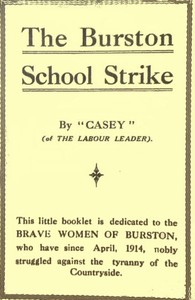
The Burston School Strike, published in 1915 by the National Labour Press, is a polemical pamphlet that documents a rural Norfolk conflict through a blend of political commentary and firsthand accounts. The author, writing under the pseudonym 'Casey,' frames the strike as a challenge to 'autocracy' and a warning to the teaching profession. The text is dedicated to 'the brave women of Burston' and opens with a preface quoting Charles Kingsley, signaling its intent to connect local events to broader struggles against injustice.
The pamphlet's structure alternates between narrative passages and reproduced children's essays, which offer unpolished glimpses into the strike's daily realities. These essays, with their misspellings and colloquial details, provide a counterpoint to the author's more rhetorical sections, grounding the conflict in the voices of the children themselves.
The Author's Voice and Rhetorical Strategy
Casey adopts a sardonic, indignant tone throughout, targeting the 'squire and the rector' as 'Lord High Tololorums of the countryside.' The preface explicitly states the pamphlet's purpose: to 'focus the clear white light of public opinion upon Burston.' The author does not feign neutrality; instead, the text is a deliberate piece of advocacy, aiming to expose what it calls 'the tyranny of our own country side.'
This rhetorical stance is reinforced by literary allusions and ironic asides. For instance, Casey invokes the 'Law Assyrian came down like a wolf on the fold' to describe legal actions against the strikers, and quips about 'hard wooden benches' after magistrates impose fines. The author also directly addresses the children, blaming them for not having 'rich parents'—a sarcastic jab at class privilege. These devices create a partisan, emotionally charged narrative that prioritizes persuasion over dispassionate reporting.
Children's Essays as Documentary Evidence
The pamphlet includes several essays written by striking schoolchildren, which Casey presents as evidence of the community's spirit. These texts are reproduced with their original spelling and grammar, preserving the children's voices. One essay describes 'bobies standing round' and 'Mrs. Boulton brought a pale of lemonade and nuts,' while another notes that 'we had three or four policemen to gaurd the school, but there was no need for them as we did not get to fighting.'
These passages reveal the strike's informal, communal nature: lessons were held on the Common, with teachers working 'as a labour of love' and receiving payment in eggs, milk, and 'Burston smiles.' The essays also document the children's awareness of the conflict, as when one mentions 'two Turncote blacklegs' who broke the strike. By including these unpolished accounts, Casey provides a rare bottom-up perspective on a labor dispute, though the selection and framing remain the author's own.
The Strike's Legal and Institutional Context
Casey details the legal proceedings against the striking parents, noting that thirty women were fined five shillings each after a single test case. The author criticizes the School Attendance Officer for failing to verify whether children were attending an alternative school, and highlights the National Union of Teachers' code of professional conduct, which forbade members from taking appointments where another had been 'unjustly dismissed.'
The pamphlet also references the rector's use of 'glebe notices' to evict tenants, portraying this as an attempt to 'remove the bravest and best' from the village. While the excerpts do not reveal the strike's outcome, they establish the key institutional adversaries: the Church, the local magistracy, and the Education Committee. Casey's framing aligns the strike with broader labor movements, comparing teachers' struggles to those of 'dock labourers, the miners, and cotton operatives.'
Readers should approach this pamphlet as a primary source that reflects a specific political moment and authorial agenda. The children's essays offer unfiltered material, but their selection serves Casey's argument. To understand the full context of the Burston School Strike, one would need to consult additional records, such as local newspaper accounts or official education board documents. This booklet remains valuable for its vivid portrayal of rural resistance and its demonstration of how early twentieth-century labor activists used print to mobilize public opinion.
Reading the 1915 pamphlet, I kept thinking how the villagers’ fierce, practical defense of their school wasn’t about abstract systems, but about the living shape of a community’s mind. That same quiet conviction, that education is less a curriculum than a kind of shared inhabitation, surfaced again in The Idea of a University Defined and Illustrated In Nine Discourses Delivered to the Catholics of Dublin — Reading Companion. A different century, yet the same warm insisting on integrity over mere instruction.
There are no reviews for this eBook.
How did this book work for you?
Your answers remain private and are stored only in this browser.
Robert Mark Anderson - 1 month ago
Michael Moreno - 2 weeks ago
Elizabeth Martinez - 1 week ago