1

A student's history of education — Inside the Classic
(0 User reviews)
1631
Project Gutenberg
2019
Not confirmed
Education -- History
Readers of public-domain and historical texts
Project Gutenberg digital edition
en
Edition facts
Words
129,099
Reading time
562 min
Text sections
18
The source record for A student's history of education — Inside the Classic measures this digital text at 129,099 words, 9 hr 22 min estimated reading time, and 18 detected text sections.
The text analysis averages about 19.7 words per sentence, while the detected sections provide another way to judge how the source is divided.
Project Gutenberg metadata also associates the work with “Education -- History,” connecting these edition facts with the source record’s subject description.
Source:
Project Gutenberg record #60113
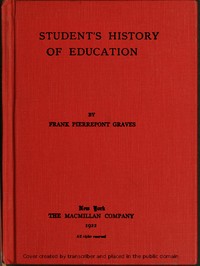
Graves's 1915 textbook traces educational history from primitive times to the early 20th century, emphasizing how past practices illuminate current school problems. The preface argues for a functional, teacher-focused approach, dismissing antiquarian detail. Excerpts show detailed institutional analysis, as in the account of S.P.G. charity schools in colonial America.
Editorial Edition Score
4.9/5
★★★★★
★★★★★
Calculated from edition completeness, EPUB availability, text structure and catalogue metadata. Not a user rating.
How this score is calculated
- Description quality20 pts
- Title & short description10 pts
- Source metadata20 pts
- Text length15 pts
- Chapters / structure15 pts
- EPUB file integrity20 pts
Total of 100 points, scaled to a 2.5-5.0 range. Editions with an empty description or a missing EPUB file are not scored.
Edition quality
Read the complete public-domain text at its original source.
Read on Project GutenbergGraves opens his preface with a direct challenge: the history of education must justify itself by serving the teacher's professional needs. He explicitly rejects antiquarian completeness, insisting that only records aiding analysis of present-day problems deserve inclusion. This functionalist stance shapes the entire work, as seen in the detailed case study of the Society for the Propagation of the Gospel's charity schools in colonial New York. Graves traces the 1709 founding under William Huddleston, the gradual addition of free clothing, and the school's eventual transformation into Trinity Church School. He notes attendance ranged from eighteen to nearly eighty pupils, with girls often equaling or exceeding boys, and dissenters sometimes comprising half the enrollment—though sectarian tensions could drive them away.
A Functionalist Preface
Graves's preface is a compact manifesto. He writes that the subject must “disrupt the teacher’s complacent acceptance of the present” and enable reconstruction of ideas in light of historical conditions. This is not a neutral survey; it is a deliberate argument for relevance. He admits his own reluctance to curtail classical disciplines, but concludes that the functional approach is “necessary and wise.” The preface thus frames the entire text as a tool for professional reflection, not a repository of facts.
The tone is direct and slightly defensive, as if anticipating critics. Graves uses phrases like “frankly dismissed from discussion” to underscore his selectivity. This opening establishes a clear authorial voice: pragmatic, self-aware, and focused on utility over erudition.
Institutional Detail in Colonial Charity Schools
The excerpt on S.P.G. schools exemplifies Graves's method. He provides specific numbers: the first school opened in New York City in 1709; attendance ranged from 18 to nearly 80; girls were “generally admitted” and sometimes outnumbered boys. He lists the books supplied by the society—horn-books, primers, spellers, catechisms, psalters, prayer books, testaments, bibles—and notes that secondary instruction occurred “intermittently” alongside elementary work.
Graves also records opposition: dissenters and Quakers feared an established church, and after 1750 hostility grew as the society was seen as supporting the king. Yet he concludes that the S.P.G. “stood first and foremost for the extension of religion and education to the virgin soil of America” and likely influenced universal education. The passage balances institutional detail with interpretive caution, never claiming more than the records support.
Pace and Selectivity Across Eras
Graves covers millennia in a single volume, but his pace is uneven. The preface and colonial section are dense with specific dates, names, and statistics, while earlier periods are treated more summarily. This reflects his functionalist principle: he lingers where the past directly illuminates present practice. The colonial charity school, with its sectarian tensions and gradual expansion, is a case study in how institutional forms evolve.
The text's rhythm shifts between brisk narrative and patient exposition. Graves often pauses to explain the significance of a detail—for instance, noting that free clothing was added only later to the New York school. These micro-analyses give the work a pedagogical texture, as if the author is modeling the very analysis he hopes teachers will adopt.
Graves's history rewards readers who approach it as he intended: not as a chronicle but as a mirror for current practice. The colonial section, with its attention to enrollment, curriculum, and opposition, offers a template for examining any educational institution. Readers may find it useful to compare Graves's functionalist lens with other historical surveys, noting what he includes and what he dismisses. The text is a period piece in its assumptions, but its method remains provocative.
There’s something gentle about Graves’s hope that old classrooms speak to our own, and I kept thinking of that while rereading Special Method in the Reading of Complete English Classics In the Grades of the Common School — Text and Context. It feels less like instruction and more like a quiet nod across a century, two teachers sharing the same patient wonder at what children carry from a page.
There are no reviews for this eBook.
There are no comments for this eBook.
Reader reflection
Your personal reading reflection
Build a private reading journal entry for this title.
Your progress
0
/
10
2
How much did you enjoy the reading experience?
3
Would you pass this book on to a friend?
4
Did the language feel accessible?
5
Could you follow the author’s main argument?
6
How closely did the book connect with your experience?
7
Did you gain anything practical from the text?
8
Would you read this book again?
9
What is the main idea you are taking away?
10