1

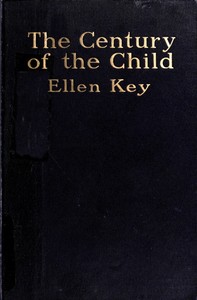
The Century of the Child — Reading Notes
669
10
Project Gutenberg
2018
Education; Child rearing; Parent and child
Readers of public-domain and historical texts
Project Gutenberg digital edition
en
Edition facts
Words: 73,158
Reading time: 319 min
Text sections: 7
Source:
Project Gutenberg record #57283
Ellen Key's 1909 treatise argues that societal transformation must begin with the 'holiness of generation,' critiquing modern parenting, schooling, and the erosion of home life through recurring imagery of homelessness and the child as a symbol of renewal.
Editorial Edition Score
4.7/5
★★★★★
★★★★★
Calculated from edition completeness, EPUB availability, text structure and catalogue metadata. Not a user rating.
Edition quality
Ellen Key opens The Century of the Child with a striking image: the new century as a naked child recoiling from a world bristling with weapons. This metaphor sets the tone for a work that repeatedly uses the child as a measure of societal health. Key structures her argument around the conviction that human nature must be transformed through a new consciousness of the 'holiness of generation.' The book moves from the right of children to choose their parents, through critiques of schooling and child labor, to visions of future education. Throughout, she contrasts the ideal of a nurturing home with the reality of intellectual homelessness, a recurring motif that ties together her observations on family, school, and society.
The Child as a Symbol of Renewal
Key's opening chapter establishes the child as both a literal being and a symbol of potential renewal. She describes the turn of the century as a moment filled with 'sad memories or eager hopes,' and the child descending in terror represents the failure of the previous century to create a peaceful world. This image recurs implicitly throughout the book: the child is the site where transformation must begin. Key argues that 'nothing will be different in the mass except in so far as human nature itself is transformed,' and that this transformation hinges on how society treats its youngest members. The child is not merely a passive recipient of education but the central figure around which 'all morals, all laws, all social arrangements will be grouped.' This symbolic weight gives the book its driving force, as Key repeatedly returns to the gap between the ideal of childhood as a sacred period and the reality of neglect and mismanagement.
The Architecture of Home and Homelessness
A striking structural feature of Key's argument is her use of spatial imagery to diagnose social ills. She devotes an entire chapter to 'Homelessness,' where she describes how children and parents become 'as mutually dependent as the roots and flowers of plants, so often separate with mutual repulsion.' The home, which should be a place of rhythm and festivity, is instead a site of irritation and boredom. Key contrasts the 'artists of home life'—often simple, unexamined mothers—with highly cultivated mothers whose 'well-thought-out plans' fail. The school, clubs, and outside pleasures accustom youth to 'outside life,' killing the 'true feeling for holiday.' This movement between inside and outside, between the ideal home and the actual one, structures Key's critique: she repeatedly shows how institutions encroach on domestic space, leaving children intellectually homeless even within their own families.
The Mother as Artist or Architect
Key's treatment of motherhood is notably ambivalent. She praises the 'unselfish mother' who allows a child to grow according to his own laws, but she also catalogues maternal failures with sharp specificity. Mothers who 'spend the whole day in keeping their children's nervous system in a state of irritation' or who treat children as 'clay that she desired to mould' are condemned. Key quotes a son's bitter exclamation: 'even a mother must know how she tortures another; if she has not this capacity by nature, why in the world should I recognise her as my mother at all.' This direct speech, drawn from a book Key references, gives her argument an emotional edge. She distinguishes between the 'artist of home life'—who makes 'the rhythm of everyday life a dance'—and the methodical, educated mother whose very expertise becomes a form of stupidity. The mother figure thus oscillates between ideal and failure, a tension that Key uses to argue for a new kind of maternal consciousness rooted in selflessness rather than control.
The School as a Displacing Force
Key devotes several chapters to schooling, but her critique is less about curriculum than about the school's role in displacing the home. She writes that 'the school, not father and mother, teaches children to play, the school gives them manual training, the school teaches them to sing, to look at pictures, to read aloud.' This enumeration underscores a loss: the home no longer moulds the child's soul life. Parents surrender their children to schools during the years when they should be influencing their minds, and when the school returns them, parents 'do not know how to make a fresh start.' Key's recurring image of 'soul murder in the schools' suggests a violence done to the child's inner life. The school of the future, which she sketches, would be radically different—but the excerpts provide only hints of that vision. What remains clear is that Key sees the school as a symptom of a broader societal failure to prioritize the child's holistic development over institutional efficiency.
Readers approaching The Century of the Child should attend to its movement between the intimate and the institutional. Key's arguments gain force from her concrete observations of family life—the mother who irritates, the child who feels homeless—rather than from abstract theory. The book's structure, with its repeated returns to the home as both problem and solution, rewards careful attention to its imagery of space and movement. While Key's proposals for reform are only partially visible in these excerpts, her diagnosis of the gap between ideal and reality remains pointed.
Reader reflection
What did you think of this book?
Answer a few questions and save a private reflection on this device.
Your progress
0
/
10
2
What was your overall reaction to the book?
3
Would you recommend this book to another reader?
4
How easy was the book to follow?
5
Which element worked best for you?
6
Did the book give you something worth debating?
7
Did any part of the book stay with you emotionally?
8
Did you relate to its people, ideas, or situations?
9
What is the main idea you are taking away?
10