1

The Burston School Strike — Themes and Context
59
11
Project Gutenberg
2020
Higdon, Thomas George; Higdon, Annie K.; Burston Strike School -- History
Readers of public-domain and historical texts
Project Gutenberg digital edition
en
Edition facts
Words: 10,476
Reading time: 46 min
Text sections: 2
Source:
Project Gutenberg record #61938
A 1915 pamphlet by 'Casey' documenting the Burston School Strike in Norfolk, where villagers defied the rector and authorities for fifteen months. The text combines polemical commentary with excerpts of children's essays, revealing the strike's grassroots character and the author's advocacy for teacher unionization.
Editorial Edition Score
4.4/5
★★★★★
★★★★★
Calculated from edition completeness, EPUB availability, text structure and catalogue metadata. Not a user rating.
Edition quality
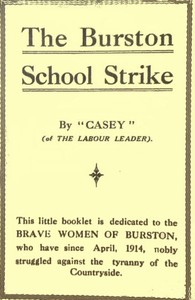
The Burston School Strike, published in 1915 by the National Labour Press, is a polemical pamphlet that documents a rural Norfolk conflict through a blend of political commentary and firsthand accounts. The author, writing under the pseudonym 'Casey,' frames the strike as a challenge to 'autocracy' and a warning to the teaching profession. The text is dedicated to 'the brave women of Burston' and opens with a preface quoting Charles Kingsley, signaling its intent to connect local events to broader struggles against injustice.
The pamphlet's structure alternates between narrative passages and reproduced children's essays, which offer unpolished glimpses into the strike's daily realities. These essays, with their misspellings and colloquial details, provide a counterpoint to the author's more rhetorical sections, grounding the conflict in the voices of the children themselves.
The Author's Voice and Rhetorical Strategy
Casey adopts a sardonic, indignant tone throughout, targeting the 'squire and the rector' as 'Lord High Tololorums of the countryside.' The preface explicitly states the pamphlet's purpose: to 'focus the clear white light of public opinion upon Burston.' The author does not feign neutrality; instead, the text is a deliberate piece of advocacy, aiming to expose what it calls 'the tyranny of our own country side.'
This rhetorical stance is reinforced by literary allusions and ironic asides. For instance, Casey invokes the 'Law Assyrian came down like a wolf on the fold' to describe legal actions against the strikers, and quips about 'hard wooden benches' after magistrates impose fines. The author also directly addresses the children, blaming them for not having 'rich parents'—a sarcastic jab at class privilege. These devices create a partisan, emotionally charged narrative that prioritizes persuasion over dispassionate reporting.
Children's Essays as Documentary Evidence
The pamphlet includes several essays written by striking schoolchildren, which Casey presents as evidence of the community's spirit. These texts are reproduced with their original spelling and grammar, preserving the children's voices. One essay describes 'bobies standing round' and 'Mrs. Boulton brought a pale of lemonade and nuts,' while another notes that 'we had three or four policemen to gaurd the school, but there was no need for them as we did not get to fighting.'
These passages reveal the strike's informal, communal nature: lessons were held on the Common, with teachers working 'as a labour of love' and receiving payment in eggs, milk, and 'Burston smiles.' The essays also document the children's awareness of the conflict, as when one mentions 'two Turncote blacklegs' who broke the strike. By including these unpolished accounts, Casey provides a rare bottom-up perspective on a labor dispute, though the selection and framing remain the author's own.
The Strike's Legal and Institutional Context
Casey details the legal proceedings against the striking parents, noting that thirty women were fined five shillings each after a single test case. The author criticizes the School Attendance Officer for failing to verify whether children were attending an alternative school, and highlights the National Union of Teachers' code of professional conduct, which forbade members from taking appointments where another had been 'unjustly dismissed.'
The pamphlet also references the rector's use of 'glebe notices' to evict tenants, portraying this as an attempt to 'remove the bravest and best' from the village. While the excerpts do not reveal the strike's outcome, they establish the key institutional adversaries: the Church, the local magistracy, and the Education Committee. Casey's framing aligns the strike with broader labor movements, comparing teachers' struggles to those of 'dock labourers, the miners, and cotton operatives.'
Readers should approach this pamphlet as a primary source that reflects a specific political moment and authorial agenda. The children's essays offer unfiltered material, but their selection serves Casey's argument. To understand the full context of the Burston School Strike, one would need to consult additional records, such as local newspaper accounts or official education board documents. This booklet remains valuable for its vivid portrayal of rural resistance and its demonstration of how early twentieth-century labor activists used print to mobilize public opinion.
Reader reflection
How did this book work for you?
Your answers remain private and are stored only in this browser.
Your progress
0
/
10
2
What was your overall reaction to the book?
3
Would you recommend this book to another reader?
4
How demanding did the text feel?
5
How did the pace of the book feel?
6
Would you start a conversation about this book?
7
What was the strongest part of the book?
8
How strong was your personal connection to the text?
9
What did this book teach you most?
10