1

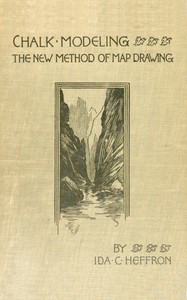
Lessons in chalk modeling: The new method of map drawing — Text and Context
2086
10
Project Gutenberg
2022
Geography -- Study and teaching; Map drawing
Readers of public-domain and historical texts
Project Gutenberg digital edition
en
Edition facts
Words: 25,835
Reading time: 113 min
Text sections: 25
Source:
Project Gutenberg record #69493
Ida Cassa Heffron's 1900 manual for teachers combines chalk modeling, map drawing, and geography instruction. The text emphasizes mental imaging, structural analysis, and sequential expression, with detailed lessons on landforms, erosion, and climate zones.
Editorial Edition Score
4.8/5
★★★★★
★★★★★
Calculated from edition completeness, EPUB availability, text structure and catalogue metadata. Not a user rating.
Edition quality
Ida Cassa Heffron's manual repeatedly insists that a clear mental image must precede any attempt at drawing. In the preface she states that with 'a clear mental image of surface forms and areas, the expression of the same will be a simple and easy matter.' This emphasis on visualization before execution shapes the entire instructional method. The book is structured as a series of progressive lessons, moving from simple surfaces to complex continental maps, each step reinforcing the habit of careful observation and deliberate expression.
Heffron's voice is direct and teacherly, often addressing the instructor directly: 'Take the children into your confidence.' She warns against corrections during sketching, which destroy the 'pleasing quality which marks a sketch as “artistic.”' The text is accompanied by numerous illustrations, though the excerpts provide only their captions and descriptions.
The Sequence of Seeing and Drawing
Heffron's lessons follow a deliberate progression from simple to complex. Part I establishes the necessity of structural geography and field lessons, while Part II offers fifteen specific modeling exercises. The first lessons focus on representing surfaces with light and shade, then move to water-partings, lakes, and erosion sketches. Later lessons apply these skills to continents: North America, South America, Eurasia, Africa, and Australia.
This structure mirrors her pedagogical principle: knowledge must be 'arranged in orderly sequence, so logical and clearly defined, that we shall not be obliged to go back and modify or correct any part of our expression.' The sequence itself becomes a teaching tool, building skills incrementally.
Notably, the book includes a lesson on mapping a section of the United States for use in 'preparatory lessons on the Civil War,' suggesting an interdisciplinary application of the mapping method.
Voice and the Teacher's Role
Heffron's prose is consistently instructive and personal. She uses the second person to address the teacher, as in 'Take the children into your confidence.' This direct address creates a sense of shared endeavor. She also reflects on the process of learning to draw: 'When we try to express our knowledge of a subject by drawing, we are often greatly surprised to find how little we know of it.'
The text balances technical instruction with encouragement. Heffron acknowledges that repeated attempts are necessary for progress, and she frames mistakes as opportunities for closer study. Her tone is patient but firm, emphasizing the importance of accurate study before expression.
The excerpts show that she values both observation and imagination. In one lesson, she instructs the reader to draw from an 'imaginary picture' and to 'clear it up, classify its component parts into primary and secondary.' This blend of empirical observation and mental construction is central to her method.
Pace and Density of Instruction
The book's pace varies between dense theoretical passages and concrete, example-driven lessons. The introduction and preface are compact, laying out the rationale in a few pages. The lessons themselves are more varied: some are brief, like Lesson I on surfaces, while others, such as Lesson VI on climate zones, include multiple illustrations and detailed descriptions.
Heffron often clusters related concepts. For instance, in Lesson IV she covers 'Meeting of Land and Water. Lakes. Springs. Islands. High and Low Tide' in a single lesson. This rapid coverage assumes a teacher who can unpack each topic with students. The later continent lessons are more expansive, with North America receiving two lessons (VIII and IX) and Eurasia one with 'Sections in Detail.'
The illustrations are integral to the instruction. The excerpts reference figures showing erosion, rock formations, and scenes from Siberia, the Sahara, and the Amazon. These images serve as both examples and prompts for student observation.
Heffron's manual is best read as a practical companion for teachers, not a theoretical treatise. The lessons assume access to chalk, a blackboard, and the ability to sketch. Readers should approach the book with a willingness to practice the exercises sequentially, as the author intends. The illustrations, though not reproduced in full here, are essential to understanding the method. For modern educators, the book offers a window into early 20th-century progressive pedagogy, where geography, art, and mental discipline converged.
Reader reflection
Your personal reading reflection
Build a private reading journal entry for this title.
Your progress
0
/
10
2
Did this book hold your interest?
3
Would you pass this book on to a friend?
4
How much effort did this book require?
5
What was the strongest part of the book?
6
Would you start a conversation about this book?
7
How strongly did the book affect you emotionally?
8
Was the book what you thought it would be?
9
Which lesson or insight stayed with you?
10