1

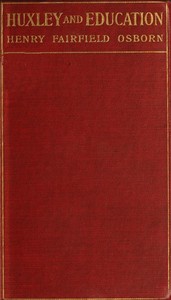
Huxley and education Address at the Opening of the College Year, Columbia University, September 28, 1910 — Edition Insights
737
7
Project Gutenberg
2015
Education; Huxley, Thomas Henry, 1825-1895
Readers of public-domain and historical texts
Project Gutenberg digital edition
en
Edition facts
Words: 8,719
Reading time: 38 min
Text sections: 1
Source:
Project Gutenberg record #50338
Henry Fairfield Osborn's 1910 address at Columbia University channels Thomas Henry Huxley's educational philosophy, blending personal reminiscence with a call for 'centrifugal' teaching that prioritizes student-led discovery and productive expression over passive reception.
Osborn opens his address by invoking the memory of his former teacher, Thomas Henry Huxley, whom he heard lecture during the winter of 1879–80. He proposes to speak for Huxley, drawing on the essays in Science and Education and on his own thirty-seven years of experience as student and teacher. The address is framed as a direct appeal to students at the start of the academic year, a moment Osborn describes as “the most sanguine day of the college year,” when hope outruns the impossible task of mastering modern knowledge.
The text is not a systematic treatise but a personal, anecdotal argument. Osborn recounts his own “early flounderings and blunderings” in seeking the true method of education, and he uses Huxley’s example—his life and tone rather than his precepts—as a guiding light. The address thus blends memoir, homage, and pedagogical manifesto.
The Centrifugal Teacher vs. the Expert on the Bank
Osborn contrasts two types of teachers. One he compares to “expert swimmers who sit on the bank and talk inspiringly on analyses of strokes.” The other, the “centrifugal teacher,” takes pupils into the water, even pretending to drown to provoke a rescue. This metaphor extends into a practical method: Osborn describes getting out of the lecture chair and making students lecture to him, a technique he links to the Socratic principle and to Langdell’s method of teaching law. The result, he claims, is a “real intellectual struggle for existence” in the classroom, mirroring the world of affairs.
The passage reveals Osborn’s conviction that education must be active, not passive. He values “productive power, centrifugal force, original, creative, individual efficiency” above the mere reception of facts. This is not a theoretical ideal but a practice he has tried “with marked success.” The language is concrete, even athletic: the coach must “get into the scrimmage with the team.”
Self-Education Through Blundering and the Bare Bones of Existence
Osborn dwells on his own educational missteps. In 1877, he recalls, few men knew how to guide graduate youth; the Johns Hopkins was still nascent, and Agassiz’s influence had waned. With two companions, he followed “a sort of blind instinct” to make a discovery. He quotes Huxley’s observation about the “Voyage of the Rattlesnake”—that it is good to get down to “the bare bones of existence”—and applies it to self-education. The implication is that error and difficulty are not obstacles but essential components of genuine learning.
This section grounds Osborn’s argument in autobiography. He does not claim that his path is the only one, but he uses his own “flounderings” to illustrate a principle: that education must be shaped by the learner’s own needs and experience. The reference to Huxley’s voyage is not decorative; it ties Osborn’s personal story to a scientific explorer’s ethos of direct encounter with reality.
Production as the Goal Across Millennia
Osborn extends his argument across human history. He points to the wall painters of the Magdalenian caves as “the producers and hence the educated men of their day,” and he traces the same productive impulse back to Eolithic men 200,000 years ago and forward to the inventors of dirigible balloons and aeroplanes. The standard of a liberal mind, he asserts, has always been the same: “the sense of Truth and Beauty,” which are in conformity with Nature. He quotes Keats’s “Ode on a Grecian Urn” to seal the point.
This sweeping historical frame is not mere ornament. It serves Osborn’s central claim that education’s secret lies not in subject or language but in preparation for a “living productive principle.” The examples are specific and deliberately anachronistic—Palaeolithic toolmakers and modern aviators are placed on the same continuum. The effect is to make his pedagogical argument feel universal, rooted in the longue durée of human culture.
Osborn’s address is best read as a period piece that reveals how one prominent scientist-educator adapted Huxley’s legacy for an American research university in 1910. The catalog subject “Teaching Methods” accurately describes its content, but the excerpts show that Osborn’s method is less a system than a set of vivid metaphors and personal anecdotes. Readers interested in the history of progressive education, the reception of Huxley in the United States, or the rhetoric of early twentieth-century academic addresses will find this text a compact primary source. The full speech likely contains additional examples and arguments not captured in these excerpts.
Reader reflection
Your personal reading reflection
Build a private reading journal entry for this title.
Your progress
0
/
10
2
Was reading this book enjoyable?
3
How likely are you to recommend this book?
4
How much effort did this book require?
5
Did the book offer a fresh perspective?
6
How clear did the writing feel?
7
What was the strongest part of the book?
8
What was its emotional impact?
9
Which lesson or insight stayed with you?
10