The high school course in English — Key Ideas to Explore
Edition facts
The catalog record for The high school course in English — Key Ideas to Explore provides practical reading context through 22,712 words, 1 hr 39 min estimated reading time, and 16 detected text sections.
The text analysis averages about 20.5 words per sentence, while the detected sections provide another way to judge how the source is divided.
Project Gutenberg metadata also associates the work with “English language -- Study and teaching (Secondary),” connecting these edition facts with the source record’s subject description.
Calculated from edition completeness, EPUB availability, text structure and catalogue metadata. Not a user rating.
How this score is calculated
- Description quality20 pts
- Title & short description10 pts
- Source metadata20 pts
- Text length15 pts
- Chapters / structure15 pts
- EPUB file integrity20 pts
Total of 100 points, scaled to a 2.5-5.0 range. Editions with an empty description or a missing EPUB file are not scored.
Read the Text
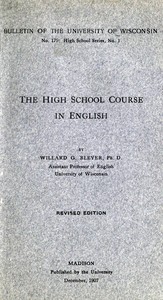
1. THE HIGH SCHOOL COURSE IN ENGLISH, by Willard G. Bleyer, Ph. D., Assistant Professor of English. 1906. 1907.
2. THE HIGH SCHOOL COURSE IN GERMAN, by M. Blakemore Evans, Ph. D., Assistant Professor of German. 1907.
3. REPORT ON THE ENTRANCE EXAMINATION IN ENGLISH COMPOSITION, by Willard G. Bleyer, Ph. D., Assistant Professor of English. [_In Preparation._]
4. THE HIGH SCHOOL COURSE IN MATHEMATICS, by Ernest B. Skinner, Ph. D., Assistant Professor of Mathematics. [_In Preparation._]
5. THE HIGH SCHOOL COURSE IN LATIN, by a committee of the Wisconsin Latin Teachers Association. [_In Preparation._]
6. THE HIGH SCHOOL COURSE IN FRENCH, by Hugh A. Smith, M. A., Professor of Romance Languages. [_In Preparation._]
Issued bi-monthly, and entered at the postoffice, at Madison, as second-class matter.
THE HIGH SCHOOL COURSE IN ENGLISH
BY WILLARD G. BLEYER, Ph. D. Assistant Professor of English University of Wisconsin
UNIVERSITY OF WISCONSIN MADISON 1907
I. PURPOSE OF THE COURSE 7
II. ORGANIZATION OF ENGLISH WORK 9 1. Length of Course 9 2. Plan of Course 10 3. Arrangement of Classes 11 4. Conferences of Teachers 12
III. COMPOSITION 13 1. Theme Writing 13 2. Correction of Themes 17 3. Filing of Themes 19 4. Conferences on Written Work 20 5. Oral Composition 20 6. Principles of Composition 21 7. Use of Text-book 22
IV. READING 23 1. Methods of Teaching 23 2. Reading Aloud 27 3. Choice of Reading 28 4. Library Reading 29
V. FIRST YEAR ENGLISH 30 1. Composition 31 2. Grammar 32 3. Rhetorical Principles 33 4. Theme writing 34 5. Reading 35
VI. SECOND YEAR ENGLISH 37 1. Composition 37 2. Reading 39
VII. THIRD YEAR ENGLISH 40 1. Reading and History of Literature 40 2. Composition 41
VIII. FOURTH YEAR ENGLISH 42 1. Reading 42 2. The Novel 42 3. The Drama 43 4. The Lyric 43 5. The Essay 44 6. Library Reading 44 7. Composition 45 8. Writing of Verse 46
IX. OUTLINE OF HIGH SCHOOL COURSE IN ENGLISH 47
X. LIST OF READINGS FOR FOUR YEARS 50
XI. OUTLINE FOR THE STUDY OF COMPOSITION AND STYLE 53 1. Whole Composition 53 2. Paragraphs 55 3. Sentences 57 4. Words 60 5. Figures of Speech 60 6. Qualities of Style 62 7. Forms of Discourse 62
XII. BIBLIOGRAPHY 65 1. The Teaching of English 65 2. Literature 66 3. Language and Grammar 68 4. Rhetoric and Composition 68
This bulletin has been prepared with the purpose of offering some practical suggestions in regard to the organization of the high school course in English and to the methods of teaching English. As it is designed for the principals and teachers of Wisconsin schools, the plan and methods conform to the courses of study and conditions required of free high schools in this state. The aim has not been to discuss theories or to offer novel solutions for the problems of teaching, but rather to present ways and means of accomplishing the generally accepted purposes of the study of English in secondary schools. All the methods and plans suggested have been shown by experience to be practical, and are adapted to present conditions in both large and small high schools.
While the plan of the work has been made as flexible as possible in order to adapt it to different schools, it has seemed desirable to indicate definitely how all of the details of the course should be organized and what methods should be used to bring about the required results. The object has been to consider the purpose of each part of the English work, and to show as specifically as possible what must be done and to some extent how it must be done to accomplish this purpose. By having a definite aim for each year’s work and by seeing clearly what is to be accomplished in each part of the subject, the teacher of English feels responsible for the successful completion of a specific part of the course. At the same time the originality and ability of the teacher need not be hampered by a definite plan but may be exercised in adapting the work to different conditions in different schools and classes.
In discussing the course in English, the general aim and methods in teaching the important elements, composition and reading, are taken up first, and then the particular phases of each subject to be presented in each year, are considered. What is presented under the general topics, reading and composition, therefore, applies to the work of each year unless otherwise stated, and usually is not repeated in considering each year of the course.
A second edition of this bulletin has made possible some revision. No essential changes have been made, but considerable new material has been added. Some parts have been developed at greater length in order to explain the methods more fully. The most important addition is the outline for the study of composition and style, which has been included for those teachers who desire to review the various phases of rhetorical theory in preparation for teaching composition or reading. The bibliography has been extended to include a number of standard reference books on various phases of the English work. The books have been selected on the basis of their practical value to the teacher in the work actually required in the high school course in English, and of the possibility of assisting the teacher to build up for himself, at reasonable cost, a good working library. In order to accomplish the latter purpose the less expensive reference books have, as far as possible, been chosen, and the price and the publisher of each have been given.
I PURPOSE OF THE COURSE
The main objects of the teaching of English as presented in the Report of the Committee of Ten[1], are (1) “to enable the pupil to understand the expressed thoughts of others;” (2) to enable him “to give expression to thoughts of his own;” (3) “to cultivate a taste for reading, to give the pupil some acquaintance with good literature, and to furnish him the means of extending that acquaintance.” Other subsidiary objects may be accomplished by the study of English, the Report points out, but these should never be permitted to encroach upon the main purposes. While these purposes are considered separately, and are apparently separated in arranging the course of study, the Report continues, their mutual dependence must constantly be kept in mind. By studying the thoughts of others as expressed in the literature read in or out of the class room, the pupil can be led to see how to express his own thoughts more effectively. All reading of good literature should tend to cultivate a taste for reading, and all study of good literature should lead to a better appreciation of what is best in expression. The survey of the history of English and American literature accompanied by the reading and study of characteristic selections of every period, will open up to the pupil the whole field of literature in English and will furnish him the means of judging intelligently of what he reads. This interdependence of the main purposes of the study of English requires the closest correlation of every phase of the English work.
Report of Committee on Secondary School Studies, p. 86.
Since the English work is divided into two principal parts, reading and composition, it may be well to consider briefly the purpose of each in relation to the main objects just considered.
The first object of the work in reading must always be to have the pupil understand the thought expressed on the printed page. However thorough has been his training in the grades, the average pupil on entering high school needs to be taught how to read. Generally he gets but a hazy, general idea from reading a paragraph, either because he fails to grasp the meaning of each sentence, or because he does not combine the sentence-thoughts in their relation to the topic. The aim of the reading must be to enable the pupil to understand each idea as it is presented, to combine these ideas to get the thought of the sentence, and to follow the chain of thought from sentence to sentence until he grasps the meaning of the paragraph, essay, story, or poem, as a whole. As rapidly as the maturity of the pupil permits, other elements that aid in the better understanding of a piece of literature may be considered in connection with the reading. The study of the structure, the form, the author’s purpose, his style, the revelation of the author’s personality, the relation of the piece of literature to the age in which it was written, and a comparison with other pieces of the same type, all give a clearer understanding of literature. The other purpose of the reading is to stimulate the pupils’ interest in good literature, and to lead them to read what is worth while, on their own initiative. If interest is aroused by the reading and study in class, of one work of an author, it is easy to create a desire to read other works by the same author, outside of the class room. By suggestions and advice the teacher can do much toward directing the pupils in their outside reading. To lead pupils to read, understand, and appreciate the best of English literature is certainly an aim that is worth striving to accomplish.
To enable the pupil to give clear and effective expression to his own thoughts, is the end and aim of the other important part of the English work—composition. That composition is the expression of his own thoughts is the first principle that must constantly be impressed upon the pupils’ minds. The misconception that the only ideas worth expressing in writing themes are those derived from books, must be corrected at once. While reproductions and paraphrases of the expressed thoughts of others may sometimes be used as exercises, the fact must be made clear to the pupils that these are not original compositions, in as much as they are not the expression of their own ideas.
The relation of clear thinking to clear expression is another factor to be considered in teaching composition. Much of the instruction in theme writing is really concerned with training the pupils to think logically and to arrange their thoughts in an orderly manner. Pupils must be taught that as they can give clear expression only to those thoughts that are clear in their own minds, the first process in theme writing is the clarifying and arranging of their ideas. The mental training given by such systematic preparation for theme writing as the making of outlines or other devices for grouping thoughts in a logical plan, is invaluable, since, unlike that given by other studies, it is concerned largely with the pupil’s own thoughts rather than with those acquired from books.
The third important element in composition is the style or form of expression. The first aim of teaching composition, whether written or oral, must be to give the pupils sufficient command of simple, idiomatic English for the needs of everyday life. If the average pupil can be taught to express his ideas in clear, correct English, much will have been accomplished by the four years’ training. Those pupils who show natural ability in expression can be encouraged to develop their talent for writing or speaking in connection with class work or with the various outside activities of the school, and may be given considerable assistance in their efforts by the teacher of English. It is much more important, however, to enable the majority of high school pupils to express themselves simply, naturally, and correctly, than to attempt to develop literary style where there is little natural ability.
II ORGANIZATION OF ENGLISH WORK
All high schools provide four years of instruction in English, and most of the schools devote five periods a week to the subject in each year. The course of study outlined in this bulletin, therefore, is arranged on the basis of five periods a week for four years. The successful completion of at least two years’ work in English, one-half of which shall be devoted to composition and rhetoric, and one-half to the study of English classics, is required of all students for graduation from Wisconsin high schools, and for entrance to the University of Wisconsin. The first two years of English are always required of all high school pupils whether they pursue an elective or a prescribed course of study. In some high schools four years’ study of English is required of all pupils, and in most of the Wisconsin high schools the curriculum provides for three years of English in all courses. When the course of study is partly elective, pupils are usually advised to continue with a third and often a fourth year of English after completing the two years of required work. Thus practically all high school pupils pursue the course in English for at least three years.
Whether pupils who study English for three years take up the work in the third or the fourth year of their course, is generally determined by the arrangement of the other subjects in the curriculum. When a choice may be made by either third or fourth year pupils between third and fourth year English, the principal and teacher of English can often decide for the pupil, basing their decision in each case upon what they know of the pupil and his plans. For some pupils the survey of English and American literature in the third year will be most valuable since it furnishes them the means of extending their acquaintance with literature by independent reading. Other pupils will doubtless derive more benefit from the intensive study of a few classics outlined for the fourth year.
The arrangement of the several phases of the English work in the course, and the amount of time that is to be devoted to each is as follows[2]:
For a complete outline of the course see p. 47.
First year—5 periods a week; one-half of the time to be given to composition, and one-half to the reading and study of literature.
Second year—5 periods a week; one-half of the time to be given to composition, and one-half to the reading and study of literature.
Third year—5 periods a week; from one-tenth to one-fifth of the time to be given to the history of English literature during the first three-quarters of the year and to the history of American literature during the last quarter of the year; four-fifths of the time to be devoted to the study of the works of representative authors in each period of the history of English and American literature; and from one-tenth to one-fifth of the time to be given to composition.
Fourth year—5 periods a week; four-fifths of the time to be devoted to the study of typical examples of each of the following forms of literature: the novel, the drama, the lyric, and the essay; one-fifth of the time to be given to composition.
The reading and study of literature in class in each year is to be supplemented by library reading of literature, the amount of which will be determined by library facilities and other local conditions.
3. Arrangement of Classes
If the English work is being taught by several teachers, the distribution of classes among the teachers deserves careful consideration. No English work should be entrusted to a teacher who is not interested in the subject and who is not adequately prepared to teach it. It is particularly important that the first year classes should be in charge of the best teachers of English that the school has in its corps. The not infrequent practice of having the thoroughly prepared and experienced teachers take charge of third and fourth year English, and of assigning the first year classes to the young and inexperienced English teacher, or even to teachers of other subjects who have little or no interest in the work and who are compelled to take classes in first year English because their time is not completely occupied by their own subjects, generally proves extremely unsatisfactory. If the pupils in the high schools are to have the right attitude toward the study of English, and are to begin the subject in the right way, the best teachers must be provided for the first year work, since much of the success of the whole high school course in English depends upon the manner in which the introductory work is taught.
The number of classes in English to be assigned to the teacher and the size of these classes must also be considered. The teaching of English requires an unusual amount of work outside of class. First, the preparation for each day’s teaching whether the work is in composition or reading demands much time and energy if it is to be done as it should be. Second, the correction of themes is a daily task that must be done carefully and accurately and that requires the best effort of the teacher when his mind is most keen and active. Third, personal conferences with each pupil on his written work are now generally conceded to be essential for successful training in writing. All these elements must be considered in arranging the programme of classes for teachers of English. Teachers cannot do satisfactory work if they must prepare for five or six classes a day, teach these classes, correct twenty-five or thirty themes daily, and hold conferences with pupils before and after school. The teaching of many classes exhausts the energy of the teacher and makes accurate correction after school or in the evening, as well as the careful preparation for the next day’s classes, extremely difficult if not impossible. Conferences on written work should be provided for in the regular programme and should not interfere with the teacher’s other duties before and after school. Four classes a day, two periods daily for conference with pupils, and not more than a hundred pupils in all classes, a number which requires the correction of one hundred themes a week, is an arrangement of work that makes possible effective teaching.
4. Conference of Teachers
To give unity to the four years’ work in English, it is essential that all the teachers of English in each high school meet at frequent intervals to discuss organization, methods, and progress of the work. Each teacher will thus familiarize himself with the English work of the whole school, and can do his particular part of it more intelligently and more effectively. As the success of high school English also depends in no small degree upon the character of the instruction which the pupils have received in the grades, and particularly in the seventh and eighth grades, it will be found very profitable to have similar conferences occasionally between the seventh and eighth grade teachers and the high school teachers of English. A closer relation ought to exist between the English work of the last two grades and the high school, and there seems to be no better way to accomplish this than to bring about cooperation between the teachers through the medium of these conferences. The benefit to the teachers and the great advantage that results to the English work of the school repay many fold the time and effort devoted to these conferences. If local conditions make these meetings of grade and high school teachers impracticable, the high school teacher of English should make every effort to familiarize himself with the amount and character of the training which the pupils have had before entering the high school, by visiting the schools and conferring with the teachers in the seventh and eighth grades. The knowledge thus acquired of the earlier training of the pupils will be of great service to the high school teacher in planning his work both in reading and composition.
The ability to write clearly and accurately can generally be acquired only by practice. If this practice is to be really effective it can not be confined to one semester or one year, but must extend through the whole course in English. Training in composition naturally includes a study of the principles of the art; and since these principles are of different degrees of difficulty, all can not be presented in one year, but must be developed from year to year as the ability and maturity of the pupil makes possible the comprehension and application of them. Practice in writing and instruction in the principles of composition, therefore, must form a part of all instruction in English throughout the four years.
Since it is only by constant practice that the average pupil can learn to write good English, it naturally follows that the essential part of the composition work is the writing of themes. The methods by which the pupil is given this practice are of the greatest importance. In the first place, as has already been indicated, it should be made clear to the pupil what original composition is, and what it is not. The belief, all too prevalent among pupils, that ideas for compositions are to be obtained largely if not entirely from books, should be promptly eradicated from their minds. They must be constantly impressed with the fact that the expression of their own ideas is the important factor in all original composition.
Willard G. Bleyer’s 1907 bulletin, part of a University of Wisconsin high school series, treats English as a sequence of teachable skills rather than a body of content. The opening table of contents—listing composition, reading, and year-by-year plans—signals a systematic approach. Bleyer insists that first-year pupils write one-paragraph themes of about 150 words, a length he argues reveals characteristic errors as clearly as longer papers and prevents “writing to fill space.” His rationale is practical: short themes allow teachers to correct quickly while still seeing each student’s faults.
The Paragraph as a Unit of Instruction
Bleyer elevates the paragraph to a central pedagogical tool. In first-year composition, he requires “one well-rounded paragraph of about 150 words” per theme, arguing that this teaches the pupil from the start “to regard the paragraph as a unit of some length, which may be complete in itself.” This is not merely a convenience for grading; it reflects a structural principle. By limiting the assignment to a single paragraph, Bleyer forces the student to organize ideas within a bounded form, avoiding the sprawl of longer, unfocused essays. He also pairs this with a dual writing regimen: one theme prepared outside class and another written rapidly during a recitation period. The in-class exercise gives practice in producing a single draft under time pressure, while the out-of-class theme allows for careful revision. Both are corrected promptly using signs and abbreviations, and the pupil must revise or rewrite—a process Bleyer insists be returned to the teacher for verification.
Correlating Reading and Composition
Bleyer advocates a tight link between what students read and what they write. In the first year, after studying “descriptive methods used in the portrayal of a character or scene in the story read in class,” pupils are encouraged to write descriptions of familiar persons or places. The reading list itself is chosen with correlation in mind: short stories, tales, and narrative sketches—such as Hawthorne’s “Twice Told Tales” and Irving’s “Rip Van Winkle”—are favored because they make possible “close and effective correlation of the reading and composition.” Bleyer warns against selections that are too long, lest interest flag or the pupil fail to grasp the work as a unit. This emphasis on manageable, prose-based texts suggests a deliberate scaffolding: the pupil learns narrative structure from the reading and then applies it in writing. The teacher’s role extends beyond correction; conferences are used to learn “concerning the pupil’s interests and character” and to encourage those disheartened by the difficulties of expression.
A System of Teacher-Pupil Conferences
Bleyer devotes notable attention to individual conferences, which he calls “of great importance” in the first year. These meetings serve multiple functions: they allow the teacher to talk over written work, to encourage a struggling pupil, and to gain insight into the pupil’s “interests and character.” The conference is not merely remedial; Bleyer states that “by sympathy and insight” the teacher can be as helpful to the excellent pupil as to the mediocre or poor one. This reflects a view of teaching as responsive and interpersonal, not mechanical. The bulletin also recommends regular conferences of teachers themselves—a point buried in the organization section—to ensure consistency across the course. Bleyer’s system thus balances standardized procedures (signs for correction, fixed theme lengths) with individualized attention, a tension that runs through the entire document.
Bleyer’s bulletin is less a curriculum than a method. Readers interested in early twentieth-century educational reform will note its emphasis on efficiency, measurable outcomes, and the teacher’s diagnostic role. The document’s value lies not in its literary judgments but in its detailed, almost procedural account of how English was to be taught—one paragraph, one conference, one corrected theme at a time.
Years with Bleyer’s little bulletin taught me how a quiet conversation shapes a mind, much as two strangers find common ground over a shared predicament. There is the same gentle art of listening in that old classroom advice and in International Incidents for Discussion in Conversation Classes — Inside the Classic, where every example waits patiently, like a familiar chair, for someone to sit and simply talk.
-
Cole Bell - 3 weeks ago
A brilliantly crafted guide for high school English teachers, offering practical strategies for teaching literature, composition, and grammar. The author's passion for the subject shines through, and the curriculum suggestions are both engaging and effective. This book revitalized my teaching approach and improved my students' engagement. Absolutely essential for every English educator. -
Kristen Wright - 1 week ago
This book is a disappointment, offering little more than a rigid, traditional approach to teaching English. The author seems out of touch with modern pedagogical practices and diverse student needs. The suggested activities are often generic and uninspiring, and the book fails to address contemporary issues like digital literacy. A more dynamic and inclusive curriculum guide is needed. -
Walter Johnson - 1 week ago
A useful manual for planning a high school English curriculum, with many solid ideas for lessons and assessments. The book is well-organized and easy to follow, though some of the literary selections feel outdated for today's students. The author also assumes a certain level of student ability that may not always be realistic. Overall, a decent resource but nothing groundbreaking.
How will you remember this book?
Save your reaction, strongest insight, and memorable passage.
Ella Wilson
3 weeks ago