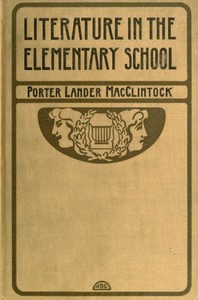
Literature in the Elementary School — Key Ideas to Explore
Edition facts
This digital edition of Literature in the Elementary School — Key Ideas to Explore is described by source-level measurements including 69,574 words, 5 hr 3 min estimated reading time, and 7 detected text sections.
The text analysis averages about 30.5 words per sentence, while the detected sections provide another way to judge how the source is divided.
Project Gutenberg metadata also associates the work with “Literature -- Study and teaching,” connecting these edition facts with the source record’s subject description.
Calculated from edition completeness, EPUB availability, text structure and catalogue metadata. Not a user rating.
How this score is calculated
- Description quality20 pts
- Title & short description10 pts
- Source metadata20 pts
- Text length15 pts
- Chapters / structure15 pts
- EPUB file integrity20 pts
Total of 100 points, scaled to a 2.5-5.0 range. Editions with an empty description or a missing EPUB file are not scored.
Read the Text
y cautious upon this point; in all his tales he seems to have reduced the element of the marvelous to the smallest amount and to have called upon it only at the pivotal points. Compare in his _Cinderella_ the sufficiency of his single proviso, "Now, this godmother was a fairy," with the tedious superfluity of irrelevant marvels in Grimm's version of the same tale. Is this bringing the fascinating abundance of the Teutonic folk fancy to a disadvantageous comparison with the neat and orderly, but more common-place, Gallic mind? By no means. One has many occasions to regret, when he reads Perrault's version of the wonderful tales he found, that he was a precisian in style and a courtier in manners; and we may find in the most apparently artless tales told by Grimm or by Asbjörnsen the most perfect organization and economy; as, for example in _Briar-Rose_ or in _The Three Billy Goats Gruff_.
Besides, one hastens to add that every child should hear and should later on have a chance to read some of the free, wandering, fantastic things which his teacher cannot feel justified in giving to the class.
One is obliged to take some attitude in mediating the folk-tales to the modern child, toward the fact that we often find them reflecting a moral standard quite different from that which the average well-bred child is brought up by; and this situation is complicated by the fact that the children are too young to understand dramatically another moral standard. This aspect of the stories has been pretty well covered by the general discussion in the previous chapter. But, luckily, it is quite possible to reject all those folk-tales of questionable morals and objectionable taste and still have plenty to choose from. Be slow to reject a folk-tale unless the bit of immorality--a lie, an act of disloyalty, or irreverence--or the bit of coarseness really forms the pivot of the story. Only then is the story unsafe or incurable.
One must take an attitude, not only toward the morals of the folk-tale, but toward its manners as well. There is some violence in many of the most attractive nursery tales; many of them reflect a rather rough-and-tumble state of social communion; many exhibit a superfluity of bloodshed or other grisly physical horrors. We quickly grant that it is not wise to read enough of these, or to linger long enough over the forbidding details, to create a deep or an abiding atmosphere of terror. But it is certainly true that the modern child of six or seven has so little apperception material for physical horrors that they do not take any deep hold upon him. Indeed, the safety of modern life, and the absence of visible violence, have taken the emotional appeal out of many grim lessons of Spenser's and of Dante's. Murder in the _Märchen_ is to the modern child actually a bit of fine art--merely a neat and convincing way of disposing of iniquitous elder brothers and hostile magicians. The fact that the child's experience and information enable him to make no image of the physiological sequelae of the cutting-off of heads, for instance, makes it easy for the teacher to carry him harmless past details that would seem brutal to his nervous and squeamish elders. And these details are never the point of emphasis in any good story. And on the whole, those persons whom the children like and are likely to incorporate into their "pattern," have manners either just or gentle even in the folk-tales.
It might be well to introduce among the folk-tales an occasional short story of contemporary life, recording the activities of persons such as the children actually know. This is not so important in this stage of their experience as it will be later; first because the folk-tales do not seem antiquated nor, if they are wisely selected, unduly fantastic to them, since they find themselves imaginatively so much at home with material and the method; and, in the second place, because in every well-regulated school their fact studies and occupation work are at this time concrete and charming, and keep them rightly and sufficiently in touch with the world of actuality.
Of course we must accompany and supplement the folk-tales by verses, since even at this age we may impress upon the children the music of speech, and some of the minor literary beauties. They will probably be delighted to repeat (in many classes many of the children will be learning them for the first time) the lovely hereditary jingles and ballads from Mother Goose--"The Crooked Man," "I Saw a Ship a-Sailing," "Sing a Song of Sixpence," the rhymes for games and for counting-out. There are a very few of Stevenson's simple enough for this period; and there may be a further choice among things found here and there, simple, objective, and perfectly musical. It is not so much the content and meaning of poetry that we can hope to impress upon little people under eight, as the music and motion of the verse. There will be, however, many members of every class who will be interested in the meaning, the images, and the persons, if there be persons. We will take all pains, therefore, to see that these be not unsuitable.
These--folk-tales and simple singing lyrics--with a fable or two told as anecdotes, and repeated until even the little children begin to see that there is something more than meets the eye--all graded and modified in the light of the personnel and experience of the actual class, may constitute the literature of the first two years of school.
The presupposition that myth is _par excellence_ the literary material for young children doubtless grew out of a misinterpretation of the so-called mythopoeic age in the children, and some fundamental misconception of the nature of myth and its relation to other folk and traditionary material. There is no place in this little book even to suggest the problems that surround the nature and genesis of myth. But it does seem desirable to make in a simple way a few distinctions that may serve to set us on the right road.
First of all, myth is religion, and not art. It is not a thing of mere imagination. It is the explanation or interpretation of some physical fact, some historical occurrence, some social custom, some racial characteristic, some established ritual or worship. It is the religious or emotional response to some influence or activity in the world so impressive or so efficacious as to seem to call for explanation in terms of supernatural agencies.
This explanatory or interpretative stage or aspect of myth may be first historically, or it may not be. It is probably first in most myths in a simple and crude form, which in all developed myths has been enriched and modified by influences from the other stages and aspects. The second stage--or shall we call it merely another aspect--is the assigning of distinct personality and individuality to the agencies assumed to account for events and appearances. Then follows rapidly the interrelations and interactions of these persons, the surrounding of them with friends and subordinates, the building-up of a whole intricate society of divinities after the model of human society--all at first symbolistic and of religious significance. A third stage or aspect is that of the cult, the worship, the establishment of a priesthood delivering authoritative messages, mediating influences to the people, and adding constantly to the body of explanations and interpretations surrounding each divinity. The fourth stage or aspect is that in which it becomes, or becomes identified with, a body of moral doctrines or ethical principles; where the personal divinities, with their qualities, insignia, and associations, are taken as symbols of inner human forces, of moral and social achievement, as expressions of spiritual influences operant in human nature and life.
Let it be understood that in naming these stages or aspects there has been no attempt to place them either in chronological or in logical order, and no intention of saying that they stand apart from one another in an easily recognized distinctness. But, however interlinked and mutually modified they may be, we must in any discussion of myth, be aware of these four sides or steps.
Take, for example, the Greek myth of Apollo. As an explanation of physical phenomena he is light or fire, sometimes specialized as the spirit of the sun. But he is embodied and endowed with a personality; he has social conditions and subsidiary functions assigned to him. As a person he is the son of Zeus and Leto, twin brother of Artemis, leader of the nine Muses, guardian of pastured flocks and herds, as Artemis of the wild creatures who feed or frolic by night. As his worship spread and deepened, there gathered about him many other functions--he was the god of healing, of music, of law, of atonement; and many tributary and subordinate divinities were associated with him in all these activities. There gathered into his myth also an enormous and complex body of stories, romantic and mystical, explanatory and prophetic--stories of adventure, of contact with the other gods, of sojourns with men, of pilgrimages to unknown regions; some of them merely romantic, some of them symbolistic, many of them profoundly significant of his powers and offices.
And the myth of Apollo is remarkable for its ancient and elaborate worship. Already when the Homeric poems were made, the shrine of Apollo at Delphos was the scene of an old and complicated ritual. There was even then a temple rich with the accumulated treasure of the votive offerings of generations of worshipers. Priests and prophets, the mystic offices of the Pythia, poets and musicians, stately processions of kings and warriors seeking oracles, combined to maintain the dignity and sanctity of this most impressive worship.
From the very earliest times of which we have record of this myth, Apollo was known to be a spiritual and ethical force at work in man's soul. He was named when men tried to speak of those experiences which wrought expiation and purification. He stood for milder law, for beneficent and benevolent social order, for art, for the songs of the sacred bard, the dirge of grief, the paean of victory, the games--all the gentler things of social culture and personal experience.
In these and in many other ways did the myth of Apollo express the human soul and act upon it. It was a religion--as every developed myth is--to be handled reverently. We might have chosen other examples quite as elaborate and as full of mystic significance--the myth of Dionysus, or the more widespread and deeply devotional myth of Demeter.
Art, too, concerned as it is with everything that promotes or reflects man's spirit, has uses for the elements of myth, and has its own way of handling them. On two of the four steps of myth art, especially literature, finds acceptable material. On the stage named second--the stage in which the influence or power becomes personified, takes on relations to other personified influences, and calls into being other divine persons, his children, his helpers and subordinates, takes his place in a society of divinities, and exercises his more or less specialized function in this society, and also in human life and activity--have the poets and romancers found many opportunities. Adventures and romantic experiences of all sorts easily attached themselves to the person of some divinity, especially as the character of the personal divinities became more and more humanized by the accretion of such tales. And while we find echoes of myth in _Märchen_ and romance, we quite as constantly find apotheosis of merely human romance and adventure in myth. Among the literary peoples, poets and dramatists found it often desirable to use the foundation of this group of divine personalities as the starting-point for a performance purely artistic; it gave them the immense advantage of starting without explanation and preparation, since their audiences could be counted upon to know the divine personages and circumstances; and the further advantage of adding dignity and size to their inventions by accrediting them to superhuman agents. These literary additions, these variations upon the religious meanings, invented for artistic purposes, often gradually incorporated themselves into the myth, and by modern students are not carefully distinguished from the other, the religious and devotional elements. A comic adventure told of Hermes may not have in it any more of myth than a similar story told of Autolycus.
Literature finds much use for material of the mythical kind on what we have called the fourth step. To express and render concrete, impulses, influences, and powers that sway and dignify human conduct, and that form and ennoble human character, the literary artist gladly employs the persons of the great myths. All human experience has elements and influences coming into it from an apparently mystic sphere, that must either be described in abstract terms or embodied in concrete persons and symbols. The latter is ever the method of art. So we find everywhere in literature the use of the great symbols already constituted in myth, or the invention of new symbols for the purpose. Homer would convey to us the sense of the presence that guided and guarded the wise and resourceful Odysseus; so the stately Athene, ages long the goddess "who giveth skill in fair works, and noble minds," comes and goes through the poem. Hauptmann would convey to us in _The Sunken Bell_, some impression of the magic and the charm of that beauty which lies in the free soul and wild nature, so he invents Rautendelein. But neither Homer nor Hauptmann is priest or devotee interpreting facts or conserving worship. They are artists picturing human life and introducing, each in its place, the various elements of human experience.
It is in regard to this literary use of myth that there exists much confusion, and that most mistakes are made as to the educational use of myth. Many persons who contend that "myths" can be given to children as literature call the _Iliad_ and the _Odyssey_ "myths;" indeed, they are likely to call all legendary stories in which the supernatural element is large "myths;" and they call all romantic stories that have become attached to any divinity "myths."
We should distinguish myth from saga, from legend, from merely fanciful symbolistic tales, from tales of human heroes. The Homeric poems make much of the religious side of human nature, and the poet chose in order to give to his action and issue a superhuman dignity to set that action in the presence of the gods themselves. Yea, in the climaxes of the Titanic struggle the Powers themselves take a hand, so deeply does the poet feel that everything noblest and most passionate in human nature is involved; and, despairing, as it were, of conveying to us in merely human terms the implications of the strife between the two kinds of ideals, he sets Aphrodite over against Athene, not merely Trojan against Greek. But the _Iliad_ is, for all that, not myth nor a collection of myths, but the story of the wrath of Achilles--a very human hero, who loved his friend. The story of Baldur is myth--explaining and interpreting, personifying and glorifying, a superhuman influence and effect beyond the reach of human experience; the story of Siegfried is a saga, a human experience, under whatever enlarged and idealized conditions, yet still a type-experience of the human being. The garden of Eden is myth-interpretation and explanation of many, some the grimmest, facts of man's nature, and his relation to a supernatural power; the story of Abraham is a saga--a typical history of human experience, a typical picture of human culture. The whole artistic purpose and effect of the hero-tale and the saga are different from those of myth; the center of interest is a human being; the emphasis is upon human life; the meaning is upon the surface. In true myth the purpose is not artistic, but religious; the emphasis is upon superhuman activities; the meaning is buried beneath symbols--the more beautiful the myth, the more difficult and complex the symbol.
So one has almost to smile at the statement, commonly made that myth, implying all myth, is childlike, and should therefore be given to little children as literature, especially while they themselves are in the mythopoeic age--presumably from four to seven. There are so many fallacies in this statement that one pauses embarrassed at his many opportunities of attack.
First as to the childlikeness of myth. There are, of course, undeveloped races that have a naïve and childish myth, but it is also so crude and unbeautiful that it would never commend itself to one seeking artistic material for children. The developed myths, those that have achieved the elaboration of beautiful episodes, are most unchildlike. They are far, far away from the crude guesses of the primitive mind. They have all been worked over, codified, filled with theological and symbolistic content by priests and poets. One can be very sure that no sensible teacher who has mastered the material, would attempt to teach the whole of any Hebrew or Greek or Scandinavian myth as myth within the elementary period. If he takes one of the especially romantic or beautiful episodes out of the myth, he is obliged to thin it out to the comprehension of the children, and to mutilate it so as to make of it a mere tale. When one reads Hawthorne's version of Pandora and Prometheus and realizes the mere babble, the flippant detail, under which he has covered up the grim Titanic story of the yearnings and strivings of the human soul for salvation here and hereafter, the very deepest problems of temptation and sin, of rebellion and expiation, he must see clearly what is most likely to happen when a complex and mature myth is converted into a child's tale. To make a real test, leave the alien Greek myth and try the same process with one that we have built into our own religious consciousness--the temptation and fall in the Garden of Eden; a story, which is, by the way, much more naïve in conception and detail than that of Prometheus. We must conclude that such myths are not childlike, and that to make such a version of them as will appeal to the little child's attention and feeling gives but a shallow and distorted view of them.
There should undoubtedly be a place in education for the study of myth as religion and as an influence in human culture; should it not be somewhere well within the adolescent period, when the symbols of the great myths attract and do not baffle the child, when their religious content finds a congenial lodging-place and a sympathetic interpretation in his own experiences? It would seem only fair to reserve the beautiful and reverential myths of the Greeks, Romans, and Scandinavians for this period, rather than to use them in the age when there is little more to appeal to than the tendency, so short-lived and shallow-rooted in the modern child, to see personal agencies behind appearances. For this, confused with a degree of grammatical uncertainty of speech, is practically all that we can find under close analysis, of the mythopoeic faculty in little children brought up under modern conditions.
There are still those, one discovers, who contend that myth should be given to children as literature, because later in life--when they come to read the _Aeneid_ in High School, or _Paradise Lost_ in college, or _Prometheus Unbound_ or even Macaulay's essays--they will come upon references to Zeus, to the fall of Troy, to the Titans, to Isis and Osiris, and they ought to be able to call up from what they had as literature in the elementary school such information as would enable them to understand these allusions and fill out these references. Luckily, the number of people who hold the fundamental theory of education adumbrated in this view is becoming so rapidly smaller that this chapter will, let us hope, be too late to reach them. The multiplication table is a tool; the mechanics of reading and writing are partially mere tools; but mythology, especially mythology substituted for literature, can in no sense be regarded or treated as a tool.
Porter Lander MacClintock opens Literature in the Elementary School by grounding his argument in direct experience: the book emerged from teaching at the University of Chicago's Laboratory School under John Dewey, from private reading with children, and from lectures to teachers. He acknowledges that the material retains the informal, spontaneous character of its origin as lectures, and notes that a synopsis was circulated in 1904. This origin shapes the book's structure—it is not a detached manual but a practitioner's reflection, aiming to articulate what literature can distinctively offer children in school settings.
From Lecture Hall to Printed Page
The preface reveals MacClintock's method: the book's chapters began as lectures, and he admits the difficulty of turning “spontaneous and informal lectures” into decorous chapters. This origin explains the direct, conversational tone that persists throughout. He also notes that central material first appeared as articles in the Elementary School Teacher in 1902, and a synopsis was widely circulated by 1904. Readers should expect a work that argues from lived practice rather than abstract theory, and that assumes familiarity with ongoing debates in progressive education.
The Antidote to Romance: Stories of Real Life
In a key passage on stories of real life, MacClintock warns that too much romance and fantasy can distort a child's “sense of fact” and “vitiate” taste. He proposes that realistic stories serve as an artistic antidote, one that “should have the same kind of charm as the original poison.” He insists that even young children should be appealed to on several sides; a child who likes only fairy tales or war stories is limited. The goal is catholic taste. This section shows MacClintock balancing the value of imagination with the need for grounding in actuality.
Art Casting Back Its Radiance
MacClintock describes how realistic stories “throw back upon actual life the glow of art.” He illustrates with classroom examples: children who made a verse about “rosy radishes” and then painted them found new joy in a grocer's window; those who learned Lowell's phrase “dusty gold” for dandelions sought to create a phrase for buttercups. Yet he notes a limit—when children tried to make poetry about Uneeda biscuits and ginger-ale, they concluded “it would not go.” The passage reveals his belief that art dignifies life, but only certain subjects readily accept that halo.
Recognition and the Child's Experience
MacClintock highlights the “tingling interest” children feel when a story parallels their own lives—a father who saw a bear, a found eagle's feather, daffodils in a garden. This recognition, he argues, is central to literature's educational value. The excerpts show him attending to the child's perspective, not just the teacher's. His examples are concrete and drawn from classroom observation, reinforcing the book's grounding in practice rather than prescription.
MacClintock's book is best read as a series of connected arguments rather than a systematic curriculum. Readers will find the most value in his specific classroom anecdotes and his insistence that literature serves education not by moralizing but by shaping perception and taste. The informal, lecture-derived style invites the reader to engage critically with his claims, testing them against their own experience with children and texts.
MacClintock’s gentle insistence on literature as a living companionship made me think of Hugh Miller’s own patient assembling of a self. Both understood that early learning is less about lessons than about quiet absorption—words that settle in the bones. That same unhurried trust in formative reading lingers in My Schools and Schoolmasters; Or, The Story of My Education — Themes and Context, like a familiar lamp left burning.
Grace Wilson
1 week agoMadison Rodriguez
2 weeks agoSophia Anderson
2 weeks agoWhat did you think of this book?
Answer a few questions and save a private reflection on this device.
Lucas Robinson
3 weeks ago