
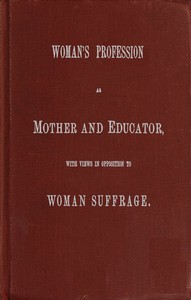
Woman's Profession as Mother and Educator, with Views in Opposition to Woman Suffrage — Story, Setting & Ideas

(5 User reviews)   1163
In Category - Educational Theory
Beecher, Catharine Esther, 1800-1878 Project Gutenberg 2017
Women -- Suffrage; Women -- Education Readers of public-domain and historical texts
Project Gutenberg digital edition en

Edition facts

Words 48,356
Reading time 211 min
Text sections 14

The catalog record for Woman's Profession as Mother and Educator, with Views in Opposition to Woman Suffrage — Story, Setting & Ideas provides practical reading context through 48,356 words, 3 hr 31 min estimated reading time, and 14 detected text sections.

The text analysis averages about 29.3 words per sentence, while the detected sections provide another way to judge how the source is divided.

Project Gutenberg metadata also associates the work with “Women -- Suffrage,” connecting these edition facts with the source record’s subject description.

Catharine Beecher argues against woman suffrage by grounding women's influence in domestic and educational roles, using personal recollections of Litchfield's intellectual circle to claim that domestic training produces superior mental power.
Share
Editorial Edition Score 4.7/5

Calculated from edition completeness, EPUB availability, text structure and catalogue metadata. Not a user rating.

How this score is calculated
  • Description quality20 pts
  • Title & short description10 pts
  • Source metadata20 pts
  • Text length15 pts
  • Chapters / structure15 pts
  • EPUB file integrity20 pts

Total of 100 points, scaled to a 2.5-5.0 range. Editions with an empty description or a missing EPUB file are not scored.

Edition quality

Read the Text

y ten years, in which, as it seemed to me, every thing was done that could be to abate such evils, I have concluded that such institutions for both boys and girls may be called successful only on the same calculation as would be made in cultivating a garden on the top of a house. The best of soil, seed, manure, and labor, with water and sun and awnings, may be provided, and yet the proper place to make a good garden is on mother earth. And so the proper place to educate children before maturity is under the mother's care, with the coöperating aid of a school.

If I could narrate one half of the sad histories of the ruined boys and girls, and the consequent agonies from blasted parental hopes, that have come to my personal knowledge, where health or morals, or both, were destroyed for a whole life at large boarding-schools, this false and fatal method would be greatly abated.

And here I would direct attention to one item so pernicious, and yet so common and so misunderstood as to excite constant wonder and regret as connected with boarding institutions for both sexes, and that is _the want of effective methods for providing pure air_. In private families, only a few lungs vitiate the inhaled air; but the larger the number in one building, the larger are the arrangements needed for emptying out the foul air and introducing the pure.

An open fire is a sure and certain method. But when buildings are warmed by hot-air furnaces, or by hot-water or steam-pipes, the almost inevitable results are pernicious. In the case of heated air from a furnace, it always will find exit from a building in the shortest or most available direction, and then all the rooms not in this line of draught will have the air nearly stationary, to be breathed over and over again by their inmates.

Heating by steam or by hot-water pipes involves still greater difficulties, when no arrangement is made for carrying off the foul air, inasmuch as it is the air _in_ the house which is heated without introducing pure air.

This is the most dangerous of all methods of warming when there is no connected ventilating arrangement, while it is the best and most agreeable of all methods when properly managed. Mr. Lewis Leeds, ventilating engineer in New-York City, has invented the following method. The coils of steam or hot-water pipes are placed close to a window, with an opening at the bottom of it, regulated by a register which admits pure air directly on to the coils, and thus it is warmed.

Thus a person can sit by the coils and secure radiated heat as from a fire, have the light of the window and the influx of perfectly pure and yet warm air. In addition, every room has an opening both at top and bottom into a warm-air flue, through which the impure air of the room is constantly carried off.

_Any_ room can be perfectly ventilated which has openings at the top and bottom of a flue, through which warm air is passing. But no flues filled with cold air will ventilate a room, though housebuilders, and householders, and school committees have been ignorantly providing such useless arrangements all over the land.

And here I affirm with heart-felt sorrow that never, in a single instance, have I known or even heard of a large boarding-school with any proper arrangements for ventilation. Even Vassar College, now so extensively regarded as a model institution, has adopted the most dangerous mode of warming without any arrangement but doors and windows to supply pure air to its recitation-rooms and sleeping-rooms.

And so, as in all similar cases, the strong and well, who are distressed for want of pure air, will have windows open, and then the delicate, who are not inured to sudden changes or to great extremes, will take colds. There is no doubt that the reports of the miasmatic diseases and lung affections of teachers and pupils in this institution have been greatly exaggerated; but not because there has not been abundant reason for expecting such results.

When I took charge of my present school, I found neither the boarding-house nor school-building provided with any proper modes of ventilation, and after making all changes for improvement at command, it is still needful to make it the constant duty of one teacher to see that, so far as practicable, every room in school and boarding-house is properly warmed and ventilated every hour of the day and night.

In regard to the course of study in the collegiate department of a woman's university, there should be as great an amount as is required in any of our colleges, yet only a few studies carried to so great an extent as in many sciences pursued by men. But there should be a much _greater variety_, together with an accuracy and thoroughness that colleges rarely secure. And all should have reference to women's profession, and not to the professions of men. Much in this department at first must be experimental, having in view the ideal indicated.

So in regard to introducing _practical_ training for woman's domestic duties _as a part of common school education_; although it is certain that much more can be done than ever has been attempted, and that, too, as a contribution to intellectual development rather than the reverse, this also must be a matter of experiment.

In regard to a _special_ training in the preparatory and the collegiate schools for future self-supporting employments, much more can be done than has ever been supposed, and a few particulars will be enumerated to illustrate. Young women of affectionate disposition, good intelligence and morals, having only limited means, might be trained to become a _mother's assistant_ in charge of a nursery, partly by the studies of the primary and preparatory schools and partly by learning the methods of the Kindergarten. Thousands of parents in all parts of our nation would offer liberal wages to young women thus trained for one of the most sacred offices of the family state.

Women of suitable social and moral character might be trained, _in connection with school studies_, to be superior seamstresses and mantua-makers, and thus be enabled to gain liberal wages.

If young ladies knew how much usefulness and comfort may be connected with this domestic art, they would seek it with more interest than any school study. The scarcity of well-trained mantua-makers in all parts of the land has made my early training in this art a great blessing to me and to many others whom I have been thus enabled to aid and to teach; and there is no branch of school training that can be made so directly available in promoting economy, comfort, and usefulness.

Women trained to fit young boys for college, in private families or in small neighborhood schools, would command very high remuneration in many quarters. _Every_ young girl whose means will allow it ought to be prepared for this duty.

Pupils who have a decided talent for either music, drawing, or other fine arts, might have a _special_ training for one of these professions; while those without any such tastes or aptitudes should be dissuaded from wasting time, labor, and money, as is so absurdly and widely practiced, in learning to play the piano and acquiring other accomplishments never pursued in after-life. Nine tenths of young girls thus instructed lose all they learn in a very short period.

Some pupils have fine voices and a talent and taste for elocution, and such might be trained for teachers of this art or for public readings.

Some pupils have talents that prepare them to excel in authorship, and to such an appropriate and more extensive literary culture could be afforded.

The art of book-keeping and of quick and legible penmanship insures remunerative employment; and many other specialties might be enumerated in which, _during school-days_, a woman might be trained to a self-supporting profession. And _every_ woman should be trained for all the duties that may in future life be demanded as wife, mother, nurse, and school-teacher, if not in the ordinary school, in a separate professional school.

When institutions are endowed to train women for all departments connected with the family state, domestic labor, now so shunned and disgraced, will become honorable, will gain liberal compensation, and will enable every woman to secure an independence in employments suited to her sex. And when this is attained, there will be few or none who will wish to enter the professions of men or take charge of civil government.

Having expressed so strongly my views in reference to large boarding-schools for both sexes, I will add some further details of my _ideal_ for organizing a Woman's University. This has been suggested by recent interviews with some who may have much influence in managing the large funds recently bequeathed in Massachusetts for establishing institutions for women, in one case a lady having bestowed what will probably amount to nearly half a million, and in another case a gentleman has bequeathed a million and a half for this purpose.

This, I believe, is but the beginning of similar benefactions that will be provided for women in all parts of our country. There are men of wealth who have lost a dear mother, wife, or daughter, who would find comfort and pleasure in perpetuating a beloved name by an endowment that for age after age will minister to the education and refinement of women and the support and training of orphans.

In this view, it seems very important that the first endowed institutions of this kind should adopt plans that may be wisely imitated.

It seems desirable that such endowed institutions should be placed in or so near a large town that the pupils of all the schools, except the professional one, should reside with their parents instead of congregating in a great boarding-house. The professional school would ordinarily embrace only women of maturity, and might demand a location with surrounding land for floriculture, horticulture, and other feminine professions.

The Kindergarten, the primary school, and the preparatory school might each have a principal and an associate principal, supported partly by tuition fees and partly by endowment. These principals might establish a family, consisting of the two, who would take the place of parents to several adopted orphans and to several pay-pupils whose parents, from ill health or other causes, would relinquish the care of their children.

The collegiate schools might have endowed departments corresponding to professorships in colleges, each having a principal and associate principal, who also could establish families on the same plan. When completed, the university would then consist of a central building for school purposes, surrounded by fifteen or twenty families, each having a principal and associate principal, acting as parents to a family of from ten to twelve pupils, and all in some department of domestic training.

Thus some thirty or forty ladies of high character and culture would be provided with the independence and advantages now exclusively bestowed on men, while at the same time the institution would practically and to a considerable extent be an orphan asylum offering unusual advantages.

In regard to the practicability of finding women properly qualified to carry on such a university with success, there is no difficulty. Few know so well as I do how many women of benevolence and high culture are living with half their noblest energies unemployed for want of the opportunities and facilities provided for men. There is nothing needed but _endowments_ to secure the services of a large number of ladies of the highest culture and moral worth, well qualified to establish not only one but many such institutions.

In my attempts to organize female institutions on the college plan of independent principals of endowed departments, responsible not to an individual but to a faculty and corporation, I have been met with objections that apply as much to colleges for men. The jealousies and jars incident to all complex institutions are the result of the frailties of humanity common to both sexes. I have, in a large number of instances, organized institutions on the college plan, which for years were conducted with perfect harmony, some of them are still prospering, and others were ended only for want of endowments to retain the highest class of teachers.

AN ADDRESS TO LADIES OF HARTFORD, CONN.,

INVITED FROM ALL RELIGIOUS DENOMINATIONS;

Calisthenic Hall of the Hartford Female Seminary,

LADIES AND KIND FRIENDS:

At a former meeting I stated that, as former principal of this Seminary, I so exhausted my nervous system that I have never been able to assume responsibilities involving obligations which, by my failure, would cause disappointment to others. My method, therefore, has been to originate plans, and then induce others, more capable than myself, to execute them, and in such a way that I could help without taking any responsibility.

Thus I originated the plan for transferring teachers to the West, executed by Gov. Slade. And thus also I organized the American Women's Educational Association, for securing _endowed_ collegiate and professional schools for women, which has established several flourishing institutions at the West. The most important of these is the Milwaukee Female College, which for more than fifteen years has been conducted by the chief agent of this Association, Miss Mary Mortimer; and which now numbers 180 pupils, and exhibits many of the benefits of our plan, although only partially endowed. The object of this meeting is to gain your influence in order to secure, not only what has been gained at Milwaukee, but to accomplish the whole plan of a fully endowed Woman's University, as the model which we hope to see reproduced all over the nation.

In all these educational efforts, I have been led by a deep and painful sense of the depressed and suffering condition of large portions of our sex, and to an extent little realized by women in easy and prosperous circumstances. I introduce here an extract from a published article of mine that gives some small exhibition of these painful facts.

That there is something essentially wrong in the present condition of women, is every year growing more and more apparent, while the public mind is more and more perplexed with diverse methods proposed for the remedy. In one of our leading secular papers we read this statement of the case from the pen of a working woman:

"There are so few departments of labor open to women, that, in those departments, the supply of female labor is frightfully in advance of the demand. The business world offers the lowest wages to eager applicants, certain that they will be ravenously clutched. And, indeed, to see the mob of women that block and choke these few and narrow gates open to them—the struggle—the press—the agony—the trembling eagerness—you might suppose they were entering the temple of fame or wealth, or, at least had some cosy little cottage ahead, in which competence awaited the winner. Nothing of the sort. These are blind alleys, one and all. The mere getting in, and keeping in, are the meagre objects of this terrible struggle. A woman who has not _genius_, or is not a _rare exception_, has no opening—no promotion—no career. She turns hopelessly on a pivot; at every turn the sand gives way, and she sinks lower. At every turn light and air are more difficult, and she turns and digs her own grave. Do you say these are figures of speech? Here, then, are figures of _fact_. There are _now thirty thousand_ women in New York, whose labor averages from _twelve to fifteen hours a day_, and yet whose income seldom exceeds _thirty-three cents a day_. Operators on sewing-machines, and a few others, enjoy comparative opulence, gaining five to eight dollars a week, though from this are to be paid three or four dollars for a bed in a wretched room with several other occupants, often without a window or any provision for pure air, and with only the poor food found where such rooms abound. Thousands of ladies, of good family and education, as teachers receive from two to six hundred dollars a year. Few women get beyond that, and a large proportion of them are mothers with children. Over these poorly-paid laborers broods the sense of hopeless toil. There is no bright future. The woman who is fevered, hurried, and aching, who works from daylight to midnight, loathing her mean room, her meaner dress, her joyless life, will, in ten years, neither better herself nor her children. The American working-woman has no share in the American privilege given to the poorest _male_ laborer—a growing income, a bank account, and every office of the Republic, if he have brain and courage to win them."

This describes the condition and feelings of not all, but of a large class of women in many of our larger cities, who must earn their own livelihood. But, in the medium classes, as it respects wealth, the unmarried or widowed women feel that they are an incumbrance to fathers and brothers, who often unwillingly support them from pride or duty. For such, also, there is "no opening—no promotion—no career;" and they must remain dependent chiefly on the labor of others till marriage is offered, which to vast numbers is a positive impossibility.

This has lately been proved, from the census, by a leading New York paper. In that it is shown that, in all our large cities, the male inhabitants, under fifteen and over the usual marriageable age, are greatly in excess of the females, and, consequently, the women at the marriageable age are greatly in excess of the marriageable men. Thus, in New York City, according to the statements of the _New York Times_, there are eleven thousand more females than males, of all ages, while there are one hundred and thirty-two thousand more women of marriageable age than men of that age. This is perhaps a large estimate, but the disproportion is at all events enormous.

And, in the rural districts of New York State, we find a similar state of things; for the excess of females, of all ages, is twenty-one thousand, while the excess of marriageable women, if at the same ratio as that stated in New York City, would be two hundred and sixty-three thousand. A similar state of things will be seen in all our older States.

The most mournful feature in this case is the fact that most of these women have never been trained for any kind of business by which they can earn an independent livelihood. The Working-woman's Protective Union, of New York City, reports that, of thirteen thousand applicants, not one-half were qualified to do any kind of useful work in a proper manner. The societies that are formed to furnish work for poor women report that their greatest impediment is that so few can sew decently, or do any other work properly.

The heads of dress-making establishments report that very few women can be found who can be trusted to complete a dress, and that those who are competent find abundant work and good wages. The demand for really superior mantua-makers is almost universal in country places, and even in many of our cities.

In former days sewing was taught in all schools for girls, but now it is banished from our common schools, and the mothers at home are too neglectful, or too ignorant, or too pressed with labor, to supply the deficiency.

It was reported in the _New York Tribune_, not long since, that there are at least twenty thousand professed prostitutes in New York City alone, while Boston, in proportion to its number of inhabitants, shows a larger number, and all our cities give similar reports. This, it is hoped is an estimate much in excess of the reality; but the truth is mournful enough. Multitudes of these unfortunates have only two alternatives—on the one hand, poor lodgings, shabby dress, poor food, and ceaseless daily toil from eight to ten or fifteen hours; on the other hand, the tempter offers a pleasant home, a servant to do the work, fine dress, the theatre and ball, and kind attentions, with no labor or care. Where is the strength of virtue in those who despise and avoid these outcasts, that might not fall in such perilous assaults?

Catharine Beecher's 1872 volume opens with a dedication to the ministers of the United States, framing the woman suffrage movement as an emergency that unites 'all the antagonisms that are warring on the family state.' The catalog subjects—Women—Suffrage and Women—Education—accurately reflect the book's dual focus, but the excerpts reveal that Beecher's opposition to suffrage is inseparable from her positive argument for women's domestic and educational profession. She does not merely list objections to voting rights; she constructs an alternative vision of female influence rooted in motherhood, teaching, and household management.

Domestic Training as Intellectual Discipline

Beecher devotes considerable space to arguing that women's traditional domestic duties exercise all intellectual and moral powers more thoroughly than men's specialized professions. She writes that a woman 'as mother and housekeeper has a constant succession of employments that tax all her intellectual and her moral powers,' while a man in his daily toils 'has only one or two subjects.' This claim is central to her opposition to suffrage: if women already wield supreme influence through the home, the ballot is unnecessary.

To support this, Beecher offers a detailed recollection of women in Litchfield, Connecticut, around fifty years earlier. She names Mrs. Judge Reeve, Miss Sarah Pierce, her mother, and aunts, noting that none had studied Latin, Greek, or mathematics, yet they were regarded as intellectual equals by the most talented jurists and gentlemen of the day. One brother even argued in a college exercise that women possess superior mental powers by nature. The passage is striking for its concrete, personal evidence—Beecher does not rely on abstract theory but on remembered conversations about Lavoisier's chemistry, medical reading, and literary discussions.

Health, Maternity, and the Need for Instruction

Another strand of Beecher's argument addresses what she calls 'the feeble constitution and poor health of women, causing them to dread maternity.' She describes an accumulation of 'mental and bodily tortures' and criticizes the 'extreme fastidiousness' that prevents mothers from learning or teaching necessary health information. She recounts a conversation with a lady physician who said she could not call mothers together to warn them because 'they would not hear me—I should have to nail the doors and windows to keep them.'

Beecher's solution is not to grant women political power but to train women teachers as lecturers on health in every school district. This proposal ties directly to her catalog subject of Women—Education, but the excerpts show that education is framed as a remedy for physical and moral decline, not as a path to equality. The emphasis on bodily suffering and the need for practical instruction in 'the laws of health' reveals a reformist impulse that coexists with her anti-suffrage stance.

The Structure of the Volume and Its Rhetorical Strategy

The table of contents lists five addresses or essays: 'An Address on Female Suffrage,' 'An Address to Ladies of Hartford, Conn.,' 'An Address to the Christian Women of America,' and three notes labeled A through D. This structure suggests that the book is a collection of occasional pieces rather than a single sustained treatise. The excerpts we have come from the dedication and from a later section that appears to be part of one of these addresses.

Beecher's rhetorical strategy is notable for its reliance on personal authority. She identifies herself as 'the daughter and sister of nine ministers of Jesus Christ,' grounding her right to address clergymen in family connection rather than public office. She also uses her own childhood memories as evidence, a move that personalizes her argument but also limits its generalizability. The excerpts do not reveal whether she engages with opposing arguments in detail or whether the later notes address counterpoints.

Readers should note that the excerpts represent only a portion of the book's argument. Beecher's opposition to suffrage is embedded in a broader vision of women's influence through domestic and educational work, and her evidence is often anecdotal and autobiographical. The catalog subjects accurately capture the book's themes, but the excerpts suggest that the relationship between them is more integrated than a simple pro/con debate. Those interested in nineteenth-century anti-suffrage rhetoric will find a carefully constructed case that prioritizes maternal and pedagogical authority over political rights.

The rain kept me inside all afternoon, and I kept returning to Catharine Beecher’s insistence that domestic training sharpens the mind. Her quiet confidence about women’s influence felt like a closed room, yet it made me wonder how such ideas were later turned into practical, structured learning. That wondering led me, almost by accident, to The Making of a Trade School — Reading Companion. The two books seemed to converse, each holding a different key to the same old door.

Evelyn Torres
1 month ago

Sebastian Taylor
1 month ago

Mia Smith
1 week ago

Leo Allen
3 weeks ago

Theodore Green
1 month ago

5
5 out of 5 (5 User reviews )

Add a Review

Your Rating *
  • ...
    William Lisa Alvarado - 1 month ago
    This book is difficult to digest from a modern viewpoint. It perpetuates a limiting view of women's potential and makes arguments that are often based on biological determinism and religious dogma. While it's useful as a primary source, it offers no real value for contemporary discussions on gender roles. The writing is dense and the logic feels forced, making it a tedious read except for historical researchers.

  • ...
    April Friedman - 3 weeks ago
    The book provides an interesting counterpoint to the suffrage movement, but it is clearly a product of its time. The author makes a coherent case for women's influence in the home, but the exclusion of women from public life feels narrow today. It's well-written and offers a perspective that is often overlooked in discussions of women's history, but modern readers will likely disagree with its conclusions.

  • ...
    Curtis Barrera - 2 weeks ago
    This is a fascinating historical document that powerfully articulates a woman's role as mother and educator. Written in an era when suffrage was a hotly debated topic, it presents a domestic and maternal ideal with eloquence and conviction. The arguments are well-reasoned from the author's perspective, offering valuable insight into the social dynamics of the time. A thought-provoking read for history enthusiasts.


Reader reflection

What did you think of this book?

Answer a few questions and save a private reflection on this device.

Your progress 0 / 10
1

Where are you in your reading?

2

Did this book hold your interest?

3

Would you pass this book on to a friend?

4

How easy was the book to follow?

Related eBooks