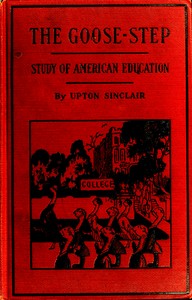
The Goose-step: A Study of American Education — Background and Themes

(0 User reviews)   93
In Category - Educational Theory
Sinclair, Upton, 1878-1968 Project Gutenberg 2021
Education -- United States; Universities and colleges -- United States Readers of public-domain and historical texts
Project Gutenberg digital edition en

Edition facts

Words 199,253
Reading time 867 min
Text sections 98

The Goose-step: A Study of American Education — Background and Themes can be approached with a clearer sense of reading commitment from its source measurements: 199,253 words, 14 hr 27 min estimated reading time, and 98 detected text sections.

The text analysis averages about 25.5 words per sentence, while the detected sections provide another way to judge how the source is divided.

Project Gutenberg metadata also associates the work with “Education -- United States,” connecting these edition facts with the source record’s subject description.

Upton Sinclair's 1923 exposé of American higher education argues that universities serve corporate and wealthy interests, suppressing academic freedom and radical ideas. The book profiles dozens of institutions and their leaders, using satirical chapter titles and firsthand accounts to illustrate how trustees, presidents, and donors enforce ideological conformity.
Share
Editorial Edition Score 4.9/5

Calculated from edition completeness, EPUB availability, text structure and catalogue metadata. Not a user rating.

How this score is calculated
  • Description quality20 pts
  • Title & short description10 pts
  • Source metadata20 pts
  • Text length15 pts
  • Chapters / structure15 pts
  • EPUB file integrity20 pts

Total of 100 points, scaled to a 2.5-5.0 range. Editions with an empty description or a missing EPUB file are not scored.

Edition quality

Read the Text

ss of “boundings” appeared in little diagrams; Switzerland was yellow and Germany pink, and no one burdened your mind with the idea that these spots of color represented places where human beings lived. At this same time the little boy was going to Sunday school, where he learned something called “the creed,” with a sentence declaring that “from Thency shall come to judge the quick and the dead.” The little boy pondered hard, but never made sure whether “Thency” was the name of a person or a place.

Some thirty-five years have passed, but the little boy still remembers the personalities of these teachers. There was a middle-aged lady, stout and amiable, and always dressed in black; then one who was angular and irritable; then one who had pretty brown eyes and hair, but to the puzzlement of the little boy had also the beginnings of a mustache. Next came a young man with a real mustache, and pale, washed-out eyes and complexion; but he was dreadfully dull. The novelty had worn off the school by this time, and the boy had got tired of stowing away packages of facts in his mind. He had become so expert that he was able to do two years’ work in one, and at the age of twelve was ready for what was called the City College. But he was judged too young, and had to take one year in the grammar school all over. The fates took pity on him, and gave him as teacher for that year a jolly Irish gentleman, so full of interest in his boys that he did not keep the rules. If you wanted to ask him questions you asked, and without first raising your hand; you might even get into an argument with him, as with any boy, and if he caught you whispering to your neighbor, his method of correcting you was novel, but highly effective—he would let fly a piece of chalk at your head, and you would grin, and the class would howl with delight.

In this strange, happy group the little boy went by the nick-name of “Chappie”; for the school was located on the East side of New York, and most of the boys were “tough,” and had never before heard the English language correctly spoken by a boy. “Chappie” owned a collection of one or two hundred story-books which had been given him by aunts and uncles and cousins at a succession of Christmases and birthdays. The priceless treasure, when he left the school, became the foundation of a class library, to the vast delight of the other boys and of the Irish teacher. So the boy ended his grammar-school life in a blaze of glory, and went away thinking the public school system a most admirable affair.

CHAPTER II THE COLLEGE GOOSE

The College of the City of New York at that time occupied an old brick building on Twenty-third Street and Lexington Avenue. It gave a five years’ course, leading up to a college degree; but the first two or three years were the same as high school years at present. The boy went there, not because he knew anything about it, nor because he knew what he wanted, but because that was the way the machinery was built; he was turned out of the grammar school hopper, and into the city college hopper. In his earliest days it had been his intention to become the driver of a hook-and-ladder truck; later on he had decided to follow his ancestors to Annapolis; now he had in mind to be a lawyer; but first of all he wanted to be “educated.”

Most of the students in this college were Jews. I didn’t know why this was; in fact, I hardly knew _that_ it was, because I didn’t know the difference between Jews and Gentiles. They came from poor families, and most of them worked hard; they lived at home, so there was little of what is called “college life” about our education. There were feeble attempts made to get up “college spirit”; now and then a group of lads would run about the streets emitting yells, but their efforts were feeble, and struck me as silly. In the course of time one of the better dressed members of my class came to me with mysterious hints about a “fraternity.” I didn’t know what a “fraternity” was, and anyhow, I had no money to spare; I was living on four dollars and a half a week, and earning it by writing jokes and sketches for the newspapers.

I took six or eight courses each half year at the college, and as I recall them, my principal impression is of their incredible dullness. For example, the tired little gentleman who taught me what was called “English”; I remember a book of lessons, each lesson consisting of thirty or forty sentences containing grammatical errors. I would open the book and run down the list; I would see all the grammatical errors in the first three minutes, and for the remaining fifty-seven minutes was required to sit and listen while one member of the class after another was called on to explain and correct one of the errors. The cruelty of this procedure lay in the fact that you never knew at what moment your name would be called, and you would have to know what was the next sentence. If you didn’t know, you were not “paying attention,” and you got a zero. I tried all kinds of psychological tricks to compel myself to follow that dreary routine, but was powerless to chain my mind to it.

Then there was “history”; first the history of the world, ancient and modern, and then the history of England. I remember the tall, stringy old gentleman who taught us lists of names and dates, which we recited one hour and forgot the next. Here, if you were caught not paying attention, it was possible to use your wits and “get by.” I remember one bright moment when we were discussing the birth of the first prince of Wales. Said the professor: “How did it happen that an English prince, the son of an English king, was born on Welsh soil?” The student, caught unawares by this singular question, stammered, “Why—er—why—his mother was there!”

Also there were the physics classes; rather less dull, because they included “experiments,” which exhibited the peculiarities of natural forces—sparks and smoke, and noises of explosions major or minor. But why these things happened, or what they meant, was never understood by anyone, and whether an explosion was major or minor was entirely a matter of luck. I remember composing a poem for the college paper, dealing with the effect of physics upon a poet’s mind:

He learned that the painted rainbow, God’s promise, as poets feign, Was transverse oscillations Turning somersaults in rain.

And then there was drawing. We sat in a big studio, in front of plaster casts of historic faces, and we made smudges supposed to resemble them. On this subject, also, I wrote some verses, portraying the plight of a student who forgot which cast he was copying, and paced up and down before them, exclaiming: “Good gracious, is it Juno or King Henry of Navarre?”

I studied a number of complicated technical subjects—perspective and mechanical drawing and surveying—though now, thirty years later, I could not survey my front porch. I studied mathematics, from simple addition to differential calculus. The addition I still remember; but if I were asked to do the simplest problem in algebra I should not have an idea how to set about it.

I remember with vividness the men who put me through these various torments; young men, some feeble, some impatient, but always uninterested in what they were doing; old men, kind and lovable, or irritable and angry, but all of them hopeless so far as concerned the task of teaching anybody anything of any use. Every morning we spent half an hour in what was called “chapel,” and the old men, the members of the faculty, were lined up on the platform, and remain to this hour the most vivid line of human faces stored in my memory. It was their duty to listen to student oratory; and so perfect had been the discipline of their lives that they were able to sit without moving a muscle, or giving the least sign of what they must have felt.

Sooner or later we came into the class-rooms of these old men, and each in turn did what he could for us. I remember the professor of German, lovable, genial, highly cultured. During the two years that I studied with him, I learned perhaps two hundred words—certainly no more than I could have learned in two days of active study under an intelligent system. Little things he taught me that were not in the course, for example by a slight frown when he saw me trimming my finger-nails in class.

And then the professor of Greek, a white-whiskered old terror. For three years he had me five hours per week, and today I could not read a sentence from a child’s primer in Greek, though I still know the letters and the sounds. I suppose there are Greek words which I have looked up in the dictionary a thousand times, yet it never occurred to any human being to point out to me that I might save time and trouble by learning the meaning of the words once for all. I marvel when I realize that it was possible for me to read “The Acharnians” of Aristophanes, line by line, and hardly once get a smile out of it, nor have it occur to me that there was any resemblance between what happened in that play, and the fight against Tammany Hall and the Hearst newspapers which was going on in the world about me.

And then the professor of Latin; he also was a terror, though his whiskers were brown. He was a prominent Catholic propagandist, editor of “The Catholic Encyclopedia,” and conceived a dislike for me because I refused to believe things just because they were told me. I can see this old gentleman’s knitted brows and hear his angry tones as he exclaims: “Mr. Sinclair, it is so because I say it is so!” Five hours a week for five years I studied with that old gentleman, or his subordinates, and I read a great deal of Latin literature, but I never got so that I could read a paragraph of the simplest Latin prose without a dictionary. I look at a page of the language, and the words are as familiar to me as my own English, but I don’t know what they mean, unless they happen to be the same as the English.

And then the professor of chemistry; an extremely irascible old gentleman with only one arm. There was a rumor to the effect that he had lost the other through the misbehavior of chemicals, but I never investigated the matter. I learned that chemistry consists of mixing liquids in test-tubes, and seeing that various colored “precipitates” result. After you do this you write down formulas, showing that a part of one chemical has got switched over to the other chemical; but why these things happen, or how anybody knows that they happen, was something entirely beyond my comprehension, and which neither the professor of chemistry nor his three assistants ever explained to any member of my class. My most vivid recollection of this class has to do with the close of the hour, when a group of us would gather with our various test-tubes, and each put up a nickel, and guess a color; then we would mix the contents of the tubes in one big tube, and shake them up, and the fellow who guessed the right color won the “pot.”

And then the professor of literature. Perhaps you think I should have had some success in classes of literature; but that only shows how little you know about college. A new professor came in just as I reached this class, and I learned in after years that he had got his appointment through the Tammany machine. A bouncing and somewhat vulgar little man, he was an ardent and argumentative Catholic, and his idea of conducting a class of literature was to find out if there was anything in the subject which could in any way be connected with Catholic doctrine and history, and if so, to bring out that aspect of the subject. Thus I learned that Milton, though undoubtedly a great poet, had cruelly lied about the popes; also I learned that Chaucer was positively not a Wyckliffite. I had not the remotest idea what a Wyckliffite was, but got the general impression that it was something terrible, and I was quite willing to believe the best of Chaucer, in spite of his perverse way of spelling English words. As part of the process of disciplining our taste in literature, we were required to learn poems by heart, and this professor selected poems which had something to do with Catholicism. Seeing that most of us were Jews, this was irritating, but we got what fun we could out of our predicament. At that time there was a popular music-hall song, with a chorus: “Ta-ra-ra-ra-boom-de-ay”; so we used to go about the corridors of our college chanting to this lively tune a poem by Austin Dobson:

Missal of the Gothic age, Missal with the blazoned page, Whence, O Missal, hither come, From what dim scriptorium?

Whose the name that wrought thee thus, Ambrose or Theophilus, Bending, through the waning light, O’er thy vellum scraped and white!

I hope you know the tune of “Ta-ra-ra-ra-boom-de-ay,” so that you may get the full cultural benefit from this recitation!

However, my little Catholic professor of literature did one thing for me; he let me know of the existence of a poet by the name of Shelley. We read “The Skylark” and “The Cloud” in class, and there came over me a realization of the ghastly farce I was going through in this college. I was near the end of my senior year, but my store of patience gave out, and I presented a letter to the faculty, stating that I was obliged to earn my own living, and requesting that I be allowed two months’ leave of absence. The statement was strictly true, but the implication, that I was going to spend the two months in earning money, was not true; I spent the two months sitting on the bed in an eight by ten hall bedroom in a lodging-house, reading Shelley’s poetry and Emerson’s Essays and the prose of Ruskin and Carlyle. I went back to college and made up my lost months in a week or two, and passed my examinations without either credit or discredit—ranking just in the middle of my class.

I take it that the purpose of education is to discover the special aptitudes of the student, and to foster them. And here was I, a man with one special aptitude; here were a score of teachers, with whom I had been in daily contact for five years; yet I am sure, if these teachers had been told that one man in the class of ’97 would come to be known throughout the civilized world in less than nine years, they would have guessed more than half my class-mates before they guessed me. I am not so egotistical as to imagine that I was the only man in that class who had special aptitudes; if none of the others have developed any, I think I know the reason—the machine had rolled them flat!

CHAPTER III THE UNIVERSITY GOOSE

Columbia University at the time I went to it had just moved up to its new buildings on Morningside Heights. The center of the group was a magnificent white marble library, built almost entirely for display, and with but little relation to books and those who were to use them. But of this I had no suspicion; I had come now to the real headquarters of education, and I studied the fascinating lists of courses, and my heart leaped, because I was free to choose whatever I wished of all this feast. I was a proud “bachelor of arts,” and declared my intention of becoming a still prouder “master of arts.” To achieve the feat I must complete a year’s course, consisting of a “major” subject and two “minors,” and I must also compose a “thesis.” To register for all this I paid a hundred and fifty dollars, earned by a newly discovered talent for writing dime novels.

My major subject was English; and as part of the work Professor George Rice Carpenter undertook to teach me the art of composition. This was an undergraduate course, taken by students of Columbia College, and so I had a chance to see how they were taught. To my dismay I found it exactly the same dreary routine that I had been through at my City College. Our professor would set us a topic on which to write a “theme”: “Should College Students Take Part in Athletics;” or perhaps, “A Description of the Country in Winter.” My own efforts at this task were pitiful, and I was angrily aware that they were pitiful; I did not care anything about the matters on which I was asked to write, and I could never in my life write about anything I did not care about. I stood some six weeks of it, and then went to the professor and told him I wanted to drop the course.

So I discovered one of the embarrassments of the American college system. Students are supposed to choose courses, but no provision is made for them to sample the wares and make an intelligent selection. If anybody finds he has made a mistake, he is in the same plight as if he has married the wrong girl; he can not get out without hurting the girl’s feelings, and I, unhappy blunderer in the undergraduate machine, had to hurt the feelings of Professor Carpenter. “I don’t know what you want,” said he, “or how you think you are going to get it; but this one thing I can tell you positively—you don’t know how to write.” To which I answered humbly, of course; that was why I had to come to him. But I had become convinced that I wasn’t going to learn in that way, and my mind was made up to drop the course.

Also I took a course in poetry with William Peterfield Trent. The predecessors of Milton were the subject of our investigation, I remember, and perhaps they were uninteresting poets—anyhow, the lectures about them certainly were. I stood it for a month or two, and then we came upon a grammatical error in one of our poets. “You will find such things occasionally,” said the professor. “There is a line in Byron—‘There let him lay’—and I have an impression that I once came upon a similar error in Shelley. Some day before long I plan to read Shelley through and see if I can find it.” And that finished me. Shelley was my dearest friend in all the world, and I imagined a man confronting the record of his ecstasies, seeking a grammatical error! I quit that course.

Also I had started one in French. It was the same dreary routine I had gone through for five years in Latin; translating little foolish sentences by looking up words in the dictionary. I seriously meant to read French, so stayed long enough to get the accent correctly, and then retired, and got myself a note-book and set to work to hammer the meaning of French words into my head. In another six weeks I had read half a dozen of the best French novels, and in the course of the next year I read all the standard French classics. I did the same thing with German; having already got the pronunciation, I proceeded to teach myself words, and in a year or two had got to know German literature as well as English.

From its first pages, Upton Sinclair’s The Goose-step announces itself as an exposé, not a detached survey. The title itself—a military drill step—signals his central metaphor: American universities, he contends, train students to march in lockstep for corporate and wealthy patrons. The table of contents reads like a rogue’s gallery, with chapter headings such as “The University of the House of Morgan” and “The University of the Black Hand,” each targeting a specific institution or power broker. Sinclair’s method is to name names, quote internal documents, and recount episodes of administrative interference. The book’s structure—moving from the “little gosling” (the student) through a series of institutional case studies—invites the reader to see a systemic pattern rather than isolated scandals.

The Opening Gambit: Satire as Evidence

Sinclair wastes no time establishing his tone. The introductory chapters use barnyard imagery—goslings, geese, goose-steppers—to frame students as passive creatures being shaped by forces they barely perceive. He quotes a University of Chicago professor who laments that alumni are indistinguishable from “bathtub salesmen,” and cites Professor Cattell’s crack that a university club could more easily lose its library than its bar. These early salvos serve a dual purpose: they entertain while documenting insider discontent. Sinclair’s own voice is sardonic, as when he imagines a president’s secretary trying to “smooth him down” before a lecture. The reader quickly learns that the book will blend muckraking journalism with personal anecdote, and that no institution—including the one that hosted Sinclair himself—will be spared.

The Middle Excerpts: Anatomy of a Power Structure

In the chapters excerpted here, Sinclair zooms in on the University of Chicago and its president, Harry Pratt Judson. He describes Judson as a “high interlocking director in all the Rockefeller foundations” and the author of a manual titled The Higher Education as a Training for Business. The phrase “interlocking directorate” recurs throughout the book, borrowed from corporate criticism to describe how the same wealthy men sit on multiple university boards. Sinclair’s account of his own invitation to speak at Chicago is a set piece: he portrays the administration’s maneuvering to confine him to a small hall, limit publicity, and protect donors from scandal. The episode illustrates his broader argument that “absolute freedom of speech” is a public-relations slogan, not a reality. By including his own role in the story, Sinclair makes the reader a witness to the mechanisms of control.

The Later Excerpts: A System of Suppression

Later in the book, Sinclair broadens his critique to the national scene. He devotes chapters to the University of California, Stanford, Harvard, Columbia, and many others, each time tracing the influence of a particular industry or fortune—lumber, mining, wheat, railroads. The chapter “Little Halls for Radicals” generalizes from the Chicago episode: “The touchiest problem with all academic authorities is that of ‘outside speakers.’” Sinclair argues that universities manage dissent by careful hiring, weeding out undesirables before they gain prestige, and then controlling the visibility of any radical event that slips through. He presents this as a deliberate strategy, not a series of accidents. The cumulative effect is to depict American higher education as a closed system where wealth dictates curriculum, hiring, and even the architecture—the “mullioned windows and crenellated battlements” that signal tradition but mask corporate control.

The Rhetorical Engine: How Sinclair Builds His Case

Sinclair’s method is cumulative and associative. He piles up examples from different states and institutions, linking them with repeated phrases like “interlocking directorate” and “goose-step.” He quotes professors and administrators against themselves, often using their own words to indict the system. The book’s length—nearly 200,000 words—allows him to amass detail without relying on a single smoking gun. He also inserts himself as a character, a tactic that risks self-promotion but also grounds the argument in lived experience. Readers should note that Sinclair does not pretend to neutrality; he writes as a socialist and a muckraker, and his evidence is selected to support a thesis. The book is best approached as a polemic supported by documentary evidence, not as an impartial academic study.

First-time readers should treat The Goose-step as a primary document of early twentieth-century reform journalism. Sinclair’s claims about specific universities can be cross-checked against other sources, but the book’s value lies in its detailed portrait of how power operated in American higher education a century ago. Pay attention to the footnotes, which Sinclair uses to cite letters, reports, and speeches. The book rewards readers who follow those trails.

I keep thinking about how Sinclair saw universities as places where dollars quietly shape what gets taught, and it reminded me of an older, gentler collection where education still felt like a shared human endeavor. Cambridge Essays on Education — Context and Discussion holds that same lingering ache—the hope that learning might belong to everyone, not just the powerful. It stays with you softly.

There are no reviews for this eBook.

0
0 out of 5 (0 User reviews )

Add a Review

Your Rating *
  • ...
    James Frank - 1 month ago
    {'content': "A provocative book that raises important questions about the purpose of education. The author's critique of standardization and conformity is valid, but the tone is quite strident and may put off some readers. Nevertheless, it provides a historical perspective that is valuable. I'd recommend it to those interested in educational philosophy, but go in with an open mind.", 'reviewer': 'Susan Lee'}

  • ...
    Renee Catherine Rojas - 3 weeks ago
    {'content': "While the author makes some valid points about the flaws in American education, the book suffers from a strong bias and oversimplification. It's more of a polemic than a balanced analysis. The lack of actionable solutions is frustrating; it offers criticism without constructive alternatives. I also found it repetitive. I'd suggest more nuanced contemporary works on educational policy instead.", 'reviewer': 'Robert Brown'}

  • ...
    Juan Anthony - 2 weeks ago
    {'content': "A powerful and eye-opening critique of the American education system. Written in a fiery, journalistic style, this book exposes the hidden curriculum and how schools may serve interests beyond student learning. It's a must-read for anyone concerned about educational reform. The author's passionate prose and well-researched arguments are both compelling and alarming. This book is a call to action.", 'reviewer': 'Harold Jenkins'}


Reader reflection

What did you think of this book?

Answer a few questions and save a private reflection on this device.

Your progress 0 / 10
1

What is your current status with this title?

2

How much did you enjoy the reading experience?

3

Would you pass this book on to a friend?

4

Did the language feel accessible?

Related eBooks