1

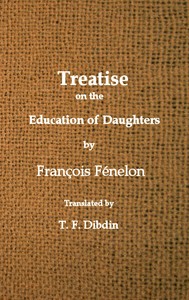
Fenelon's Treatise on the Education of Daughters Translated from the French, and Adapted to English Readers — A Closer Reading
(0 User reviews)
1405
Project Gutenberg
2014
Not confirmed
Women -- Education
Readers of public-domain and historical texts
Project Gutenberg digital edition
en
Edition facts
Words
33,570
Reading time
146 min
Text sections
4
The catalog record for Fenelon's Treatise on the Education of Daughters Translated from the French, and Adapted to English Readers — A Closer Reading provides practical reading context through 33,570 words, 2 hr 26 min estimated reading time, and 4 detected text sections.
The text analysis averages about 29.3 words per sentence, while the detected sections provide another way to judge how the source is divided.
Project Gutenberg metadata also associates the work with “Women -- Education,” connecting these edition facts with the source record’s subject description.
Source:
Project Gutenberg record #47621
Dibdin's 1805 translation of Fénelon's 1688 treatise adapts the French for English readers, adding a chapter on religious studies. The preface contrasts Fénelon's 'sententious and logical' style in this work with his 'flowing and luxuriant' Telemaque, and the text emphasizes example over precept in moral education.
Read the complete public-domain text at its original source.
Read on Project GutenbergDibdin's preface sets this translation apart by foregrounding a stylistic tension: he finds Fénelon's De l'Education des Filles 'sententious and logical,' nearly as difficult to render into English as 'the philosophical Tacitus,' whereas the same author's Telemaque is 'flowing and luxuriant.' This observation frames the entire treatise, alerting readers to a compressed, argumentative voice that prioritizes precept over ornament. Dibdin further notes that a 1797 anonymous translation adhered so closely to French idiom that 'almost every page abounds with gallicisms,' justifying his own freer approach.
The excerpts reveal a text built on short, imperative sentences and logical chains—'Teach them that nature is but the common order'—rather than the elaborate periods of Fénelon's better-known work. The translator's added chapter 'On Religious Studies' extends the original's concern with forming conscience through reasoned instruction, not rote memorization.
A Translator's Stylistic Diagnosis
Dibdin's preface is unusually candid about the challenges of rendering Fénelon's prose. He contrasts the 'flowing and luxuriant' periods of Telemaque with the 'sententious and logical' texture of the education treatise, a distinction that shapes the reader's expectations. The translator admits he has not attempted a 'literal translation' and that a 'still greater deviation' will be observable from a wish to adapt the work for English readers. This meta-commentary is itself a feature of the edition: the reader encounters not just Fénelon's arguments but Dibdin's judgments about style. The preface also mentions two earlier English versions—Dr. Hickes's 1707 translation (which Dibdin had not seen) and an anonymous 1797 Hull edition—positioning his own work as a corrective to the latter's 'gallicisms.'
The Logic of Religious Instruction
Fénelon's method for teaching religion is strikingly systematic. He advises instructors to 'assist their understanding, and put them in the way of comprehending the foregoing truths on their proper foundations,' warning against mere memorization 'in like manner as they are taught the catechism.' The excerpts show a stepwise pedagogy: first lead the child to 'a knowledge of herself and of God,' then add 'historical facts' so she may 'remark with pleasure the connection between such reflections and the history of mankind.' The argumentative structure is cumulative, moving from self-knowledge to creation, then to the Fall (man 'born with inclinations contrary to reason'), and finally to redemption. Fénelon uses analogies—the soul governing the body like a horseman, a grain of corn decaying to reproduce—to make abstract doctrines concrete.
Example Over Precept: The Role of Conduct
A recurring emphasis in the excerpts is the primacy of example. Fénelon states flatly that 'in every period of life, example has an astonishing effect upon us—in infancy, it is every thing.' Children, he argues, 'judge much more from the example of those who propose, than from the reasons which they adduce.' This leads to a sharp warning: if a child observes that 'your actions do not correspond with your precepts,' religion will appear as 'only a specious ceremony, and virtue as an impracticable idea.' The tone is direct and cautionary, with short, emphatic sentences—'Never indulge yourself before children, in any railleries about things which have relation to religion'—that mirror the 'sententious and logical' style Dibdin identified. The advice is concrete: maintain decorum, avoid levity, and let conduct match teaching.
Readers approaching this edition should attend to its layered voices: Fénelon's compressed, argumentative French refracted through Dibdin's self-conscious Englishing. The preface's stylistic observations are not mere preliminaries but a key to the text's texture. Notice how the translator's added chapter on religious studies extends or modifies the original's pedagogical logic. The treatise rewards attention to its sentence rhythms—short, imperative, logical—and to the way it builds moral arguments from concrete examples rather than abstract principles.
Fénelon’s quiet insistence that children learn more from what we do than what we say stayed with me long after closing Dibdin’s old translation. It felt like a whispered secret, not a lecture. That gentle conviction resurfaced unexpectedly while browsing The Children: Some Educational Problems — A Reader’s Guide, whose pages seem to carry a similar, unhurried faith in everyday acts over grand pronouncements.
There are no reviews for this eBook.
There are no comments for this eBook.
Reader reflection
Your personal reading reflection
Build a private reading journal entry for this title.
Your progress
0
/
10
2
Did this book hold your interest?
3
How likely are you to recommend this book?
4
What was the reading difficulty like?
5
Would you like to discuss this book with someone?
6
Was the book what you thought it would be?
7
How much did the book move you?
8
Could you follow the author’s main argument?
9
What did this book teach you most?
10