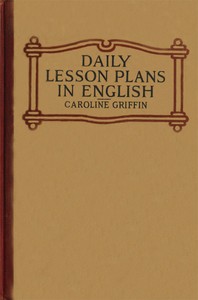
Daily Lesson Plans in English — Context and Discussion

(4 User reviews)   791
Griffin, Caroline Stearns, 1868- Project Gutenberg 2017
English language -- Study and teaching Readers of public-domain and historical texts
Project Gutenberg digital edition en

Edition facts

Words 34,692
Reading time 151 min
Text sections 12

The source record for Daily Lesson Plans in English — Context and Discussion measures this digital text at 34,692 words, 2 hr 31 min estimated reading time, and 12 detected text sections.

The text analysis averages about 13.6 words per sentence, while the detected sections provide another way to judge how the source is divided.

Project Gutenberg metadata also associates the work with “English language -- Study and teaching,” connecting these edition facts with the source record’s subject description.

Caroline Griffin's 1914 manual structures English instruction into daily plans for first and second years, using recitation, movement games, object lessons, and memory work, with recurring emphasis on observation, cleanliness, and polite speech.
Share
Editorial Edition Score 4.7/5

Calculated from edition completeness, EPUB availability, text structure and catalogue metadata. Not a user rating.

How this score is calculated
  • Description quality20 pts
  • Title & short description10 pts
  • Source metadata20 pts
  • Text length15 pts
  • Chapters / structure15 pts
  • EPUB file integrity20 pts

Total of 100 points, scaled to a 2.5-5.0 range. Editions with an empty description or a missing EPUB file are not scored.

Edition quality

Read the Text

ve the children tell, in their own words, the story of “Jim Crow.”

Have the children write the story of “Jim Crow.”

Poem to be memorized:

THE LAND OF STORY BOOKS

At evening when the lamp is lit, Around the fire my parents sit; They sit at home, and talk and sing, And do not play at anything.

Now, with my little gun, I crawl All in the dark along the wall, And follow ’round the forest track Away behind the sofa back.

There, in the night, where none can spy, All in my hunter’s camp I lie And play at books that I have read Till it is time to go to bed.

These are the hills, these are the woods, These are my starry solitudes, And there the river, by whose brink The roaring lions come to drink.

I see the others far away, As if in firelit camp they lay, And I, like to an Indian scout, Around their party prowled about.

So when my nurse comes in for me, Home I return across the sea, And go to bed with backward looks At my dear Land of Story Books.

--_Robert Louis Stevenson_

Have the poem copied.

Have the children commit to memory the first two stanzas of “The Land of Story Books.”

Have the children commit to memory the third and fourth stanzas of “The Land of Story Books.”

Have the pupils commit the entire poem, “The Land of Story Books.”

Repeat the poem of the week, entire.

Write a list of the adjectives to be found in the poem, “The Land of Story Books.”

Write a list of the verbs to be found in the poem, “The Land of Story Books.”

Write two words that rhyme with each of the following: Sit, wall, bed, lay, sea.

Write, in complete sentences, answers to the following questions, referring to the poem for the answers:

What do my parents do?

Where do I go with my gun?

What do I play that I am?

Write a letter, thanking your aunt for a birthday present, and telling what the present is.

Complete the following sentences:

I am ---- to New York.

I ---- to school yesterday.

Will you ---- to the circus with me?

Has your aunt ---- home yet?

Are you ---- to school to-morrow?

Shall we ---- part way home with you?

Write the names of five objects made of wood; five of iron; five of wool; five of cotton.

Write a composition telling about grapes.

Write a letter telling a friend about a squirrel you once saw.

Write an invitation to a school party.

Write five sentences telling about good manners in the school-room.

Describe, orally, some game you know how to play.

Copy the following from Whittier’s “The Barefoot Boy”:

How the tortoise bears his shell, How the woodchuck digs his cell, How the ground-mole sinks his well, How the robin feeds her young, How the oriole’s nest is hung; Where the whitest lilies blow, Where the freshest berries grow, Where the ground-nut trails its vine, Where the wood-grape’s clusters shine.

Write sentences explaining each reference in the poem copied yesterday. For example, “How the tortoise bears his shell”--The tortoise carries his shell on his back.

Have pupils dramatize “Little Red Riding Hood,” without preparation, and in their own way.

Ere, in the northern gale, The summer tresses of the leaves are gone, The woods of Autumn, all around our vale, Have put their glory on.

--_William Cullen Bryant_

Proverbs, to be copied and committed to memory:

He who does his best, does well.

It takes two to make a quarrel.

Make hay while the sun shines.

More haste, less speed.

A place for everything, and everything in its place.

A friend in need is a friend indeed.

Better late than never.

Look before you leap.

Honesty is the best policy.

Write a composition about “Sparrows.”

Write a telegram, congratulating either President Taft or Governor Wilson upon his nomination for President.

Conversation on how we can tell that Fall and Winter are coming.

Copy the following from “Hiawatha.”

THE FEAST OF MONDAMIN

And the maize-field grew and ripened, Till it stood in all the splendor Of its garments green and yellow, Of its tassels and its plumage, And the maize-ears full and shining Gleamed from bursting sheaths of verdure.

Then Nokomis, the old woman, Spake and said to Minnehaha: “Tis the Moon when leaves are falling; All the wild rice has been gathered, And the maize is ripe and ready; Let us gather in the harvest, Let us wrestle with Mondamin, Strip him of his plume and tassels, Of his garments green and yellow.”

Commit to memory the selection from “Hiawatha.”

Conversation on the meaning of the “Mondamin” story.

Write a story on “Corn--How It Grows.”

Write ten sentences about the uses of corn.

Write the abbreviations for _month_, _year_, the days of the week, the months of the year.

Chestnuts in the ashes Bursting through the rind, Red leaf and yellow leaf Rustling down the wind; Mother “doin’ peaches” All the afternoon-- Don’t you think that Autumn’s Pleasanter than June?

Write five reasons why autumn is pleasanter than June.

Write ten sentences containing the word blue.

Write a rhyme of four lines about apples.

What is the name of this month? What was last month called? What month follows October? What season is this? What season follows autumn? What are the four seasons? How do you know that it is autumn? How is the weather different from what it was in July? What are the birds doing this month? What is happening to the leaves on the trees? What flowers are in blossom this month?

A little verse to learn:

Work, and make the world sweet, That’s the best for you.

Read this little poem to the children:

Little Miss Chestnut lived in a tree, She and her sisters; one, two, three. Their house was covered with prickles green, To keep the squirrels away, I ween.

Soon Jack Frost knocked, just for fun; Out jumped the chestnuts, every one.

Elsie and Fred, on their walk next day, Found the nuts and took them away. On winter evenings, cold and long, They’ll roast the nuts. Here ends my song.

_Have ready_, but out of sight, a chestnut burr, if possible containing some of the nuts. If you cannot get the burr, at least have some of the nuts enough so that each child may have one to eat, after the lesson is over.

Show the children how the prickly burr protects the nuts from squirrels, and from boys and girls, until the nuts are ripe. Then Jack Frost comes along and opens the burr, and the nuts fall out.

Explain how the nut itself is the seed of the chestnut tree, and how, if allowed to lie under the snow all winter, a new little chestnut tree will start up in the spring.

Teach this little rhyme to the children:

When we have a pleasant day, We like to stroll along the way; And as we walk upon the street, The folks we know we always greet.

Use the rhyme as a means of teaching the children the proper method of salutation on the street. Let the girls wear their hats, and the boys have their caps at their seats with them. Allow a boy and a girl, with hats on, to go to the front of the room, and from opposite sides of the room walk towards each other. As they start, the children--all except the two at the front--repeat the rhyme. When the two children at the front meet, the girl nods her head politely, and the boy lifts his hat. After the simple ceremony the two children return to their seats, and their places are taken by other boys and girls, in turn, until all can perform the act easily and gracefully.

Ask each child to bring a penny to school. See how many things are to be found on the penny--as a head, date, etc.

Tell the children that October was the month when America was discovered. We live in the United States, and the United States is in America. Tell the story of Columbus and the discovery of the new continent. If well told, the story is quite as fascinating as a fairy tale.

Have the children tell back to you the story of Columbus and the discovery of America.

This poem, acted out as indicated, can be used effectively as a rest exercise. As all the children will be moving, the windows can be thrown open, and the room aired while the game is being played.

The poem is to be recited by the teacher. Allow plenty of time between lines, for each part to be acted.

Children representing Sunshine, Miss Weather and Professor Wind are first chosen. They take their places in the front of the room. Then the other children are separated, by rows of desks, into Ashes, Oaks, Maples, and Chestnuts.

October gave a party; The leaves by hundreds came--

The Ashes, Oaks, Maples, and Chestnuts come skipping, tiptoe, up the aisles, helter-skelter, to represent flying leaves.

The Ashes, Oaks, and Maples, And those of every name.

The skipping is continued, until all the leaves stand in a group at one side of the room.

Miss Sunshine spread a carpet, And everything was grand.

As these two lines are being recited Miss Sunshine pretends to spread a carpet over the entire open space at the front of the room. She may take plenty of time. The poem is not to be recited continuously.

Miss Weather led the dancing,

As this line is recited, Miss Weather skips alone across the front of the room, from one side to the other.

Professor Wind, the band.

Professor Wind marches pompously across the room, tooting a real or an imaginary horn.

The Chestnuts came in yellow,

The Chestnuts skip lightly, by couples, from one side of the room to the side where Miss Weather stands. They bow to Miss Weather by twos, turn, and skip back again.

The Oaks in crimson dressed; The lovely Misses Maple In scarlet looked their best.

The Oaks, then the Maples, followed by the Ashes, skip across the room by twos, bowing to Miss Weather, and returning to their places, after the fashion of the Chestnuts.

And balanced all their partners, And gaily fluttered by; The sight was like a rainbow Now fallen from the sky.

While the teacher is reciting the four lines given above, all the children are still, but at its close, all skip about partners, holding their clasped hands high above the head, skipping tiptoe, as before, and very light and gay.

Then in the rustic hollows, At “hide-and-seek” they played, The party closed at sundown, And everybody stayed.

All remain quiet while the four lines given above are recited, then partners separate, and everybody apparently hides somewhere.

Professor Wind played louder; They flew along the ground; And then the party ended In jolly hands around.

As Professor Wind blows his hardest, all gather from their hiding places, take hold of hands and circle round, and the game ends.

--_Selected and adapted_

Play the October game.

Play the October game.

Read this poem to the children, for them to guess who is meant:

A roguish old fellow is prowling about In field and in garden; you can’t keep him out. No matter how tall You build up your wall, He’ll find a way over, in spite of it all.

On the glass of the window his pictures you’ll see, A grand exhibition (admission is free); He works hard at night While the stars glitter bright; But when the sun rises he keeps out of sight.

He’ll sketch you a snow-covered mountain or tree; A torrent all frozen, a ship out at sea. He draws very fast, But his work does not last: It fades when the chill of the night-time is past.

Before the sun rises, while hardly ’tis light, He feels of the fruit and takes a sly bite; He has a fine taste, Though a great deal he’ll waste, Then off he will go in very great haste.

Now, who do you think this old fellow may be, The bright, sparkling work of whose fingers we see? All winter he’ll stay, What more shall I say? Only this, that his first name begins with a J.

On this, or some rainy morning of the week, talk about the weather. Why did you all come to school this morning with rubbers and umbrellas? Why is an umbrella shaped as it is? Why does the rain sometimes fall straight down, and sometimes slanting? How does the rain tell us which way the wind blows? Why do rubbers keep our feet dry, when shoes do not? What else is made of rubber?

Teach the children this memory gem:

All that’s great and good is done Just by patient trying.

What does Jack Frost do to the windows? What does he do to the nuts? What does he do to the apples? What does he do to the grass? What are some other things that Jack Frost does?

Play the October game, described under the preceding week.

An October Pumpkin Story. (To be told to the children.)

One afternoon in late October, father went down to the field to get a pumpkin.

The children went along too. They wanted to see that father picked out a large pumpkin. They wanted to help bring it back to the house.

Although it was October, there were still some pumpkins to be found in the field.

Father led the way. The children came trooping after.

The pumpkins grew down in the cornfield. Their long, coarse stems lay sprawling on the ground. Their big, rough leaves looked like green umbrellas.

The boys saw a very large pumpkin. They were just going to pick it, but father said, “Not that one.”

Father looked around until he found a deep, yellow pumpkin. He told the children that deep, yellow pumpkins make the best pies.

The children soon found another pumpkin, somewhat smoother than the others. They picked that to use for a Jack-o’-lantern.

Then they went back to the house, carrying the huge yellow fruit with them.

The girls went into the house, to see mother make pumpkin pies.

Mother cut open the yellow pumpkin. Oh, how thick the meat was! Oh, how the fat, white seeds came tumbling out! Mother said the flesh was good because it had a nice fine grain.

Mother cut the flesh into small pieces, after she had peeled off the thick rind.

Then she put the pieces into a large iron pot to boil.

When the girls had seen the pieces disappear into the pot they went to see what the boys were doing.

Out by the barn they found the boys with a jack-knife, working away at the other pumpkin. The boys were making a Jack-o’-lantern.

They had cut a round hole in the top of the pumpkin, so as to leave the stem for a handle. In this way they could lift out the round piece like a cover. They dug out all the seeds with their hands, to make it hollow.

Then they cut a small hole, shaped like a triangle, in the side of the pumpkin. They bored two round holes, one each side of the triangle. Below it they cut a funny hole shaped like a new moon.

It looked like a huge grinning face. When the boys had finished it, they put the pumpkin away in the barn.

Then they all remembered about the pumpkin that was cooking in the kitchen, so they ran back to the house as fast as they could.

By this time the pumpkin in the pot was done, and mother took it from the stove. She poured off the water, and then put the cooked pumpkin into a colander.

While mother was rubbing the soft pumpkin through the colander, the boys ran off to hunt for eggs. When they came back, mother took eight of the eggs, and about three pints of the soft pumpkin. She stirred it very fast, while the children stood around and watched, with open eyes and mouths. Then she put in milk, and spice, and brown sugar.

Oh, didn’t it look good! The children smacked their lips as each separate thing went in. Mother gave it all such a beating with her big spoon that the children said it would be good ever after.

Next came the pie tins lined with soft crust, and last of all the pies went into the oven.

That night as father and mother sat in front of the fire-place talking, a strange noise was heard. What could it be? Was it a groan? Was somebody hurt? There it was again, again, and again! It came from the front porch.

Father went to the window and drew aside the curtain. Then they saw something that made the smaller children shiver, but the older girls only laughed. The boys were not in the house.

There at the window, staring in and grinning horribly--was--well, what do you suppose? Yes it was the Jack-o’-lantern.

Talk about Jack-o’-lanterns. If possible, make one in school, or show the children one.

Talk about Hallowe’en, and how the Jack-o’-lantern is used for decoration at that time.

Talk about Hallowe’en tricks.

Play some of the Hallowe’en tricks in school.

To be copied and memorized by the pupils:

The world’s a very happy place, Where every child should dance and sing, And always have a smiling face, And never sulk for anything.

The world is such a happy place, That children, whether big or small, Should always have a shining face, And never, never sulk at all.

Have the children write answers, as complete sentences, to the following questions about “The World’s Music”:

What kind of place is the world?

What should every child have?

What should a child do?

What should a child never do?

Bring sufficient hickory nuts to the class so that each child can have one. If possible, have the nuts in the hulls. Ask the following questions, for the children to answer:

How many hulls on each nut?

What are the hulls for? (To protect the nut.)

What takes off the hulls when they are quite ripe? (The frost.)

Which is the blossom end of the nut, and which is the stem end?

Crack a hickory nut. What is there inside the shell?

Explain how the nut grows, to start a new tree.

Copy these sentences, filling the blank spaces with _is_, or _are_:

A gray squirrel ---- in the tree.

The squirrel ---- fond of nuts.

The tree ---- once the squirrel’s home.

Hickory nuts ---- the squirrel’s food.

I am just a bit sour.

Would you like to eat me?

Poem to be memorized.

Commit the first stanza of the poem to memory:

Great, wide, wonderful, beautiful world, With the wonderful water around you curled, And the wonderful grass upon your breast-- World, you are beautifully dressed!

The wonderful air is over me, And the wonderful wind is shaking the tree; It walks on the water and whirls the mills, And talks to itself on the tops of the hills.

You friendly Earth, how far do you go, With wheat fields that nod, and rivers that flow, With cities and gardens, and oceans and isles, And people upon you for thousands of miles?

Ah, you are so great and I am so small, I hardly can think of you, World, at all; And yet, when I said my prayers to-day, My mother kissed me, and said, quite gay:

“If the wonderful World is great to you, And great to father and mother, too, You are more than the Earth, though you are such a dot, You can love and think, and the Earth cannot!”

--_William Brighty Rands_

Commit to memory the second stanza of the poem.

Commit to memory the third stanza of the poem.

Commit to memory the fourth stanza of the poem.

Finish learning the poem, and recite it all.

The Post-Office.--What is a post-office? Who has charge of the post-office? Where is the post-office nearest your home? What do you see when you go to the post-office? How do you get your mail? Why do people write letters? How do letters go from one place to another? What is the stamp on a letter for? How much does it cost to send a letter? Who pays for sending a letter?

It is cold in the fall.

I like fall, for I can play out-of-doors.

Caroline Griffin's Daily Lesson Plans in English (1914) organizes instruction into day-by-day units for first- and second-year students, each week built around a mix of recitation, movement, observation, and writing. The plans rely heavily on oral participation: children name flowers, act out nursery rhymes, and supply missing words in familiar verses. A typical Monday might begin with a sunflower as a visual prompt, while Tuesday turns “Hey, diddle, diddle” into a classroom game with assigned roles. The structure is cyclical—each week reintroduces similar activity types—but the content shifts seasonally, from September sunflowers to winter snowflakes.

Recurring Patterns in Weekly Plans

Across both years, Griffin repeats a predictable weekly rhythm. Mondays often open with a concrete object or a question about the natural world (sunflower, weather, snowflakes). Tuesdays introduce movement or dramatization: first-year children play “Hey, diddle, diddle” by jumping over a makeshift moon; second-year students act out a dog’s vigilance. Wednesdays typically involve copying or memorizing a short poem or maxim. Thursdays return to oral discussion or storytelling, and Fridays close with listing or writing tasks. This pattern gives teachers a stable framework while varying the specific material.

Movement and Dramatization as Teaching Tools

Griffin frequently turns language lessons into physical activity. In the first week, children do not merely recite “Hey, diddle, diddle”—they become the cat, fiddle, dish, and spoon, with the “cow” stepping over a held object. Later, a lesson on verbs asks a child to demonstrate “run” or “walk” while classmates observe. The second-year story of a wise dog is first told by the teacher, then retold orally by students, and finally written in three sentences. This progression from listening to speaking to writing mirrors the embodied start of the lesson.

Observation and the Natural World

Many lessons begin by directing children’s attention to something visible: a sunflower, the day’s weather, a flag, snowflakes. Griffin uses these prompts to elicit descriptive language and to connect schoolwork to everyday experience. In September, children name flowers by color; in winter, they discuss where snow comes from and why it is called a blanket. The plans also incorporate riddles (“What am I?” about the tongue) that require children to infer from clues. These exercises train careful looking and logical thinking alongside vocabulary.

Emphasis on Cleanliness, Manners, and Memory

Griffin weaves social and moral instruction into the academic plan. In the second week of first year, children are asked who washed their faces and combed their hair, leading to a talk on cleanliness. Later, a dictation line reads “Be kind in all you say and do, That others may be kind to you.” Memorization of poems—such as Lord Houghton’s “Lady Moon”—is spread over several days, with each stanza copied and recited before the whole is performed. The combination of rote learning and gentle moralizing reflects early twentieth-century classroom values.

Griffin’s plans are best read as a teacher’s script rather than a student textbook. The daily entries assume a live classroom where children speak, move, and respond aloud. Readers interested in historical pedagogy will notice the absence of standardized testing and the presence of group recitation, object lessons, and physical play. The book offers a concrete picture of how one educator structured the first two years of English instruction in 1914, with an emphasis on oral language, observation, and polite behavior.

There’s a quiet tenderness in how Caroline Griffin’s old manual pauses over a child’s clean hands or a politely offered “please”—as if those small habits held the whole of schooling. I felt that same gentle patience again in How to Teach Phonics — Story, Setting & Ideas, where even the alphabet seems to wait, unhurried, for a child to find it. Strange how these century-old pages still feel like someone’s steady hand at my shoulder.

Lucas Wright
2 weeks ago

Olivia Brown
1 month ago

Scarlett Carter
2 weeks ago

Grayson Carter
3 weeks ago

4.5
4.5 out of 5 (4 User reviews )

Add a Review

Your Rating *
  • ...
    Nicole Gomez - 3 weeks ago
    {'rating': 5, 'text': "This is an incredibly practical resource for English teachers. The daily lesson plans are well-structured, engaging, and cover a wide range of skills. The activities are adaptable, and the clear objectives make it easy to implement in any classroom. It has saved me countless hours of prep time and improved my students' engagement."}

  • ...
    Shannon Shannon Henry - 3 weeks ago
    {'rating': 3, 'text': "A useful collection of lesson plans with clear outlines and objectives. The variety of activities is good, but some plans require more preparation than described, and the progression could be smoother. Still, it's a helpful starting point for teachers seeking structure and inspiration."}

  • ...
    Andrew Mckee - 2 weeks ago
    {'rating': 2, 'text': "The lesson plans are quite generic and lack creativity. They don't account for different learning styles or classroom dynamics, and the instructions are sometimes unclear. The book feels like a dry list of activities rather than a dynamic teaching guide. I found it unengaging and not very effective in practice."}


Reader reflection

How will you remember this book?

Save your reaction, strongest insight, and memorable passage.

Your progress 0 / 10
1

How far have you progressed with this book?

2

How did the book work for you overall?

3

Is this a title you would suggest to others?

4

How much effort did this book require?

Related eBooks