A Discourse Being Introductory to his Course of Lectures on Elocution and the English Language (1759) — Context and Discussion

(1 User reviews)   176
Sheridan, Thomas, 1719-1788, Mohrmann, G. P., 1925- [Editor] Project Gutenberg 2011
Elocution -- Study and teaching -- Early works to 1800 Readers of public-domain and historical texts
Project Gutenberg digital edition en

Edition facts

Words 19,157
Reading time 84 min
Text sections 3

Before opening A Discourse Being Introductory to his Course of Lectures on Elocution and the English Language (1759) — Context and Discussion, the edition data offers a quick orientation: 19,157 words, 1 hr 24 min estimated reading time, and 3 detected text sections.

The text analysis averages about 28.6 words per sentence, while the detected sections provide another way to judge how the source is divided.

Project Gutenberg metadata also associates the work with “Elocution -- Study and teaching -- Early works to 1800,” connecting these edition facts with the source record’s subject description.

Sheridan's 1759 lecture argues that English elocution is neglected in favor of Latin, reducing a living language to a dead one. He calls for systematic instruction in spoken English, using rhetorical contrasts and a metaphor of custom as a fortress to advocate reform.
Share
Editorial Edition Score 4.5/5

Calculated from edition completeness, EPUB availability, text structure and catalogue metadata. Not a user rating.

How this score is calculated
  • Description quality20 pts
  • Title & short description10 pts
  • Source metadata20 pts
  • Text length15 pts
  • Chapters / structure15 pts
  • EPUB file integrity20 pts

Total of 100 points, scaled to a 2.5-5.0 range. Editions with an empty description or a missing EPUB file are not scored.

Edition quality

Read the Text

English were reinforced by his godfather, Dean Swift, who was long an intimate of the elder Sheridan. In later years, Sheridan was eager to acknowledge that his attitudes had been profoundly influenced by those of Swift.

To some degree Sheridan's dedication to language study is evidenced in his theatrical activities. As an undergraduate, he wrote a play that was later published; and almost immediately after taking his M.A. at Trinity College, he made his professional acting debut in Dublin. This was 1743, and forty years later he was taking part in Attic Entertainments, performances "consisting of recitation, singing, and music."[4] A selective chronology suggests his involvement with the stage: 1744, acting in London with Garrick; 1750, acting and managing in Dublin; 1760, acting in London; 1780, acting manager for his son at Drury Lane.

Successful as an actor, Sheridan appears to have missed greatness because he could not overcome an inflexibility and obstinacy in personality; and the same characteristics helped to precipitate a number of squabbles and riots that marred his managerial efforts. However, much of his frustration in the theatre must be attributed to the more compelling attraction to the theory of delivery in speaking. The stage provided a practical outlet, but Sheridan's fascination with elocutionary theory dominated and deflected the interest in theatre.

That elocution was his primary concern is demonstrated in his major publications: _British Education_, 1756; _Lectures on Elocution_, 1762; _A Plan of Education_, 1769; _Lectures on the Art of Reading_, 1775; and _A General Dictionary of the English Language_, 1780. In all of these works the central argument remained unchanged after its initial statement in the complete title of _British Education_.[5] There, Sheridan suggested that a revival of the art of speaking would improve religion, morality, and constitutional government; would undergird a refining of the language; and would pave the way for ultimate perfection in all the arts.

Having posited this thesis in 1756, Sheridan was reiterating it still in the material prefatory to his pronouncing dictionary in 1780, and he never rested with publication alone. As early as 1757 he lectured on the principles of education, and he first presented his course of lectures on elocution in 1758-59 at Oxford and Cambridge. Over the years the course proved to be both popular and financially rewarding, and Sheridan sometimes presented the lectures in order to relieve financial embarassment. Nevertheless, his devotion to the cause was the crucial factor. His interest in language somehow became an almost blind devotion to spoken English, and through his course he could carry his message to influential audiences in England, Ireland, and Scotland; the Edinburgh Select Society sponsored two series in 1761, and Sheridan was lecturing on elocution as late as 1785.

The _Discourse_ typifies Sheridan's simplistic interpretation and the evangelistic ardor with which he addressed his audiences. He was not content to fault an overemphasis in the study of Latin, nor was he satisfied to argue that "the support of our establishments, both ecclesiastical and civil" rests upon public discussion. Many in his audiences would have agreed, and few would have taken issue with the contention that the "art of elocution" needed further cultivation. But Sheridan pressed on to insist that the written language, being an invention of man, "can have no natural power," and he argued that the "highest delights" of aesthetic pleasures must wait upon the perfection of spoken English. He even went so far as to suggest that the study of "grammar, rhetorick, and oratory" explained the outstanding artistic achievements of Greece and Rome.

Moreover, "other benefits to society" would add to "the glory of the nation" and to the "ornament of individuals, and of the state in general" through a loosing of silent tongues. Sheridan dreamed that the study of elocution, with a voice "far sweeter than the syren's song," would so entrance young students that they would linger long in native academic groves, avoiding the baneful influence of travel abroad "at the most unfit and dangerous season of life." Thus, individual and social perfection had to be predicated upon the study of spoken English, and Sheridan implied that to slight this study was to offer an affront to the divine plan for earthly progress.

This panacean outlook prompted Hume to remark that "Mr. Sheridan's Lectures are vastly too enthusiastic. He is to do every thing by Oratory."[6] And it is not surprising that the critical, the Johnsons and Humes, should have been distressed by Sheridan's enthusiasm, an enthusiasm that permitted him to posit such unlikely goals and to see himself as the sole authority on elocution. Yet, for every negative reaction, the elocutionists enlisted countless believers. Sheridan and other theorists capitalized upon a number of intellectual currents and social pressures of the era that centered attention upon delivery in speaking and that helped aggrandize this facet of rhetorical training. A number of forces can be isolated, but most relate to the classical inheritance, to the belief that tones, looks, and gestures constitute a natural language of the passions, and to the methodology of science.[7]

The classical inheritance was important to the elocutionists because of the impetus given to all language study. Sheridan did no more than echo a common complaint when he worried over the "many bad consequences" attending a neglect of the English language; countless writers addressed themselves to a determination of phonology and pronunciation in the attempt "to methodize" the language. Furthermore, the example of ancient oratory spoke loudly to a people striving to perfect both the individual and social institutions. Any educated man was expected to be able to express himself well in public, particularly if his vocation found him "in the pulpit, the senate-house, or at the bar." The pulpit was a favorite target, and critics regularly lamented the atrocious state of speaking "in the very service of the Most High." The elocutionists and others appear to have been convinced that the doubt and scepticism of the age would be much relieved if only the preachers would learn to speak properly. Theirs seemed the best of all possible religions, and it needed but a vitalization through adequate pulpit oratory to transcend anything accomplished by the Popish devotees on the Continent. Certainly Sheridan's references to the Continent also reflect a strong overlay of nationalism, and the same spirit creeps into his worship of Greece and Rome; but he and the other elocutionists knew that they owed a profound debt to classical rhetorical theory. Beyond supporting language study generally and beyond encouraging an interest in public speaking, ancient rhetoric justified a concentration on delivery.

After centuries of a chameleon-like existence, the complete Ciceronian rhetoric emerged in England just in time to meet a savage onslaught from the methods of science and the new epistemology.[8] Eventually, rhetoricians such as Campbell and Blair were to successfully blend the old and the new, but the elocutionists found fertile ground in delivery alone. They began, as Sheridan did, with the testimony of Cicero and Quintilian because _actio_, or _pronuntiatio_, was one of the five established canons of classical rhetoric. A favorite citation, though Sheridan did not use it, was Demosthenes' reputed response when asked to name the three most important parts of rhetoric: "Actio, actio, actio." The endorsement of antiquity lent powerful support to the study of delivery, and this was the one canon that had not been subjected to regular exhaustive analyses throughout the rhetorical tradition. Here was a topic ripe for further investigation, and by Sheridan's day, the tones, looks, and gestures of delivery had achieved commonplace status in discussions of man's emotions.

Sheridan spoke as if this natural language of the passions were "hardly ever thought of," but the belief that tones, looks, and gestures were external signs of internal emotions was firmly established by the middle of the eighteenth century. The notion has received some attention throughout western thought, but most speculation appears to date from Descartes' _Les Passions de l'ame_ in 1650. The increasing concern with mind-body problems encouraged inquiries into the nature and function of the natural language in all areas relating directly to man's emotion and its expression. The topics were as various as religion and physiognomy, but discussions of the natural language construct centered upon human communication, particularly in the arts.

The construct became especially significant in analyses of painting and sculpture. Examples of its impress can be seen in Le Brun's sketches of the passions,[9] in Hogarth's having embraced "the commonly received opinion, that the face is the index of the mind,"[10] and in Dryden's contention that "to express the passions which are seated in the heart, by outward signs, is one great precept of the painters." Dryden added that "in poetry, the same passions and motions of the mind are to be expressed,"[11] and the natural language found its way into most discussions of tragedy and the epic. Other examples of literary analysis in which the construct operated include Steele's _Prosodia Rationalis_, Say's _An Essay on Harmony, Variety, and Power of Numbers_, and Kames' _Elements of Criticism_. In sum, it was almost universally accepted that the creative artist was to observe and record the natural language of the passions. In Sheridan's words, he was to perceive and delineate the "operations, affections, and energies, of the mind itself ... manifested and communicated in speech."

The methodology of science was indirectly responsible for giving added support to this facet of elocutionary rationale. When British empiricism was pressed to the limit, considerable doubt and scepticism resulted; and the Scottish common sense philosophy was, in large part, a counter response. The operation of the natural language became one of the first principles of common sense; and in their discussions of philosophy, aesthetics, and rhetoric, the Scots argued for the study of elocution.[12]

Science contributed directly to the movement by providing the framework for analysis. Without the empirical approach and the confidence in scientific methodology, theorists simply would not have attempted to isolate and describe the elements in the external signs of the emotions. Science forced Sheridan to think in terms of empirical observation and categorization, and science permitted him to call for "sure and sufficient rules" in order that "the art of speaking like that of writing ... be reduced to a system." It is even symptomatic that he should have referred to the design of the "Great Mechanist."

Almost as enthusiastic as Sheridan, a number of other elocutionists expressed similar views and found their theories invigorated by the same forces. James Burgh in the _Art of Speaking_ (1761), John Walker in _Elements of Elocution_ (1781) and a number of other works, and Gilbert Austin in _Chironomia_ (1806) were among the more influential elocutionary theorists. Numerous other writers in both England and America participated in making the study of elocution an established part of the English rhetorical tradition.

In America, the study gained acceptance at all levels of education, and the class in elocution became a standard course in colleges and universities. Elocution centered upon oral reading and public speaking, and written composition came to be the exclusive province of the rhetoric class. The resultant distinctions between oral and written discourse played a significant role in the eventual development of separate departments of speech and English in American colleges and universities.[13]

Although speech departments grew out of elocutionary studies, elocution disappeared from the curriculum because of an association with an excessive emphasis upon performance as performance. Reaction was compounded by a sophistication in psychology that made early theory seem naïve, but neither later excesses nor seeming naïvety should be permitted to distort the main thrust of the elocutionary movement. Concentrating upon language in use, the elocutionists encouraged and anticipated analyses now being vigorously pursued in a range extending from linguistics to nonverbal communication. Their contribution has for too long been ignored, and it is happily foreshadowed in Thomas Sheridan's enthusiastic _Discourse_.

University of California, Davis

NOTES TO THE INTRODUCTION

[Footnote 1: See Wallace A. Bacon, "The Elocutionary Career of Thomas Sheridan (1718-1788)," _Speech Monographs_, XXXI (1964), 1-53.]

[Footnote 2: John Watkins, _Memoirs of the Right Honorable R. B. Sheridan_, (London, 1817), I, 43.]

[Footnote 3: _Ibid._, p. 39.]

[Footnote 4: _Ibid._, pp. 145-146.]

[Footnote 5: _British Education: Or, The Source of the Disorders of Great Britain. Being An Essay towards proving, that the Immorality, Ignorance, and false Taste, which so generally prevail, are the natural and necessary Consequences of the present defective System of Education. With An Attempt to shew, that a Revival of the Art of Speaking, and the Study of Our Own Language, might contribute, in a great measure, to the Cure of those Evils. In Three Parts. I. Of the Use of these Studies to Religion, and Morality; as also, to the Support of the British Constitution. II. Their absolute Necessity in order to refine, ascertain, and fix the English Language. III. Their Use in the Cultivation of the Imitative Arts: shewing, that were the Study of Oratory made a necessary Branch of the Education of Youth; Poetry, Musick, Painting, and Sculpture, might arrive at as high a Pitch of Perfection in England, as ever they did in Athens or Rome._]

[Footnote 6: James Boswell, _Private Papers of James Boswell_ (Mt. Vernon, New York, 1928-34), I, 129.]

[Footnote 7: See Frederick W. Haberman, "English Sources of American Elocution," _History of Speech Education in America_, ed. Karl Wallace (New York, 1954), pp. 105-126.]

[Footnote 8: See Wilbur Samuel Howell, _Logic and Rhetoric in England, 1500-1700_ (Princeton, 1956).]

[Footnote 9: Charles Le Brun, _Conférence de Monsieur Le Brun sur l'expression generale & particulière_ (Amsterdam, 1698).]

[Footnote 10: William Hogarth, _Analysis of Beauty_, ed. Joseph Burke (Oxford, 1955), p. 136.]

[Footnote 11: John Dryden, "A Parallel of Poetry and Painting," in _Essays_, ed. W. P. Ker (Oxford, 1900), II, 145.]

[Footnote 12: See G. P. Mohrmann, "The Language of Nature and Elocutionary Theory," _Quarterly Journal of Speech_, LII (1966), 116-124.]

[Footnote 13: See studies reported in _History of Speech Education in America_.]

The text of this reprint of Sheridan's _Discourse_ is reproduced from a copy in the William Andrews Clark Memorial Library.

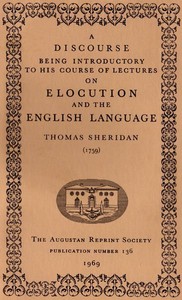
The THEATRE at OXFORD,

The SENATE-HOUSE at CAMBRIDGE,

At SPRING-GARDEN in LONDON.

By THOMAS SHERIDAN, M. A.

Being Introductory to

His COURSE of LECTURES

ELOCUTION and the ENGLISH LANGUAGE.

Ut enim hominis decus ingenium, fic ingenii ipsius lumen est eloquentia.

Printed for A. MILLAR, in The Strand; J. RIVINGTON and J. FLETCHER, in Pater-noster-Row; J. DODSLEY, in Pall-Mall; and sold by J. WILKIE, in St. Paul's Church yard.

THE TWO LEARNED UNIVERSITIES

Oxford AND CAMBRIDGE,

The following Discourse

(As a small token of gratitude

For the candour with which they received,

And the generosity with which they encouraged,

Towards improving Elocution,

And promoting the study of the ENGLISH Language)

And the most profound respect,

The THEATRE at OXFORD,

The Senate-House at CAMBRIDGE,

At SPRING-GARDEN in LONDON.

It has been a long time since all men, who have turned their thoughts to the subject, have been convinced, that the neglect of studying our own language, and the art of speaking it in public, has been attended with many bad consequences; and some of our most eminent writers have freely delivered their thoughts upon this head to the world. Amongst the foremost of this number are Milton, Dryden, Clarendon, Locke, Addison, Berkley, and Swift; besides multitudes of less note. But as they have only pointed out the evil, without examining into its source, or proposing an adequate remedy; as they have shewn the good consequences which would follow from the introduction of those studies, only in theory, without laying down any probable method, by which their speculations might be reduced to practice, their endeavours in this way, however laudable, have hitherto proved but of little benefit to mankind.

Any attempt, therefore, towards a practicable plan, whereby such studies may be introduced, will well deserve the attention of the best and wisest men; and, if it should meet with their approbation, will necessarily also obtain their encouragement and assistance.

This consideration it was, which emboldened me to appear before this learned assembly; and though, when I reflect on the knowlege, wisdom, and nice discernment, of my hearers, I am filled with that awe and reverence which are due to so respectable a body, yet, as candour and humanity are the inseparable attendants on wisdom and knowlege (for as the brave are ever the most merciful, so are the wise the most indulgent), I can have no cause to fear the submitting my opinions to the decision of such judges as are here assembled. Whatever shall appear to be founded in reason and truth cannot fail of producing its due effect in this region of true philosophy: and whatever errors or faults may be committed, as they cannot escape the penetration, so will they be corrected and amended by the skill and benevolence of such hearers. A point to be wished, not dreaded; as to an inquirer after truth, next to the being right, the thing most to be desired is the being set right. In either way, a person engaged in a new undertaking is sure to be a gainer, where honour, and certainty of success, will follow judicious approbation; where benefit, and the means of succeeding, will attend just censure.

Encouraged by these reflections, I shall therefore, without farther preface, enter upon my subject.

That the English are the only civilized people, either of ancient or modern times, who neglected to cultivate their language, or to methodize it in such a way, as that the knowlege of it might be regularly acquired, is a proposition no less strange than true.

That the English are the only free nation recorded in history, possessed of all the advantages of literature, who never studied the art of elocution, or founded any institutions, whereby, they who were most interested in the cultivation of that art; they whose professions necessarily called upon them to speak in public, might be instructed to acquit themselves properly on such occasions, and be enabled to deliver their sentiments with propriety and grace, is also a point as true as it is strange.

These neglects are the more astonishing, because, upon examination, it will appear, that there neither is, nor ever was a nation upon earth, to the flourishing state of whose constitution and government, such studies were so absolutely necessary. Since it must be obvious to the slightest enquirer, that the support of our establishments, both ecclesiastical and civil, in their due vigour, must in a great measure depend upon the powers of elocution in public debates, or other oratorial performances, displayed in the pulpit, the senate-house, or at the bar.

But to leave the public interests out of the question; is it not amazing that these studies have never been established here, even upon selfish principles, which, in all other cases seldom fail of having their due force? since it can be shewn, that there never was a state wherein so many individuals were so necessarily and deeply concerned in the prosecution of those studies; or where it was the interest, as well as duty, of such numbers, to display the powers of oratory in their native language.

There is not a single point, in which the study of oratory was necessary to the ancients, wherein it is not equally so to us; nor was there any incitement to the knowlege and practice of that art, whether of pleasure, profit, or honour, which with us is not of equal strength.

We, as well as the ancients, have councils, senates, and assemblies of the people (by their representatives) whose deliberations and debates turn upon matters of as much moment, where oratory has fields as ample, in which it may exert all its various powers, and where the rewards and honours, attendant on eloquence are equal. "If we look into the history of England, for more than a century past, we shall find, that most persons have made their way to the head of affairs, and got into the highest employments, not on account of birth or fortune, but by being, what is commonly called, good speakers."

Nor is oratory less necessary to us at the bar, than it was to the ancients; nor are the rewards of profit, fame, and preferment, less attendant on it there; as has been experienced by all in that profession, who took pains to improve their talents in that way.

But there is one point, a most momentous one, in which oratory is essentially necessary to us, but was not in the least so to the ancients. The article I mean, is of the utmost importance to us; it is the basis of our government, and pillar of our state. It is the vivifying principle, the soul of our constitution, without which, it cannot subsist; I mean religion.

"As the religion of the ancients consisted chiefly of rites and ceremonies, it could derive no assistance from oratory; but there is not the smallest branch of ours which can be well executed, without skill in speaking; and the more important parts, calculated to answer the great ends, evidently require the whole oratorial powers."

Thomas Sheridan opens his 1759 lecture with a stark contrast: while Latin once thrived as a spoken tongue, English has been left to 'low and ignorant masters' who teach only letters and spelling. He asserts that the neglect of elocution—the art of speaking with proper tone, look, and gesture—has reduced English 'at best to the state of a dead one.' The lecture, delivered at Oxford, Cambridge, and Spring-Garden, is both a diagnosis and a manifesto, urging systematic instruction in spoken English.

Sheridan's rhetoric is pointed: he challenges his audience to recall 'sufficient instances' of those who write Latin elegantly yet cannot read their own compositions aloud with propriety. This appeal to shared experience grounds his argument in observable failings, setting the stage for his proposed remedy.

The Living Language Paradox

Sheridan builds his case on a paradox: English, though widely spoken, is treated as a secondary language in education. He notes that 'the rudiments of English are now taught by low and ignorant masters, for wretched stipends,' while Latin remains the chief language of schools. The result, he argues, is a generation that can parse Latin grammar but cannot speak their native tongue with grace. He points to 'numbers who understand Latin well, who do not understand their native tongue' as evidence of this systemic failure.

His critique extends to the consequences: when public speaking gives 'pain rather than pleasure' and 'occasions satiety,' listeners turn to written language, preferring 'the invention of man, to the gift of God.' This rhetorical move elevates elocution from a practical skill to a near-spiritual necessity, framing neglect as a loss of divine capacity.

Custom as Fortress

Sheridan employs a striking military metaphor to describe the grip of educational tradition. Custom, he writes, is a 'fortress' surrounded by 'impregnable bulwarks' that cannot be taken by storm. Reason alone cannot overthrow it; 'custom alone can succeed to custom.' The only path to reform is gradual, sapping the foundations rather than assaulting the walls.

This metaphor reveals Sheridan's strategic pragmatism. He does not call for revolution but for a new custom to be elected under reason's guidance. The passage is notable for its vivid imagery and its implicit acknowledgment that his audience, steeped in classical education, must be persuaded to change habits, not just ideas.

The Missionary Tone

Throughout the discourse, Sheridan adopts what the editor G. P. Mohrmann calls a 'missionary zeal.' He presents elocution not merely as an academic subject but as a cause that can revitalize public life. His language is urgent: he speaks of 'fatal consequences' and warns that without reform, 'the noblest ends, and highest delights which language can answer or afford, will be frustrated and lost.'

This fervor is tempered by his reliance on reason and evidence. He cites observable facts—the scarcity of good speakers, the army of writers—to support his claims. Yet his tone remains that of a reformer convinced of the rightness of his vision, a quality that animates the lecture and gives it a persuasive force beyond its theoretical content.

Reading Sheridan's Rhetoric

First-time readers should attend to Sheridan's structural choices. He opens with a problem (neglect of English), diagnoses its causes (custom, Latin-centric education), and proposes a solution (systematic elocution instruction). His arguments are built on contrasts: living vs. dead language, speech vs. writing, reason vs. custom.

Notice how he uses rhetorical questions—'Is not this the case at this day?'—to engage his audience directly. His metaphors, such as the fortress of custom, are carefully chosen to make abstract arguments concrete. The lecture is as much a performance of elocutionary principles as a treatise on them; Sheridan's own delivery would have demonstrated the very skills he advocates.

Sheridan's discourse is best approached as a period piece that reveals the anxieties and aspirations of eighteenth-century language reform. Readers interested in the history of education, rhetoric, or the English language will find a passionate argument for the spoken word. The lecture's brevity (under 20,000 words) makes it an accessible entry into elocutionary theory, but its real value lies in observing how a reformer constructs his case—through vivid metaphor, pointed contrast, and an unshakeable belief in the power of speech.

Sheridan’s plea for English to breathe as a living tongue feels almost tender now, that old worry about books over speech. It drifts me back to lesson plans I once kept, where every word lesson was a small act of rescue. There’s a quiet kinship there, between his 1759 lecture and the Daily Lesson Plans in English — Context and Discussion, both reaching for a language that might yet speak itself aloud.

Ava Lee
2 weeks ago

4
4 out of 5 (1 User reviews )

Add a Review

Your Rating *
  • ...
    Seth Knox - 4 weeks ago
    {'type': 'neutral', 'content': "This discourse is an interesting historical document on elocution, offering insights into 18th-century teaching methods. The author emphasizes the importance of proper pronunciation and gesture. However, the language is archaic and the references obscure for modern readers. It's a fine academic resource, but not engaging for general readers interested in public speaking today."}

  • ...
    Tracy Peters - 3 weeks ago
    {'type': 'negative', 'content': "A discourse on elocution from 1759, but it fails to resonate today. The advice is mostly common sense wrapped in outdated rhetoric. The author's prescriptive pronunciations are irrelevant to modern English. The style is dense and unnecessarily convoluted. Only useful for narrow academic research; otherwise, it's a tedious read with little practical application."}

  • ...
    Leah Carter - 2 weeks ago
    {'type': 'positive', 'content': "A remarkable 1759 lecture that reveals the foundations of English elocution and linguistic study. The author's passion for clear speech and expressive language is contagious. His practical advice on delivery and pronunciation remains surprisingly relevant. A gem for students of rhetoric and speech. The historical context enriches the reading experience. Highly recommended for lovers of language."}


Reader reflection

How did this book work for you?

Your answers remain private and are stored only in this browser.

Your progress 0 / 10
1

Where are you in your reading?

2

Was reading this book enjoyable?

3

Would you recommend this book to another reader?

4

How demanding did the text feel?

Related eBooks