
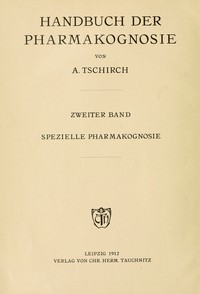
Handbuch der Pharmakognosie : Zweiter Band. Spezielle Pharmakognosie by Tschirch
Let's be clear from the start: this is not a book you curl up with for a light read. Handbuch der Pharmakognosie: Zweiter Band is a specialized academic text from the early 20th century. Published around 1909-1923, it's the second volume of Alexander Tschirch's monumental handbook on pharmacognosy—the study of medicines derived from natural sources, primarily plants.
The Story
There's no plot in the traditional sense. Think of it as a massive field guide, but instead of birds, it catalogs medicinal plants. This volume gets into the specifics. It systematically describes individual plant drugs: where they come from, what they look like, their chemical components (as understood at the time), and their historical and contemporary uses in pharmacy. Tschirch was compiling the total knowledge of his field, creating an essential reference for pharmacists, doctors, and chemists of his day. The 'story' is the story of early 20th-century science trying to organize and understand nature's medicine cabinet.
Why You Should Read It
You shouldn't, unless a specific itch needs scratching. But that's what makes it so cool for the right person. For me, the value is purely historical and atmospheric. It captures a moment when healing was deeply rooted in botany. Flipping through its pages (or a digital scan), you see beautiful, detailed illustrations of roots, barks, and leaves. You encounter names of compounds and uses that have been forgotten or revolutionized. It's a direct line to how an expert thought about his world. Reading it feels like an act of archaeology, uncovering the foundations of modern pharmacology. It's a reminder that our pills and tinctures have very long, very natural histories.
Final Verdict
This book is a specialist's artifact. It's perfect for historians of science, pharmacy, or botany. It's for that rare book collector who treasures dense, technical old volumes. If you're a writer working on a historical novel set in this period and need authentic detail about period medicines, this is a goldmine. For the average reader? It's probably impenetrable. But as a physical object and a piece of intellectual history, it's genuinely fascinating. It's not a page-turner; it's a museum exhibit you can hold in your hands, best appreciated with curiosity and respect for a bygone era of scholarship.
This digital edition is based on a public domain text. Preserving history for future generations.
Emily Lopez
10 months agoGiven the current trends in this field, the insights into future trends are particularly thought-provoking. Well worth the time invested in reading it.
Paul Harris
10 months agoIt effectively synthesizes complex ideas into a coherent whole.
David Rodriguez
2 months agoI was particularly interested in the case studies mentioned here, the nuanced approach to the central theme was better than I expected. It’s hard to find this much value in a single source these days.
Nancy Anderson
1 year agoThis digital copy caught my eye due to its reputation, the quality of the diagrams and illustrations (if applicable) is top-notch. A trustworthy resource that I'll keep in my digital library.






Linda Thomas
1 year agoLooking at the bibliography alone, the author clearly has a deep mastery of the subject matter. It’s hard to find this much value in a single source these days.